The Lost Glory of Gandikota
 #Thread
Everyone knows about USA’s Grand Canyon, one of the 7 Natural Wonders of the World. But did you know that there’s a hidden Grand Canyon in India as well?
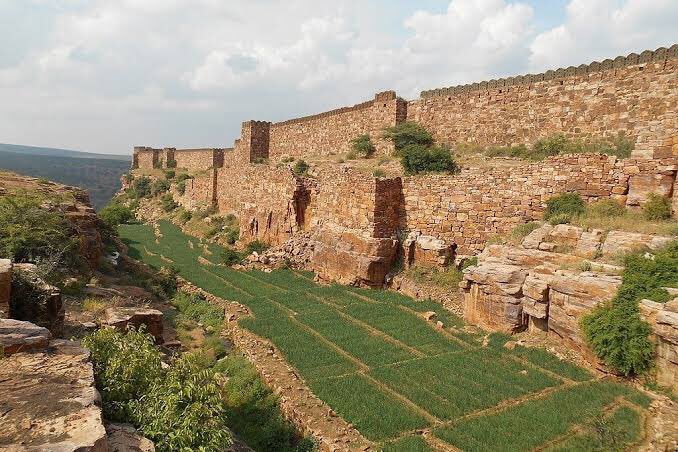
The forgotten Gorge of Gandikota is situated on the Pennar River in Andhra Pradesh

and is known as the Grand Canyon of India.
 
Gandikota was identified as strategic area and a mud Fort was constructed by Kakatiya Raja in 12th Century, Further developed by Kumara Thimma Naidu of Vijayanagar Empire and made Gandikota his capital.
He developed Gandikota as an impregnable fortress building huge boundary walls and watch towers on three sides with the Pennar river gorge forming the natural boundary wall on the fourth side.
During his reign he constructed a large temple probably Veerabhadra temple,
along with a tank which was fed by spring water which is known as Koleru. The same temple complex has been perhaps demolished to raise a Masjid and a granary has been constructed by Mir Jumla after capturing Gandikota in 1594.
 
The magnificent Gandikota fort,
is built in such a way that the Gorge provides a natural defence on its west and north sides. The Fort got the name from a big gorge formed by the Penna river (through erosional process) between the Erramala range of hills, called Gandikota hills.
In Telugu Gandi means Gorge and Kota means Fort.
Breathtaking views of gorge and the Pennar River a deep valley and impassable hills, with massive Red/pink granites and river flows about 300 feet. Layers and layers of rocks, it appears as if they’ve been arranged purposefully.
In no time one can start meditating on cliff of the gorge. The fort includes House of the Drum (drums were used to alert the army in case of invasion), Charminar, Jail (where in the prisoners were held captive) and Red Koneru (red pond - typically by dipping swords in it)
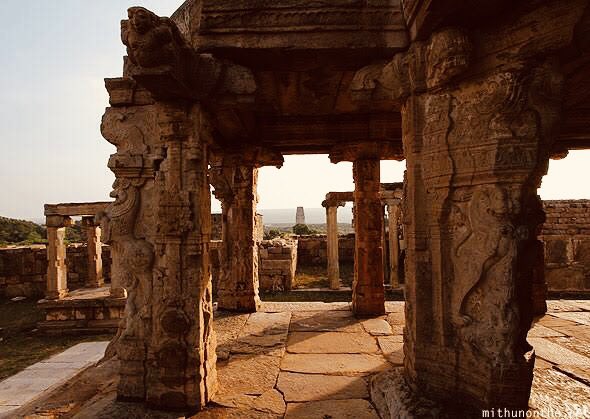
The structures that enamour visitors are the two Temples dedicated to Mahadev and Ranganatha - both are in dilapidated state. The Mantapas and intricately carved pillars still have a story to tell..
The hillock on the Gandi Gorge, also has a Viewpoint which is picturesque!
What stops the Govt to revamp this and build our tourism? Shouldn’t people be aware of their rich heritage?
 
Places to see around Gandikota are also
Belum Caves
Yaganti Temple
Oravakallu Rock Garden
Kurnool Fort

More from All

https://t.co/6cRR2B3jBE
Viruses and other pathogens are often studied as stand-alone entities, despite that, in nature, they mostly live in multispecies associations called biofilms—both externally and within the host.

https://t.co/FBfXhUrH5d


Microorganisms in biofilms are enclosed by an extracellular matrix that confers protection and improves survival. Previous studies have shown that viruses can secondarily colonize preexisting biofilms, and viral biofilms have also been described.


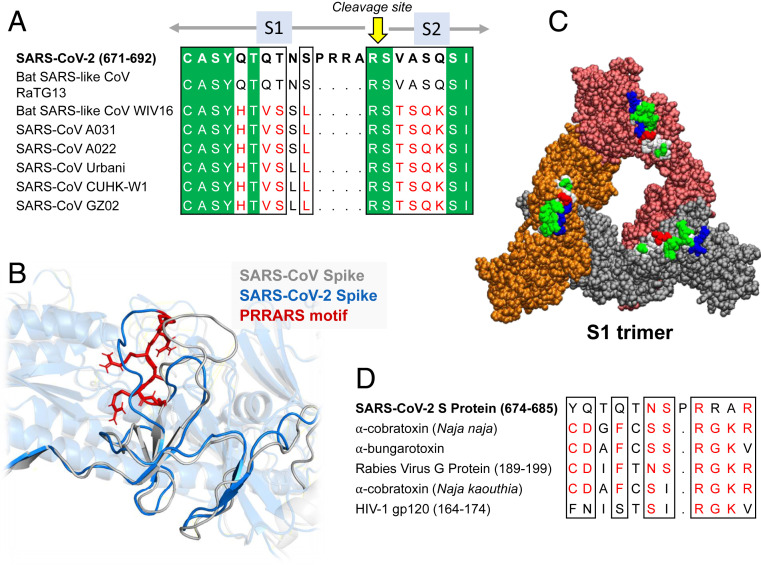
...we raise the perspective that CoVs can persistently infect bats due to their association with biofilm structures. This phenomenon potentially provides an optimal environment for nonpathogenic & well-adapted viruses to interact with the host, as well as for viral recombination.


Biofilms can also enhance virion viability in extracellular environments, such as on fomites and in aquatic sediments, allowing viral persistence and dissemination.

You May Also Like

Recently, the @CNIL issued a decision regarding the GDPR compliance of an unknown French adtech company named "Vectaury". It may seem like small fry, but the decision has potential wide-ranging impacts for Google, the IAB framework, and today's adtech. It's thread time! 👇

It's all in French, but if you're up for it you can read:
• Their blog post (lacks the most interesting details):
https://t.co/PHkDcOT1hy
• Their high-level legal decision: https://t.co/hwpiEvjodt
• The full notification: https://t.co/QQB7rfynha

I've read it so you needn't!

Vectaury was collecting geolocation data in order to create profiles (eg. people who often go to this or that type of shop) so as to power ad targeting. They operate through embedded SDKs and ad bidding, making them invisible to users.

The @CNIL notes that profiling based off of geolocation presents particular risks since it reveals people's movements and habits. As risky, the processing requires consent — this will be the heart of their assessment.

Interesting point: they justify the decision in part because of how many people COULD be targeted in this way (rather than how many have — though they note that too). Because it's on a phone, and many have phones, it is considered large-scale processing no matter what.