Alex1Powell's Categories
Alex1Powell's Authors


Latest Saves








Thread - omnibus, CRs
-Continuing Resolution (CR) is a mechanism to address a budgetary “gap”
Under @senatemajldr (not) awesome leadership CRs have become the norm, which is maddening because that’s NOT what CRs are meant for
-pocket veto
-veto
-President versus Congress
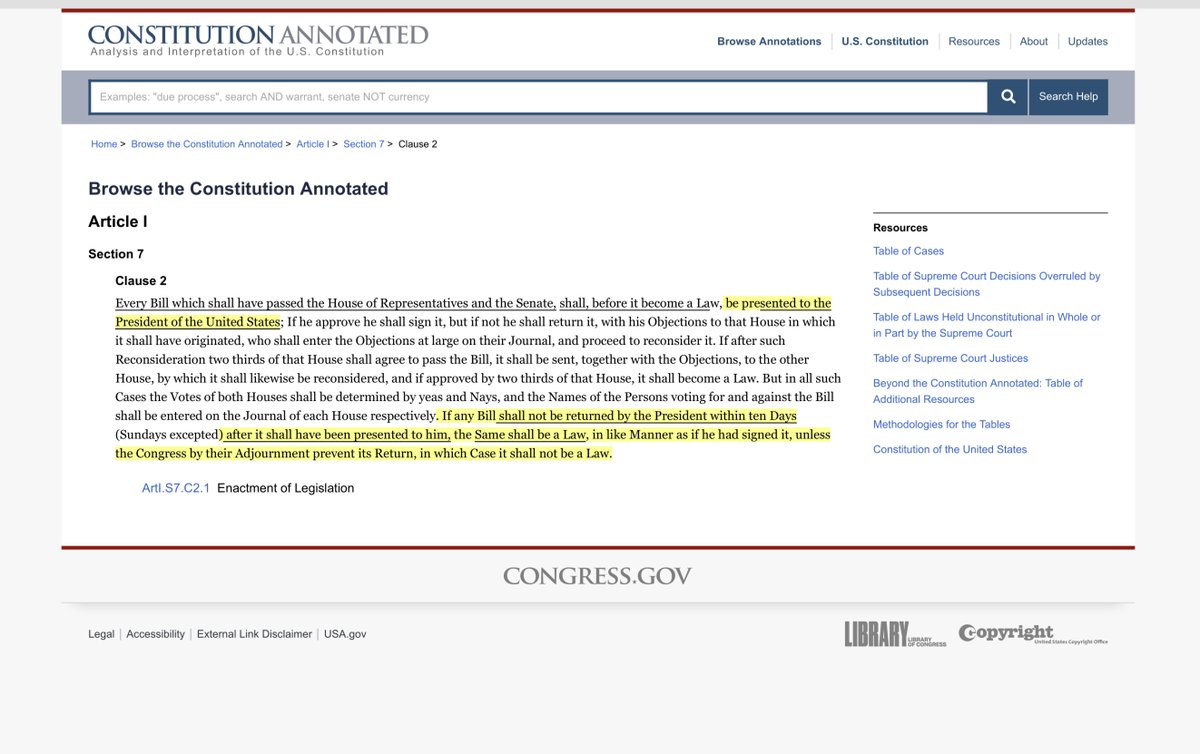
Article I, Section 7 of the Constitution
-any Bill shall not be returned by the President within 10 Days (Sundays excepted) after it shall have been presented to him, the Same shall be a Law, in like Manner as if he had signed it, unless the Congress by their Adjournment

Sorry here’s the link - Article 1, Section 7 of our Constitution (sometimes referred to as the presentment clause)
One could infer “pocket veto” +/- 2 days Jan 4th, 5th, or 6th...
https://t.co/8xrbnNLn1V
My educated guess is Trump knows
“might” (operative word) be his “trust the plan” screwing McConnell Senate GOP & nearly ALL Americans
-though lacking a signature and formal objections
-does not become law
-Pocket vetoes are not subject to the congressional veto override process
And here‘s WHY - it is literally the last sentence:
“...unless the Congress by their Adjournment prevent its Return, in which Case it shall not be a Law”
the massive bill was flown down to FL yesterday so the 10 day clock started yesterday...
https://t.co/8xrbnNLn1V

-Continuing Resolution (CR) is a mechanism to address a budgetary “gap”
Under @senatemajldr (not) awesome leadership CRs have become the norm, which is maddening because that’s NOT what CRs are meant for
-pocket veto
-veto
-President versus Congress
#Evergreen
— File411 (@File411) December 25, 2020
did you think I was randomly screaming (sometimes I do) but this thread, I walked you through some of the programs which would run out of Funding
You let me know if @realDonaldTrump isn\u2018t a petulant selfish sociopath
He does not give 1 F...https://t.co/mgLnAvrovs
Article I, Section 7 of the Constitution
-any Bill shall not be returned by the President within 10 Days (Sundays excepted) after it shall have been presented to him, the Same shall be a Law, in like Manner as if he had signed it, unless the Congress by their Adjournment
Sorry here’s the link - Article 1, Section 7 of our Constitution (sometimes referred to as the presentment clause)
One could infer “pocket veto” +/- 2 days Jan 4th, 5th, or 6th...
https://t.co/8xrbnNLn1V
My educated guess is Trump knows
“might” (operative word) be his “trust the plan” screwing McConnell Senate GOP & nearly ALL Americans
-though lacking a signature and formal objections
-does not become law
-Pocket vetoes are not subject to the congressional veto override process
And here‘s WHY - it is literally the last sentence:
“...unless the Congress by their Adjournment prevent its Return, in which Case it shall not be a Law”
the massive bill was flown down to FL yesterday so the 10 day clock started yesterday...
https://t.co/8xrbnNLn1V


THREAD. On writing, note-taking, reading, and synthesizing information. This fall, I taught Research Design at the doctoral level, and a Masters' Research (Thesis) Seminar.
Because of the way I like teaching (research design, research methods and mechanics of research), ....
... I quickly realized that teaching Note-Taking Techniques, Reading Strategies, and Synthesis Methods was complicated. It's kind of a chicken and egg problem. What do students need to learn first, reading or taking notes? Teaching strategies for both is hard to do simultaneously
I tried the following sequence:
- Reading Strategies
- Note-Taking Techniques
- Synthesis Methods
- Writing Tips
Turns out that students are thrust into the "you need to read a lot to understand what I am teaching" model quite early during their programmes. This poses challenges
Normally, I would assign Adler and Van Doren's "How to Read a Book" https://t.co/F8vQIIKSfg so that my students can learn various levels of reading.
Only problem? A&VD is a massive 350 pages' book. Just imagine the amount of time it's going to take them to even *skim it*.
After teaching this class over the summer at ITAM and this fall at CIDE and FLACSO, at the Masters and PhD levels, and after decades of teaching undergraduates, I am convinced now that
(a) students need a range (repertoire) of reading strategies
Because of the way I like teaching (research design, research methods and mechanics of research), ....
... I quickly realized that teaching Note-Taking Techniques, Reading Strategies, and Synthesis Methods was complicated. It's kind of a chicken and egg problem. What do students need to learn first, reading or taking notes? Teaching strategies for both is hard to do simultaneously
I tried the following sequence:
- Reading Strategies
- Note-Taking Techniques
- Synthesis Methods
- Writing Tips
Turns out that students are thrust into the "you need to read a lot to understand what I am teaching" model quite early during their programmes. This poses challenges
Normally, I would assign Adler and Van Doren's "How to Read a Book" https://t.co/F8vQIIKSfg so that my students can learn various levels of reading.
Only problem? A&VD is a massive 350 pages' book. Just imagine the amount of time it's going to take them to even *skim it*.
After teaching this class over the summer at ITAM and this fall at CIDE and FLACSO, at the Masters and PhD levels, and after decades of teaching undergraduates, I am convinced now that
(a) students need a range (repertoire) of reading strategies




So I'm not the first, & won't be the last, to be irked by this. But anyway, here goes.
What Murph's reporting (& opining) on is a survey that showed, in a time of international crisis where Australia has performed relatively well, politicians benefit from a "competence dividend"
That's neither a surprise, nor something to be sneered at. But it's a one-paragraph story. It's what you'd expect to see.
The journalist's role, you'd think, would be to critically unpick that. Work through what premiers & the PM did to deserve it, or otherwise.
One case that could be made is that the premiers stepped up, acted visibly & decisively on behalf of their respective states, & the PM is largely riding on their coattails.
Murph, though, has been on a weird campaign to position Morrison in particular as a statesman-in-waiting.
Once the federal government authorised Job Seeker/Lover/Keeper, Murph was convinced this was (bound to be) the end of Ideological Warrior Morrison and we'd see the emergence of pragmatic Morrison who could govern reasonably, in ways atypical of the way his party had been trending
LOL
And LOL again.
The early economic interventions were made with a gun to his head. The idea he'd suddenly become a learning learner who learns was something Murph seemed desperate to hold on to, like it was important for her sense that federal politics could work properly.
What Murph's reporting (& opining) on is a survey that showed, in a time of international crisis where Australia has performed relatively well, politicians benefit from a "competence dividend"
\U0001f644 pic.twitter.com/odGMUKzPnT
— Richard Chirgwin (@R_Chirgwin) December 25, 2020
That's neither a surprise, nor something to be sneered at. But it's a one-paragraph story. It's what you'd expect to see.
The journalist's role, you'd think, would be to critically unpick that. Work through what premiers & the PM did to deserve it, or otherwise.
One case that could be made is that the premiers stepped up, acted visibly & decisively on behalf of their respective states, & the PM is largely riding on their coattails.
Murph, though, has been on a weird campaign to position Morrison in particular as a statesman-in-waiting.
Once the federal government authorised Job Seeker/Lover/Keeper, Murph was convinced this was (bound to be) the end of Ideological Warrior Morrison and we'd see the emergence of pragmatic Morrison who could govern reasonably, in ways atypical of the way his party had been trending
LOL
And LOL again.
The early economic interventions were made with a gun to his head. The idea he'd suddenly become a learning learner who learns was something Murph seemed desperate to hold on to, like it was important for her sense that federal politics could work properly.