Daily Charts
Most Popular on 28th of October, 2018

Ironies of Luck https://t.co/5BPWGbAxFi
— Morgan Housel (@morganhousel) March 14, 2018
"Luck is the flip side of risk. They are mirrored cousins, driven by the same thing: You are one person in a 7 billion player game, and the accidental impact of other people\u2019s actions can be more consequential than your own."
I’ve always felt that the luckiest people I know had a talent for recognizing circumstances, not of their own making, that were conducive to a favorable outcome and their ability to quickly take advantage of them.
In other words, dumb luck was just that, it required no awareness on the person’s part, whereas “smart” luck involved awareness followed by action before the circumstances changed.
So, was I “lucky” to be born when I was—nothing I had any control over—and that I came of age just as huge databases and computers were advancing to the point where I could use those tools to write “What Works on Wall Street?” Absolutely.
Was I lucky to start my stock market investments near the peak of interest rates which allowed me to spend the majority of my adult life in a falling rate environment? Yup.

Here's how I'd measure the health of any tech company:
— Jeff Atwood (@codinghorror) October 25, 2018
How long, as measured from the inception of idea to the modified software arriving in the user's hands, does it take to roll out a *1 word copy change* in your primary product?
Hiring efficiency:
How long does it take, measured from initial expression of interest through offer of employment signed, for a typical candidate cold inbounding to the company?
What is the *theoretical minimum* for *any* candidate?
How long does it take, as a developer newly hired at the company:
* To get a fully credentialed machine issued to you
* To get a fully functional development environment on that machine which could push code to production immediately
* To solo ship one material quanta of work
How long does it take, from first idea floated to "It's on the Internet", to create a piece of marketing collateral.
(For bonus points: break down by ambitiousness / form factor.)
How many people have to say yes to do something which is clearly worth doing which costs $5,000 / $15,000 / $250,000 and has never been done before.

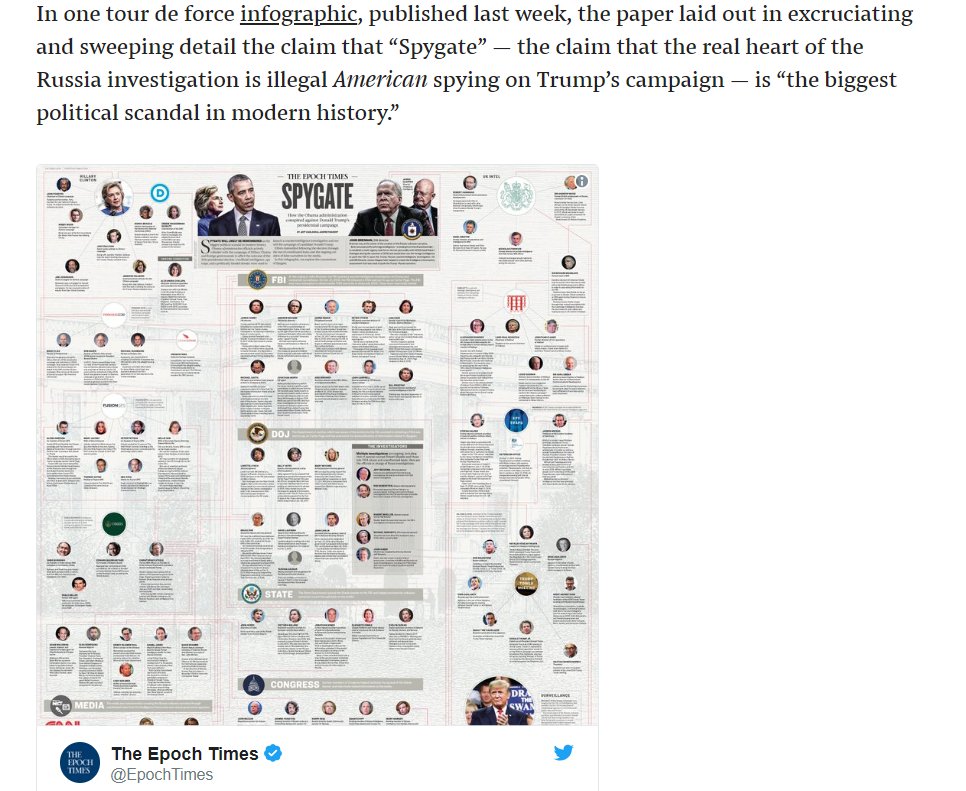
This explains why immigration is now at the center of partisan conflict.
Why did California turn Blue?
— Sen. Eric Brakey (@SenatorBrakey) October 28, 2018
Why is Texas turning Blue?
The left has failed at selling socialism to the American people for decades. We have rejected it.
Their new strategy is mass importation of new voters to transform our political culture.
Of course, the belief in ethnic bloc voting becomes a self-fulfilling prophecy.
When a slight Dem tilt among Hispanics and Asians caused the GOP to turn against them, Hispanics and Asians shifted more toward the Dems. Etc. etc. A self-reinforcing cycle.
Bush's 2006 amnesty attempt, and the 2013 intra-GOP fight over immigration reform, were two moments when the GOP could have turned back to the approach of Reagan, and courted Hispanics and Asians.
But they decided against this, and...here we are.
What will disrupt this bad equilibrium, and save American politics from being an eternal race war?
Either:
A) More white voters will grow disgusted with the GOP approach and defect, or
B) The GOP will find some non-immigration-related issues to attract more Hispanics and Asians.
As long as both parties see elections in terms of racial bloc voting - where the only way to win is to increase turnout among your own racial blocs or suppress turnout by the other party's racial blocs - American politics will not improve, and the country will decline.
(end)
Most Popular on 27th of October, 2018
\u2018The Simpsons\u2019 producer confirms Apu is being written out of show following controversy https://t.co/lKzFCe1wFa pic.twitter.com/s34IUDUtqs
— NME (@NME) October 26, 2018
2/Apu's presence in Springfield represented a basic reality of America in the late 20th and early 21st century: the presence of nonwhite immigrants.
3/As Tomas Jimenez writes in "The Other Side of Assimilation", for my generation, immigrants from India, China, Mexico, and many other countries aren't strange or foreign. On the contrary, they're a
4/But that America I grew up with is fundamentally ephemeral. The kids of immigrants don't retain their parents' culture. They merge into the local culture (and, as Jimenez documents, the local culture changes to reflect their influence).
5/Simpsons character don't change. But real people, and real communities, do. So a character who once represented the diversity that immigrants brought to American towns now represents a stereotype of Indian-Americans as "permanent foreigners".


Most Popular on 26th of October, 2018


Most Popular on 25th of October, 2018




Most Popular on 24th of October, 2018



Most Popular on 23rd of October, 2018
It looks like decolonization just took a few decades to start
Basic econ theory says poor countries should grow faster than rich ones.
But for much of the Industrial Revolution, the opposite happened.
https://t.co/JjjVtWzz5c
Why? Probably because the first countries to discover industrial technologies used them to conquer the others!
But then colonial empires went away. And yet still, for the next 30 years or so, poor countries fell further behind rich ones.
https://t.co/hilDvv0IQV
Why??
Possible reasons:
1. Bad institutions (dictators, communism, autarkic trade regimes)
2. Civil wars
3. Lack of education
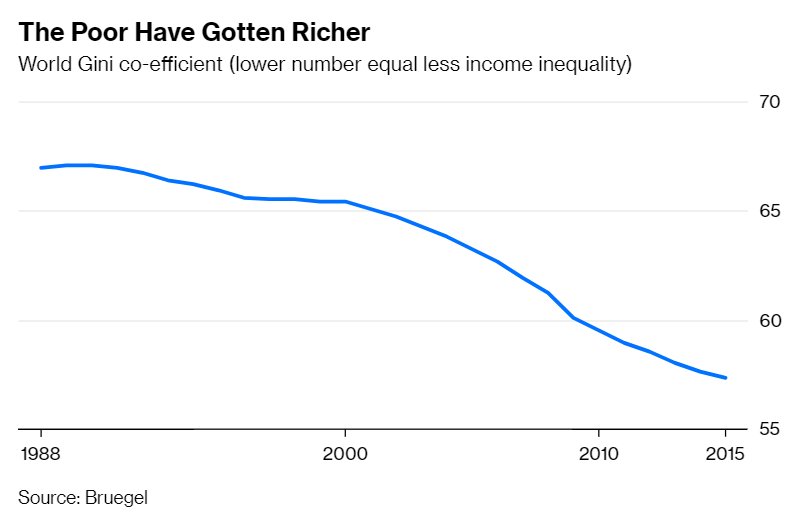
But then, starting in the 80s (for China) and the 90s (for India and Indonesia), some of the biggest poor countries got their acts together and started to catch up!
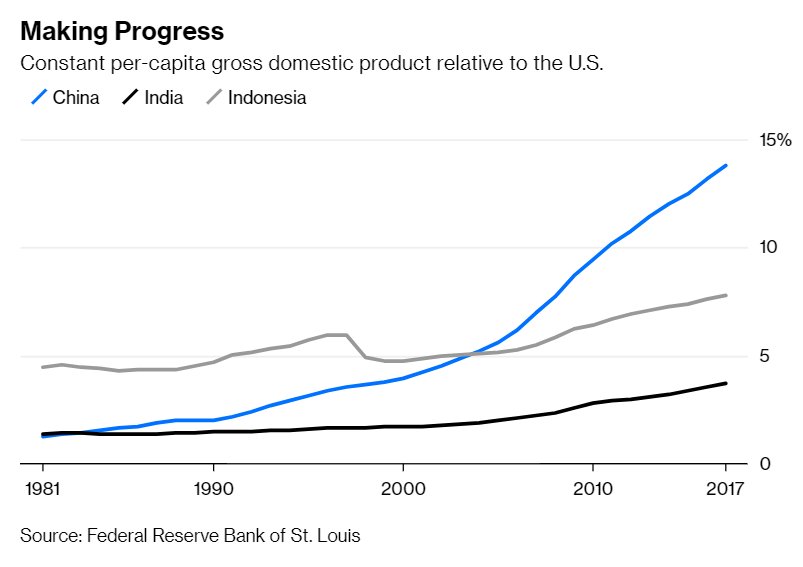
Global inequality began to fall.