Let
E = earnings
d = dividend
P = price
r = discount rate
g = (terminal) dividend growth rate
Then
y = d/P is dividend yield
Y = E/P is earnings yield
P/E = 1/Y
p = d/E is dividend payout ratio
According to the Gordon Growth Model (GGM),
y = d/P = r - g.
Hence,
Y = y/p.
So, for example, if r = 10% is the required return, and growth rate is g = 3%, then dividend yield should be y = 7%.
If also the payout ratio is 70%, then the P/E must be 10.
If the payout ratio is p = 100%, then the P/E can be ~14.
It may appear counter-intuitive that higher retention requires a lower P/E. But remember that we are talking about dividend growth rates, g, not earnings growth rates.
So if a firm is able to grow dividends without retaining earnings, this likely means that it benefits from pricing power, protecting from inflation, or that it has conservative accounting.
However, when the dividend is zero, g cannot be measured, and the model breaks down.
So we assume that earnings represent distributable cash, in the sense that if the dividend payout were 100%, the business could sustain constant earnings. And then we consider the situation where a fast-growing company wishes to retain all of its earnings for future growth.
However, indefinite growth at a rate higher than nominal GDP is implausible. And indefinite growth without dividends is, in theory, not worth anything. To be valuable, a company must eventually harvest earnings. Or it must be acquired, and its survivor must harvest earnings.
So, consider the situation where a company grows quickly for a period of time, and then grows more slowly, while paying dividends. For this we may apply a two-stage Gordon Growth Model, which is really just a special case of the Dividend Discount Model (DDM).
For simplicity, assume the initial growth is g, and payout ratio is zero, for a period of n years, prior to slowing to a (dividend and earnings) terminal growth rate h, and a 100% payout ratio, with dividend d.
The correct price after n years is given by GGM:
P_n = d / (r - h).
But in order for this price to be achieved in n years, the price today must be,
P_n = d_n / [(r - h) (1 + r)^n].
At time n, d_n = E_n, which will have grown:
E_n = E (1 + g)^n.
Hence,
P = E (1 + g)^n / [(r - h) (1 + r)^n]
= [(1 + g) / (1 + r)]^n * E / (r - h).
Rearranging, we find,
g = [(1 + r) * [(r - h) (P/E)]^(1/n) - 1] * 100%
Assume, for example, if the discount rate (required return) is r = 10%, and initial P/E is 100.
If terminal growth rate is h = 0 after n = 10 years, then the required earnings growth spurt for these 10 years will be g = 38.5% per annum, for a 26-fold increase in earnings.
But, after all, r = 10% is a nominal discount rate, a mature company may be expected to grow at a rate of
h = i + G,
where i = inflation rate and G = real GDP growth rate.
So if i = 3% and G = 2%, then, h = 5% may be expected at maturity, with a 100% dividend payout policy.
Reviewing the formula, then, we find the following results for different periods of growth, n, where g = growth rate, and m = E_n / E, the factor by which earnings multiply:
n = 10 years
g = 29.2%
m = 13 times
n = 15 years
g = 22.5%
m = 21 times
n = 20 years
g = 19.2%
m = 34 times
We see then, that a business must sustain approximately 20% earnings growth for 20 years in order for it to justify a current P/E of 100, assuming it matures at year 20.
A higher hurdle rate, r, would require more aggressive assumptions about growth, and a lower hurdle rate would require less aggressive growth assumptions.
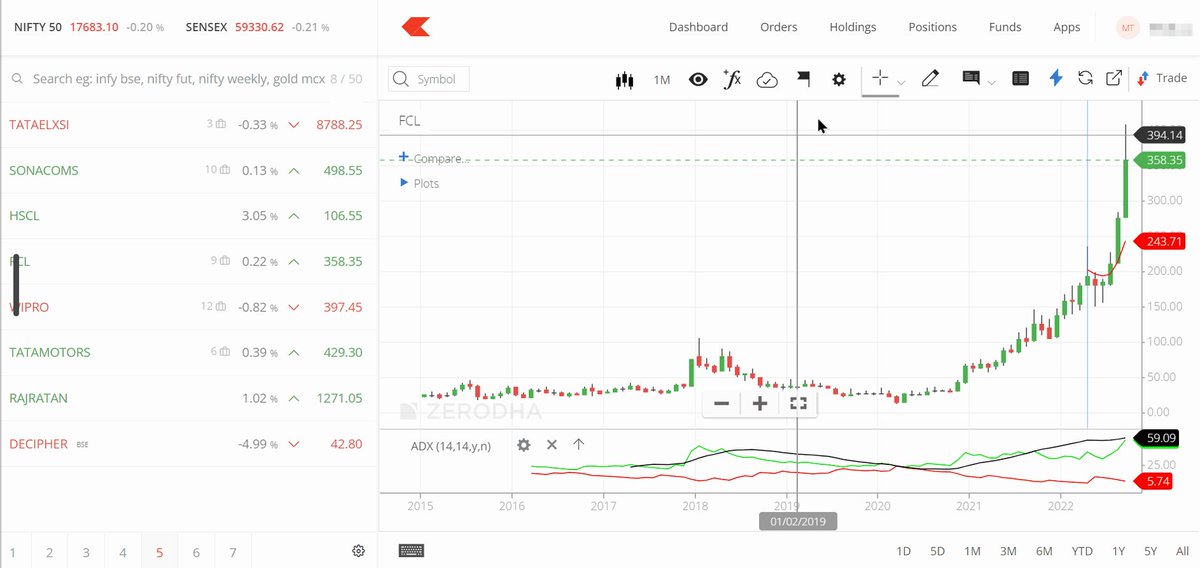
Naturally, growth rates of high-growth companies tend to fall continuously, with size (law of large numbers) and competition. But this is a rough illustration of what is required. One may experiment with with the formula using other P/E ratios, etc.
Also, the formula does not directly apply to loss-making companies. And, in fact, some loss-making companies can become profitable and grow earnings quickly via operating leverage.
$FB is one such example. When it IPO'd in 2012, it was barely profitable. However, it subsequently grew earnings one thousand fold, because revenues rose faster than costs.
Growth rates in the above examples are rare, so forecasting them should be rather difficult.
Such examples do occur, but because they are rare, investors may do well to regard a very high P/E as a warning flag, and to consider carefully their understanding of industry outlook, current and expected competitive position of the firm, and operating and financial leverage.