On this auspicious day of #GuruPurnima, happy to share an easy to read and an exceptionally worthwhile investment. I plan to make a thread that will hopefully help us invest and live better. Thank you @awealthofcs 🙏🏻

Experience has taught me that less is always more when making investment decisions. Simplicity trumps complexity. Conventional gives you much better odds than exotic. A long-term process is more important than short-term outcomes.
And perspective goes much further than tactics. Tactics are useless to investors in a matter of days—sometimes in a matter of hours. But perspective is something that stays with the investor for a lifetime. It allows you to adapt to the changing market and economic landscape.
While keeping it simple won’t make it any easier to predict the future—no one has a crystal ball—it can give you the necessary capacity to make rational decisions, no matter what happens next.
Perspective is so important because, without it, even the most intelligent of investors can be ruined from a lack of self-awareness in their own abilities. Investors that fail to put the news or market moves into the proper context....[1/2]
...in regards to their own personal circumstances are fighting an uphill battle. A proper perspective can give the investor the right frame of mind to be able to ignore news headlines and avoid acting on the damaging emotions that can hurt the decision-making process. [2/2]
I’m not here to sell you a pot of gold at the end of a rainbow. I can’t offer you a secret get-rich-quick formula for making millions of dollars overnight. The real secret is that there is no secret to be able to make millions of dollars overnight..... [1/2]
.......It only happens over a period of time. Building wealth takes patience. You can’t be in a hurry. Remember, the markets are not just about building wealth and making money. They’re a tool for your desires about creating freedom, time, memories, and peace of mind. [2/2]
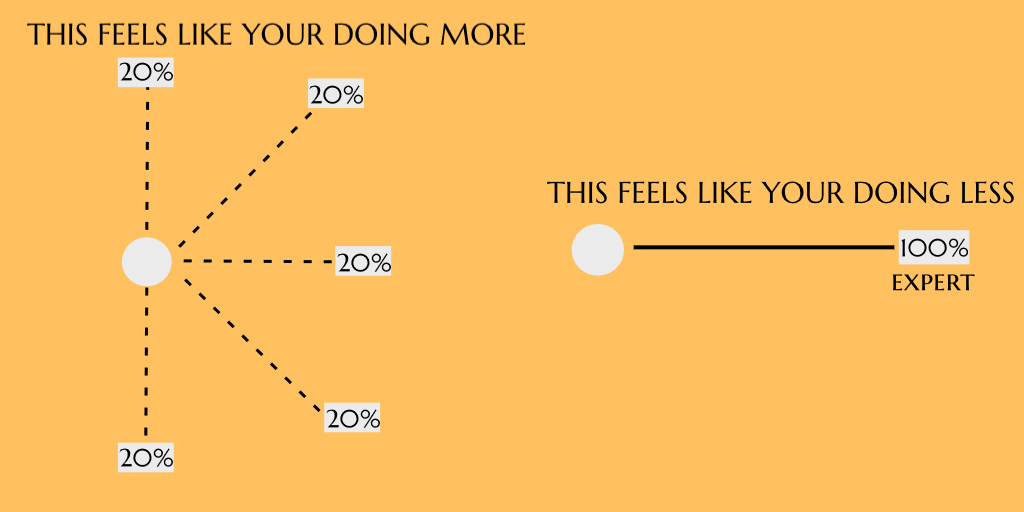
Less is always more and trying to implement a more interesting or clever portfolio strategy is akin to threading the needle. Sure, it can work, but trying harder and increasing the number of decisions you make only increases the odds that you’ll make a mistake.
Simple and effective advice:

1. Think and act for the long term
2. Ignore the noise
3. Buy low, sell high
4. Keep your emotions in check
5. Don’t put all of your eggs in one basket
6. Stay the course

It will rarely sound so great at the moment when you actually have to use it.
The problem for average investors is that when they aim for superior results, it more often than not leads to below-average performance. It’s amazing how easy it is to do worse by trying to do better.
There are no style points when investing. There's no bonus for the degree of difficultty (e.g. Biopharma vs Unilever/Diageo). You don't have to try to impress anyone. It's about getting from point A to point B, not how you get there.
You don't have to signal that you invest only in the best, most exclusive strategies. No one is there to judge you or your portfolio and you don't have to compete against your peers. The most important thing is that you increase your probability for success. That's all.
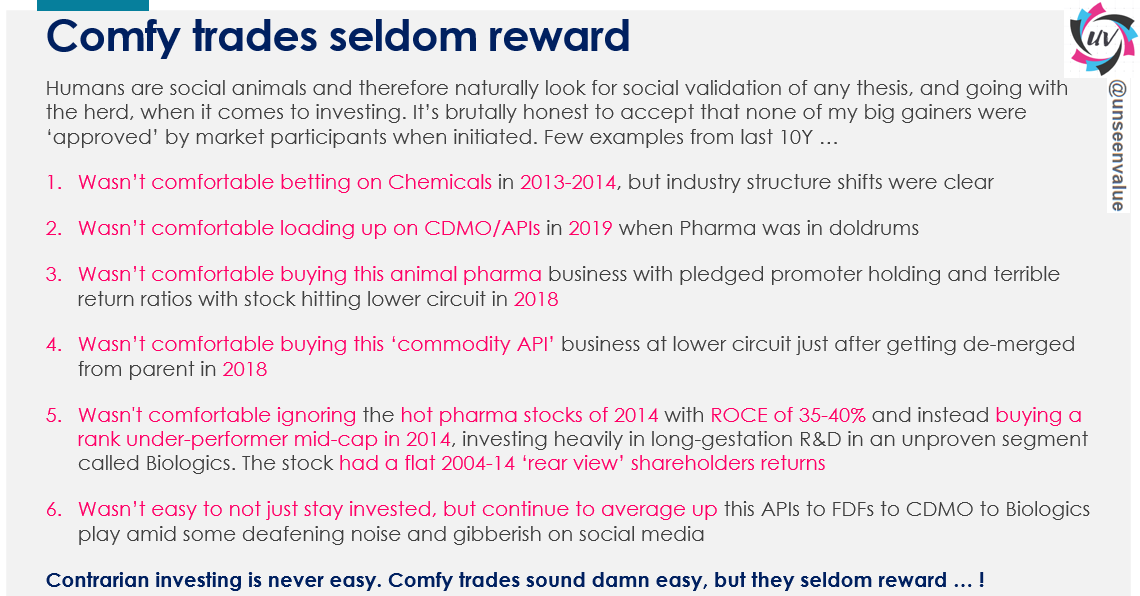
Investors chase past performance and make decisions with the herd, buying more stocks after a huge run-up in price and selling after a market crash. These errors cost investors a lot of money when compounded over very long time horizons.

More from Sajal Kapoor

More from Trading

Many of you have seen the famous Westrum Organizational Typology model, so prominently featured in State of DevOps Research, Accelerate, DevOps Handbook, etc.

This model was created Dr. Ron Westrum, a widely-cited sociologist who studied the impact of culture on safety


Thanks to Dr. @nicolefv, I was able to interview him for an upcoming episode of the Idealcast! 🤯

It was a very heady experience, and while preparing to interview him, I was startled to discover how much work he's done in healthcare, aviation, spaceflight, but also innovation.

I've read 4+ of his papers, so I thought I was familiar with his work. (Here's one paper:
https://t.co/7X00O67VgS)

I was startled to learn he has also studied in depth what enables innovation. He wrote a wonderful book "Sidewinder: Creative Missile Development at China Lake"


Dr. Westrum writes about China Lake Research Labs: "its design and structure had one purpose: to foster technical creativity. It did; China Lake operated far outside the normal envelope... Sidewinder & others were "impossible" accomplishments,

I love this book because it describes traits of organizations that routinely create and maintain greatness: US space program (Mercury, Gemini, Apollo), US Naval Reactors, Toyota, Team of Teams, Tesla, the tech giants (Amazon, Google, Netflix, Google)

You May Also Like

The entire discussion around Facebook’s disclosures of what happened in 2016 is very frustrating. No exec stopped any investigations, but there were a lot of heated discussions about what to publish and when.


In the spring and summer of 2016, as reported by the Times, activity we traced to GRU was reported to the FBI. This was the standard model of interaction companies used for nation-state attacks against likely US targeted.

In the Spring of 2017, after a deep dive into the Fake News phenomena, the security team wanted to publish an update that covered what we had learned. At this point, we didn’t have any advertising content or the big IRA cluster, but we did know about the GRU model.

This report when through dozens of edits as different equities were represented. I did not have any meetings with Sheryl on the paper, but I can’t speak to whether she was in the loop with my higher-ups.

In the end, the difficult question of attribution was settled by us pointing to the DNI report instead of saying Russia or GRU directly. In my pre-briefs with members of Congress, I made it clear that we believed this action was GRU.