A thread on ๐‡๐จ๐ฐ ๐“๐จ ๐€๐๐ฃ๐ฎ๐ฌ๐ญ ๐š ๐’๐ญ๐ซ๐š๐๐๐ฅ๐ž

1/n

1. First of all one should know when to do a straddle, ideally when premiums are good and view is ๐ฌ๐ข๐๐ž๐ฐ๐š๐ฒ๐ฌ or when you are not expecting a huge trend.

2. When you do place a straddle, you will have good premiums so you will be covered for a good amount of move.

2/n
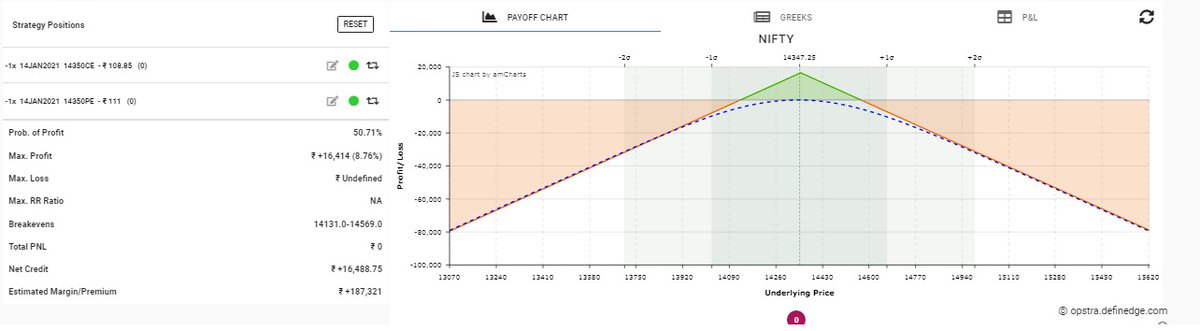
3. Find your breakevens, and ideally delta should also be neutral.

4. Do not adjust until your BEP is breached or the delta exceeds (+/-)40, whatever happens first, generally delta limit will breach first.

5. When delta reached lets say -40 it means you have to roll puts.

3/n
6. Just book profits in the current short put and roll put up by matching the premiums, delta should again be close to neutral but one can choose to have a little -ve delta since if there is mean reversion, PEs will spike.

7. This means you will be going Inverted(Short ITM)

4/n
8. Keep repeating the same process until expiry OR till either one option reaches 100 delta which will mean that you basically are short/long one future lot.

9. As soon as any option reaches 100 delta, just book the straddle be it in loss or profit, dont adjust at all.

5/n
10. While doing this keep in mind a loss limit(1-2% of cap), just get out if loss gets out of hand. "You cant play if you dont have chips"

11. If you want a video explanation check this Hindi video out on my YouTube channel
https://t.co/dO0XkuVtWG

Retweet if you gained value๐Ÿฅ‚

More from Trading

You May Also Like

Recently, the @CNIL issued a decision regarding the GDPR compliance of an unknown French adtech company named "Vectaury". It may seem like small fry, but the decision has potential wide-ranging impacts for Google, the IAB framework, and today's adtech. It's thread time! ๐Ÿ‘‡

It's all in French, but if you're up for it you can read:
โ€ข Their blog post (lacks the most interesting details):
https://t.co/PHkDcOT1hy
โ€ข Their high-level legal decision: https://t.co/hwpiEvjodt
โ€ข The full notification: https://t.co/QQB7rfynha

I've read it so you needn't!

Vectaury was collecting geolocation data in order to create profiles (eg. people who often go to this or that type of shop) so as to power ad targeting. They operate through embedded SDKs and ad bidding, making them invisible to users.

The @CNIL notes that profiling based off of geolocation presents particular risks since it reveals people's movements and habits. As risky, the processing requires consent โ€” this will be the heart of their assessment.

Interesting point: they justify the decision in part because of how many people COULD be targeted in this way (rather than how many have โ€” though they note that too). Because it's on a phone, and many have phones, it is considered large-scale processing no matter what.