1. Personality-
Though he made big profits in the year of 1986, but Profits and risk comes hand in hand.
He was down $10 million in a single day that year before bouncing back, a rollercoaster ride that would have made mere mortals lose serious sleep.
Yet Dennis cockily said that he slept like a baby during all that volatility.
His money making style was to go for the home runs and swing for the fences,But dennis was never a gambler.
Dennis was believer of the Empiricism philosophy.
Empiricism is rooted in the notion that knowledge is derived from experiment, observation, and experience
2. Family-
Dennis family was not of market operators. Dennis was always honest about his father’s “hatred” of the market, explaining,
“My grandfather had lost all his money in the stock market in the Depression. The urge to speculate kind of skipped a generation.”
You can’t have a standard attitude about money and do well in this business.
What do I mean by that? Well, my father, for in- stance, worked for the city of Chicago for 30 years, and he once had a job shoveling coal.
So, just imagine coming from his frame of reference,and thinking about losing $50 in a few seconds trading commodities
To him, that means another eight hours shoveling coal. That’s a standard attitude about money
By the beginning of 1973,at twenty-four, Dennis had made $100,000
3. Simple living-
Dennis never liked to boast about his money, He was an anti-establishment guy making a fortune leveraging the establishment, while wearing jeans.
1974 was an year of turmoil in which Richard Nixon became the first President of the United States to resign.
But this did not stop Dennis from leveraging a 1974 run-up in the price of soybeans to a $500,000 profit.
While his peers collected vintage cars and mansions, Dennis kept wearing those out-of-date polyester pants hiked over an ever expanding waist.
He exercised by eating cheap hamburgers at noisy grills. Dennis in a short-sleeved shirt, no tie, religiously pouring over arcane baseball statistics from the Baseball Abstract, was a common sight.
By the end of the year, at age twenty-five, he was a millionaire.
4. Focused on Psychology-
Dennis read Psychology Today (no government economic or crop reports for him) to keep his emotions in check and to remind him of how overrated intuition was in trading.
He knew that traders had a tendency to self-destruct.
The battle with self was where he focused his energies.
You have to have mentally gone through the process of failure,” he says, “I had a day during which I made every mistake known to modern man. I took too big risks. I panicked and sold at the bottom of every break.
I had built my net worth up to about $4,000 coming into that day and I lost about $1,000 in two hours.
It took me about three days to work through that experience emotionally, and I think it was the best thing that ever happened to me.”
5. C&D commodities -
By 1975 the International Monetary Market (IMM) was allowing anyone to trade currencies the way they did stocks.
Dennis knew what this would all mean. To trade in that bigger world,
Dennis moved into an office on the twenty-third floor of the CBOT, leaving the turmoil of screaming traders behind.
Concurrent with his move, in November 1975, Dennis and Larry Carroll formed a partnership. C&D Commodities was born.
6. Critics -
Dennis was always criticised for trading big and many big traders often said that he was controlling the markets,They blamed him for too much market volatility. Words like “collusion” were thrown around.
Dennis was not buying it. He said,
7. Rough seas-
After this, for few years he was interested into the political side and was also actively trading in the markets,
After all this political interest, Between 1980-85, he had moved beyond trading only his own money.
He was trading for others, and managing their money was not his strongest suit.
He said, “It’s drastically more work to lose other people’s money. It’s tough. I go home and worry about it.
In 1983, when his assets under management peaked at over $25 million, After a 53 percent rise in January, accounts dropped 33 percent in February and March.
That drop was enough to prompt George Soros to yank the $2 million he had invested with Dennis only two months earlier.
After a partial rebound in April and May, Dennis’s funds dived another 50 percent in value.
Dennis was famous for those big returns, and that was what his clients wanted—to become rich like Rich.
They got on board knowing full well the voyage would get rocky, but conveniently forgot that fact when rough sailing made them seasick.
At the first sign of troubled waters, when they were puking losses, they cut short the voyage and blamed Dennis.
He was learning the hard way about people’s irrational expectations
But after all this incident he made big money in the year 1986
Last thoughts-
The key is consistency and discipline.“I don’t think trading strategies are as vulnerable to not working if people know about them
as most traders believe. If what you are doing is right, it will work even if people have a general idea about it.
I always say you could publish rules in a newspaper and no onewould follow them.
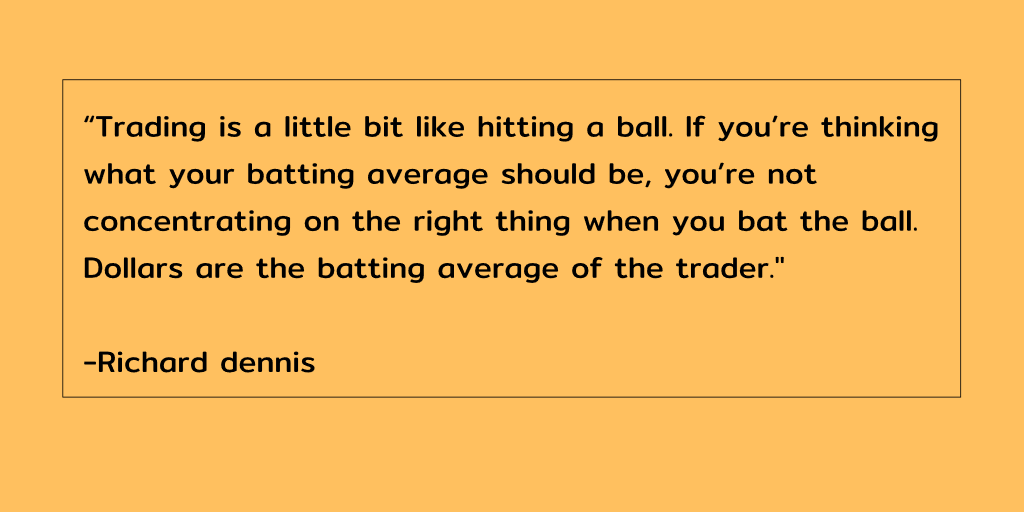
-Richard dennis

















![Peter McCormack [Jan/3\u279e\u20bf \U0001f511\u220e]](https://pbs.twimg.com/profile_images/1524287442307723265/_59ITDbJ_normal.jpg)