"How to Determine Market Trend Using CPR"
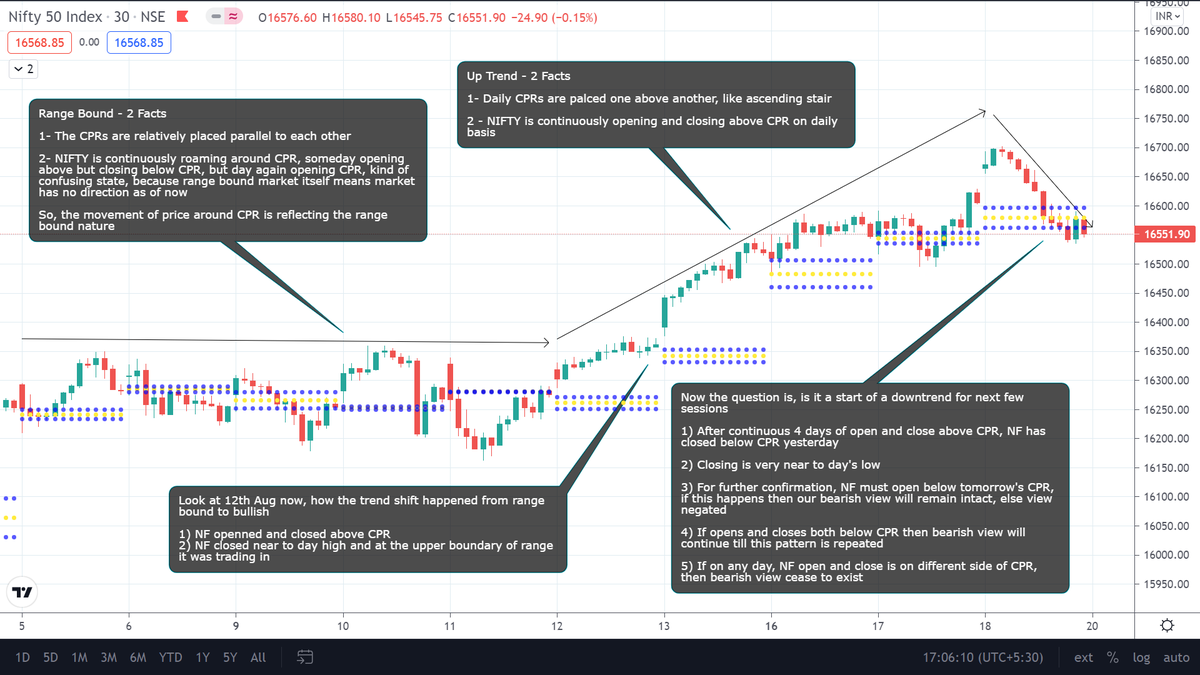
Read the writeup & most importantly understand the chart with comments
It solves the problem which traders face "what's the trend?"
If someone liked it, may send a box of chocolates, I won't mind 🍫 😄 https://t.co/BQ9bwjxBU4
SGX in -320 Pts
— Sarah (@TheCosmicTrader) August 19, 2021
Look at CPR of NF basis open & close, something unusual happened yesterday which didn't happen in last few trading sessions
If you can see above in chart, you will realize CPR is not an indicator, it is market sentiment
It's time for a short webinar
More from Ta


All my threads will be listed under here
Need help getting better entries ?
Here is your thread
Thread on Finding Entries.
— James Lefaith aka Jimmy Momo (@JamesLefaith) June 15, 2021
Firstly you have to be able to identify and area of value for an add.
NEVER BLINDLY BUY\u203c\ufe0f
ALWAYS BUY AT A KEY LEVEL OF SUPPORT, CONFIRMATION & OR IN SOME INSTANCES EVEN AT A BREAK OF A RESISTANCE LEVEL
\u203c\ufe0fThis is how you do that
This is How you can be green on every trade via risk management
RISK MANAGEMENT THREAD
— James Lefaith aka Jimmy Momo (@JamesLefaith) June 17, 2021
Bookmark this; it\u2019s important.
This thread will help you exit (Mostly) EVERY TRADE GREEN but MOST IMPORTANTLY will help you mitigate risk.
HERE is some proof. pic.twitter.com/RNFJtOqJ9C
Thread on high profitability support and resistance setups & trigger points.
\U0001f90dThread on My Support & Resistance System\U0001f90d
— James Lefaith aka Jimmy Momo (@JamesLefaith) June 19, 2021
This Thread Will Help you guys identify favorable, highly profitable, quick and smart money decision areas to add for your entries.
This Thread was requested by my good friends @DevTrades21 and @jessasecond1. Give Them a Follow
Here’s the Jimmy Momo Script, hope you all love it
EVERYONE Here\u2019s the moment we\u2019ve been waiting for, Here is the TOS study based on my candle system.
— James Lefaith aka Jimmy Momo (@JamesLefaith) September 12, 2021
Script created by @richard_the_red everyone give him a follow & thank him for putting in the time. We really hope you all enjoy it & put it to good use https://t.co/0hzRfQ3uGg

💎SECRET INFO inside
🧠Great for both beginners & advanced traders
▪️ What are they?
▪️ Types of MAs
▪️ Why are they such a powerful tool?
▪️ How to properly use them?
▪️ My best SECRET EMA value?
▪️ Which Timeframe to use?
▪️ Advanced EMA technique?
1/20

▪️ What are they?
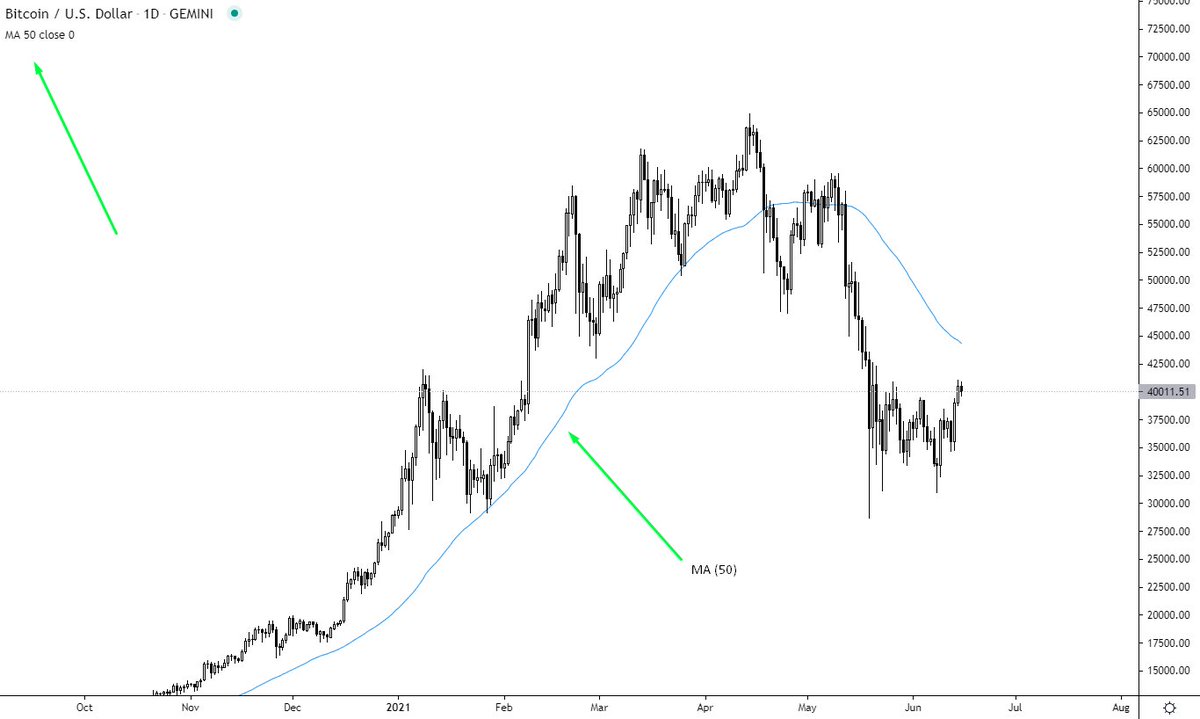
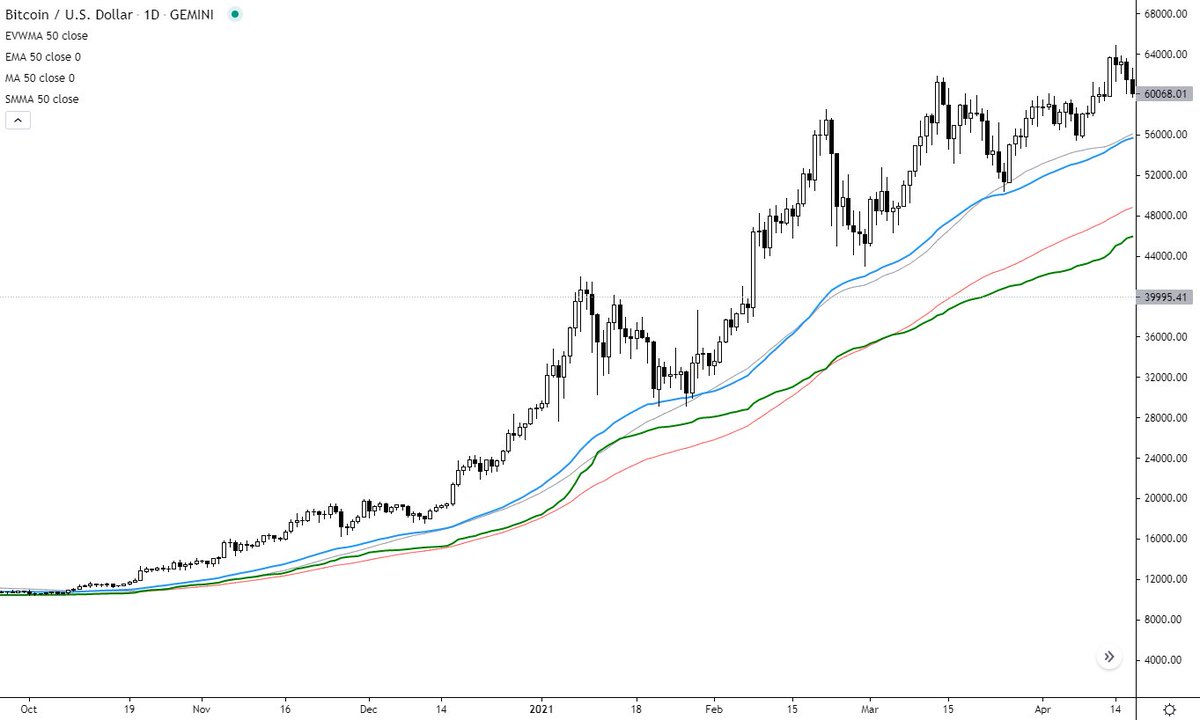
Moving average is nothing more than an average price of the last (value) of candles.
If we are gonna use an example of MA(50) it is gonna be the mean price of the last 50 candles
General rule:
Price above = Bullish 🐂
Price below = Bearish 🐻
2/20
▪️ Types of Moving Averages
1) Simple Moving Average - SMA
2) Exponential Moving Average - EMA
3) Smoothed Moving Average - SMMA
4) Volume Weighted Average Price - VWAP
There are a few more but these are the most important in my opinion.
3/20
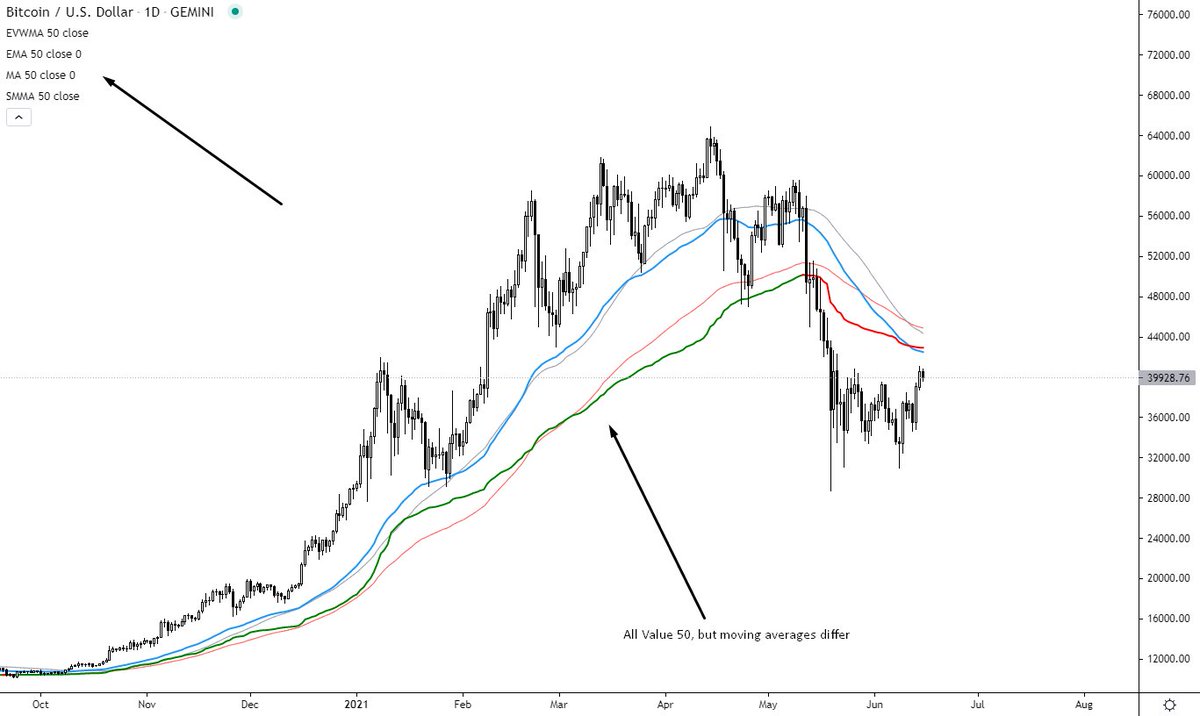
I won't be going that much into detail about each of them in this thread but more so covering MAs in general.
The important takeaway is there are many methods of calculations and each offers bit different pros & cons
I'll leave experimenting with each of them up to you
4/20
▪️ Why are they such a powerful tool?
Because they help everyone, even newbies, that are just starting out, to easily & visually clearly identify trends without understanding the advanced Market Structure techniques.
Price above = 🐂
5/20
https://t.co/g5SneLNPh5
Market Structure (MS)
— J A C K I S (@jackis_trader) July 6, 2020
Understanding MS is the most important thing in TA
It rules above everything. TL's, MA's, Indicators. Everything.
While it's nothing more than looking at swings and seeing Higher Highs (HH), Highers Lows (HL), Lower Highs (LH), and Lower Lows (LL). pic.twitter.com/QbgOSHGkBr

You May Also Like

Legacy site *downloads* ~630 KB CSS per theme and writing direction.
6,769 rules
9,252 selectors
16.7k declarations
3,370 unique declarations
44 media queries
36 unique colors
50 unique background colors
46 unique font sizes
39 unique z-indices
https://t.co/qyl4Bt1i5x

PWA *incrementally generates* ~30 KB CSS that handles all themes and writing directions.
735 rules
740 selectors
757 declarations
730 unique declarations
0 media queries
11 unique colors
32 unique background colors
15 unique font sizes
7 unique z-indices
https://t.co/w7oNG5KUkJ

The legacy site's CSS is what happens when hundreds of people directly write CSS over many years. Specificity wars, redundancy, a house of cards that can't be fixed. The result is extremely inefficient and error-prone styling that punishes users and developers.
The PWA's CSS is generated on-demand by a JS framework that manages styles and outputs "atomic CSS". The framework can enforce strict constraints and perform optimisations, which is why the CSS is so much smaller and safer. Style conflicts and unbounded CSS growth are avoided.