Hi @ASA_UK @EHRC @EHRCChair @KishwerFalkner @RJHilsenrath @trussliz @GEOgovuk

The
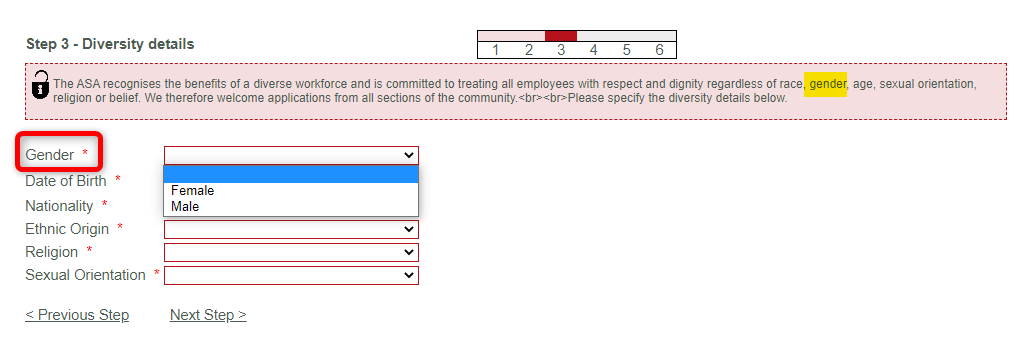
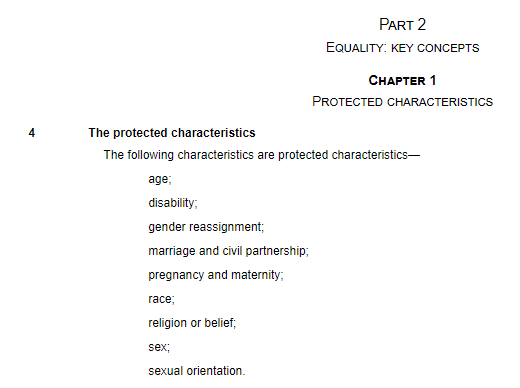
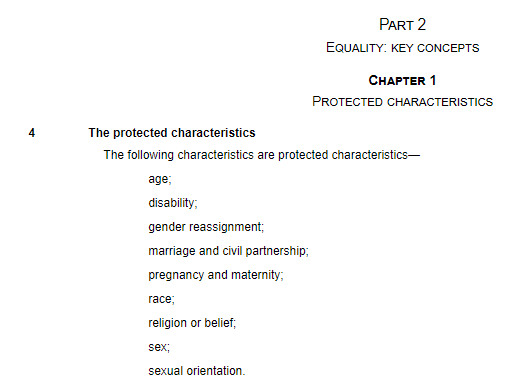
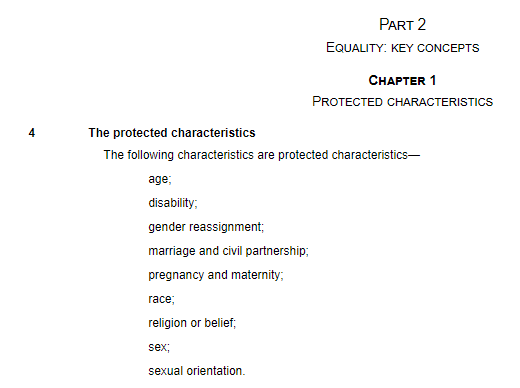
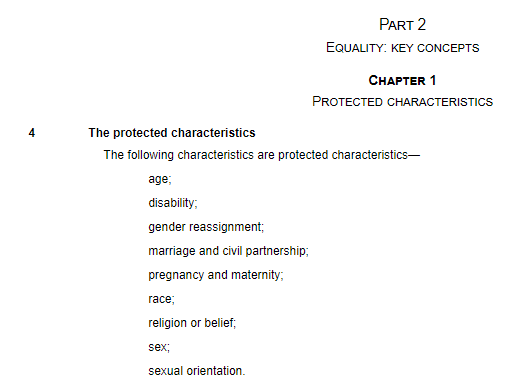
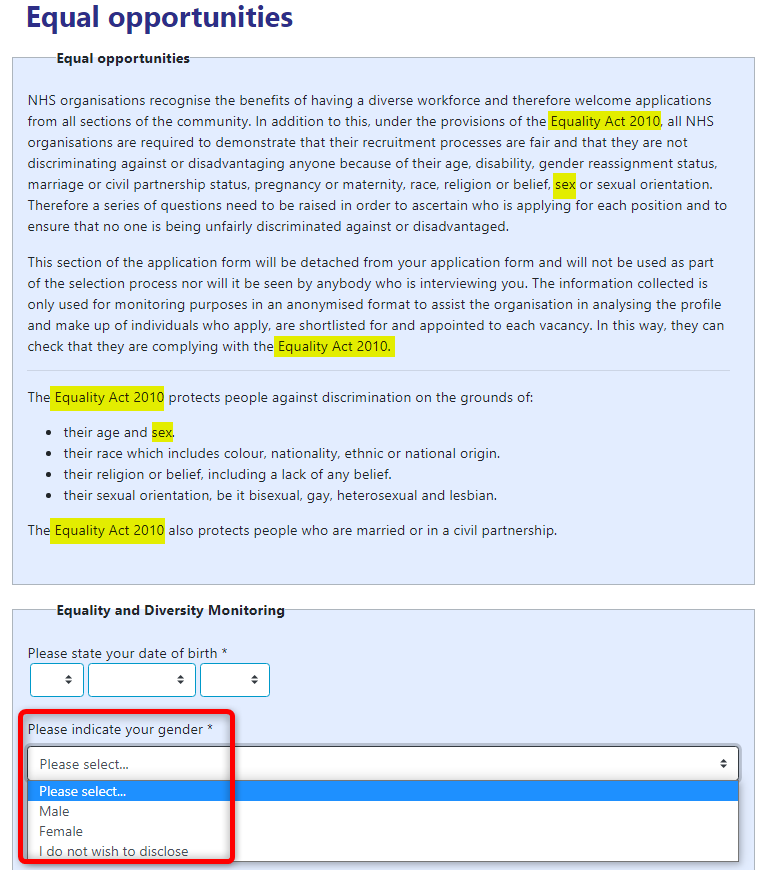
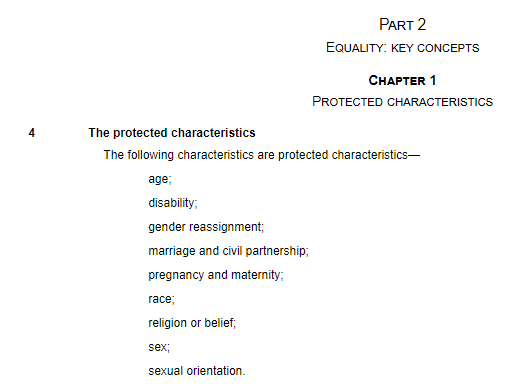
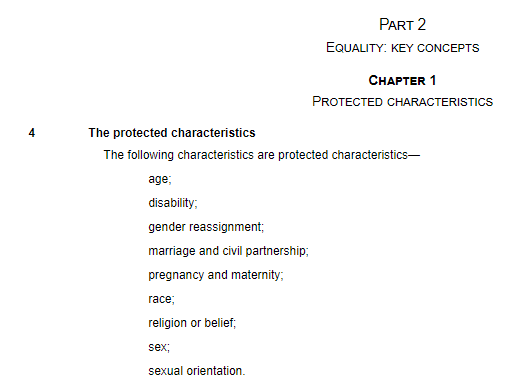
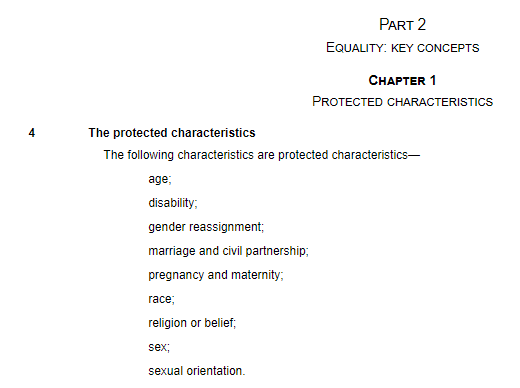
Diversity details section of your job application has what appears to be a partial list of the protected characteristics under the Equality Act 2010. However, it has 'gender' but not sex.

1/10

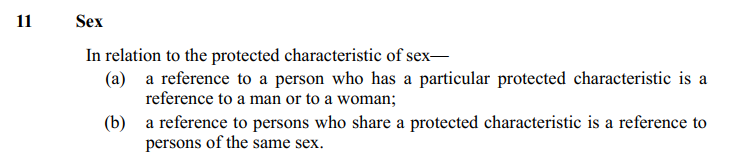
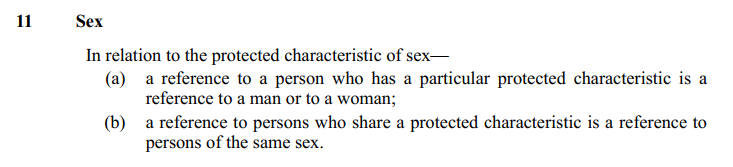
'Gender' is not a protected characteristic under the Equality Act 2010 and is not defined in the Act.

Sex is the protected characteristic under the Act, but that is not on your list.

https://t.co/qisFhCiV1u

2/10
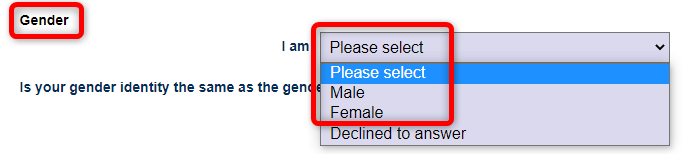
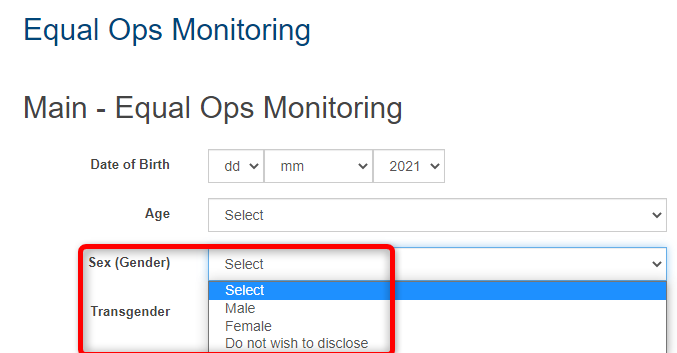
You then ask for the 'gender' of the applicant with options:

Female
Male.

3/10
'Gender' is not a protected characteristic under the Equality Act 2010 and is not defined in the Act.

https://t.co/qisFhCiV1u

4/10
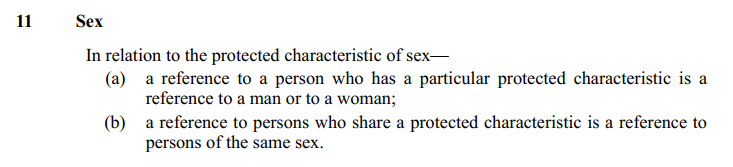
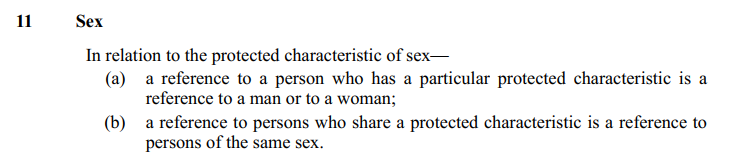
Sex is the protected characteristic and the only two possible options for sex are 'Female' and 'Male' as defined in the Act and consistent with biology, but you don't ask for that.

https://t.co/CEJ0gkr6nF

'Gender' is not a synonym for sex.

5/10
Asking about a personal characteristic such as 'gender' that is not a protected characteristic under the Act, may be in breach of the GDPR by processing personal - and potentially Special Category - data without a lawful basis.

6/10
If you choose not to gather data on specific protected characteristics (such as sex), you cannot have the information required to ascertain whether or not you could be discriminating on protected characteristics in recruitment. This could be vital in an employment tribunal.

7/10
If you choose to discriminate on characteristics (such as 'gender') that are not protected characteristics under the Act, you may inadvertently indirectly discriminate on protected grounds.

8/10
Language and meaning of words are important and proper use & understanding of terms is vital so that the public is aware of what rights they have and what your duties are. Any confusion or inconsistency over meaning may prevent people from accessing their rights in law.

9/10
Will you undertake to correct these errors and to review all your other policies, documents, reports, etc to ensure compliance?

Please respond.

https://t.co/RJAWJ1vJ6s

10/10
@threadreaderapp unroll

More from sexnotgender.info

Hi @SussexUni @adamtickell @profsaulbecker @EHRC @EHRCChair @KishwerFalkner @RJHilsenrath @trussliz @GEOgovuk

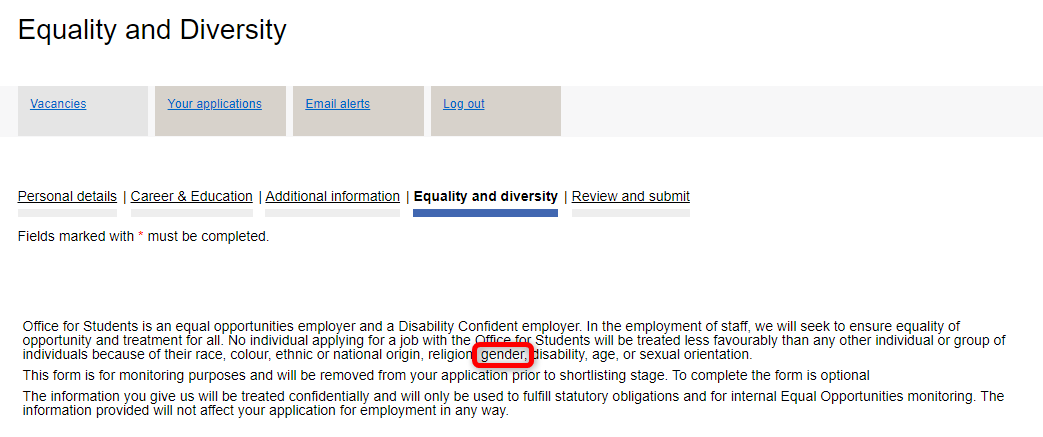
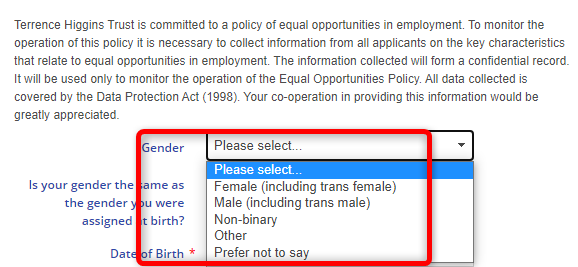
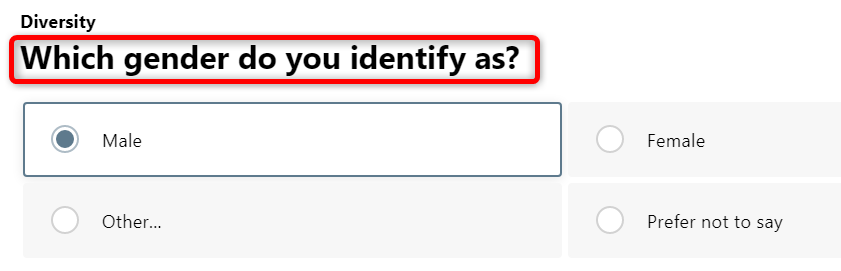
The Equal opportunities monitoring form in your job application asks for the 'gender' of the applicant with options:

Male
Female
Other.

https://t.co/DbKgiLN5yG

1/10


'Gender' is not a protected characteristic under the Equality Act 2010 and is not defined in the Act.

https://t.co/qisFhCiV1u

2/10
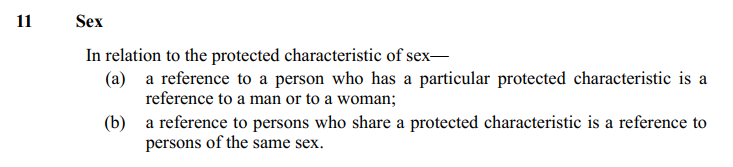

Sex is the protected characteristic and the only two possible options for sex are 'Female' and 'Male' as defined in the Act and consistent with biology - 'other' is not a valid option.

https://t.co/CEJ0gkr6nF

'Gender' is not a synonym for sex.

3/10


Asking about a personal characteristic such as 'gender' that is not a protected characteristic under the Act, may be in breach of the GDPR by processing personal - and potentially Special Category - data without a lawful basis.

4/10

If you choose not to gather data on specific protected characteristics (such as sex), you cannot have the information required to ascertain whether or not you could be discriminating on protected characteristics in recruitment. This could be vital in an employment tribunal.

5/10
Hi @chelwestft @EHRC @EHRCChair @KishwerFalkner @RJHilsenrath @trussliz @GEOgovuk

The Equal opportunities section in your job application mentions the Equality Act 2010 four times and correctly lists sex as a protected characteristic. However...

1/11


However, you then ask for the 'gender' of the applicant with options:

Male
Female.

2/11

'Gender' is not a protected characteristic under the Equality Act 2010 and is not defined in the Act.

https://t.co/qisFhCiV1u

3/11


Sex is the protected characteristic and the only two possible options for sex are 'Female' and 'Male' as defined in the Act and consistent with biology and there is no way to self-describe one's sex.

https://t.co/CEJ0gkr6nF

'Gender' is not a synonym for sex.

4/11


Asking about a personal characteristic such as 'gender' that is not a protected characteristic under the Act, may be in breach of the GDPR by processing personal - and potentially Special Category - data without a lawful basis.

5/11
Hi @UHSFT @uhs_jobs @EHRC @EHRCChair @KishwerFalkner @RJHilsenrath @trussliz @GEOgovuk

The Equal opportunities section of your job application mentions the Equality Act 2010 four times and lists sex as a protected characteristic twice.

However...

1/11


However, you then ask for the 'gender' of the applicant with options:

Male
Female.

2/11

'Gender' is not a protected characteristic under the Equality Act 2010 and is not defined in the Act.

https://t.co/qisFhCiV1u

3/11


Sex is the protected characteristic and the only two possible options for sex are 'Female' and 'Male' as defined in the Act and consistent with biology.

https://t.co/CEJ0gkr6nF

'Gender' is not a synonym for sex.

4/11


Asking about a personal characteristic such as 'gender' that is not a protected characteristic under the Act, may be in breach of the GDPR by processing personal - and potentially Special Category - data without a lawful basis.

5/11

More from Society

This is a piece I've been thinking about for a long time. One of the most dominant policy ideas in Washington is that policy should, always and everywhere, move parents into paid labor. But what if that's wrong?

My reporting here convinced me that there's no large effect in either direction on labor force participation from child allowances. Canada has a bigger one than either Romney or Biden are considering, and more labor force participation among women.

But what if that wasn't true?

Forcing parents into low-wage, often exploitative, jobs by threatening them and their children with poverty may be counted as a success by some policymakers, but it’s a sign of a society that doesn’t value the most essential forms of labor.

The problem is in the very language we use. If I left my job as a New York Times columnist to care for my 2-year-old son, I’d be described as leaving the labor force. But as much as I adore him, there is no doubt I’d be working harder. I wouldn't have stopped working!

I tried to render conservative objections here fairly. I appreciate that @swinshi talked with me, and I'm sorry I couldn't include everything he said. I'll say I believe I used his strongest arguments, not more speculative ones, in the piece.
@danielashby @AdamWJT @Greens4HS2 @TheGreenParty @GarethDennis @XRebellionUK @Hs2RebelRebel @HS2ltd I'll bite. Let's try to keep it factual. There's a reasonable basis to some aspects of this question, that it might be possible to agree on. Then there are other, more variable, elements which depend on external factors such as transport and energy policy. /1

@AdamWJT @Greens4HS2 @TheGreenParty @GarethDennis @XRebellionUK @Hs2RebelRebel @HS2ltd First up, we know reasonably well how much energy it takes to propel a high-speed train along the HS2 route. We can translate that into effective CO2 generated by making some assumptions about how green the electricity grid is. /2

@AdamWJT @Greens4HS2 @TheGreenParty @GarethDennis @XRebellionUK @Hs2RebelRebel @HS2ltd Secondly, we have a reasonable grasp of how much CO2 is going to be generated by building HS2 - there are standard methods of working this out, based on the amount of steel, concrete, earthmoving, machine-fuelling etc required. /3

@AdamWJT @Greens4HS2 @TheGreenParty @GarethDennis @XRebellionUK @Hs2RebelRebel @HS2ltd Thirdly, we can estimate how much CO2 is generated by cutting down trees, and how much is captured by planting new trees. We can also estimate how much CO2 is needed to keep the railway running and generated by maintaining the track /4

@AdamWJT @Greens4HS2 @TheGreenParty @GarethDennis @XRebellionUK @Hs2RebelRebel @HS2ltd We know how much CO2 is saved by moving goods by freight train on the lines freed up by moving the express trains on to HS2, rather than by truck. /5

You May Also Like