1/

It’s often claimed that “The Concept of Autogynephilia and the Typology of Male Gender Dysphoria” by @BlanchardPhD has been debunked.

I thought it would be interesting to see, at a basic level, how the concept and typology compares to the DSM-5.

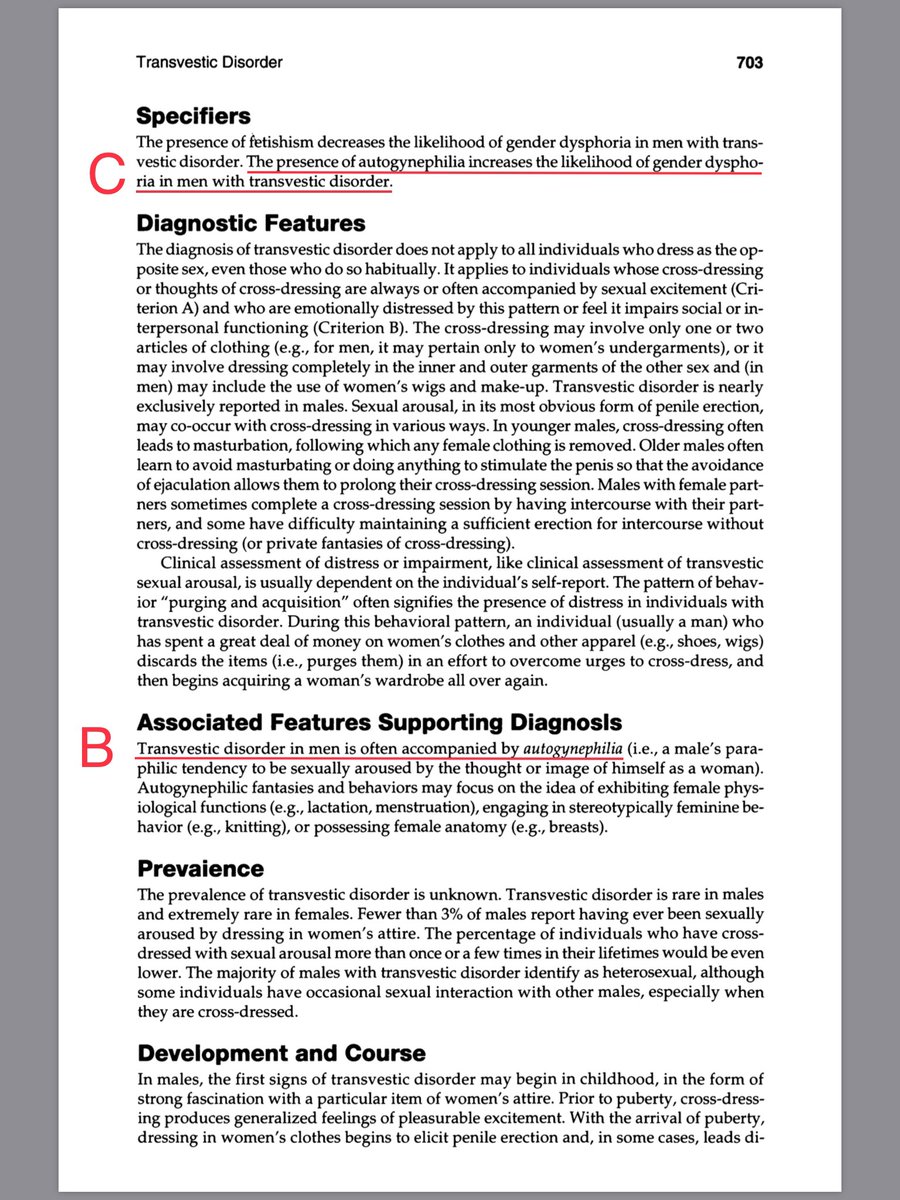
A. The definition of AGP.

2/

B. Transvestism is often accompanied by AGP.

C. The presence of AGP in transvestism increases the likelihood of [developing] Gender Dysphoria.
3/

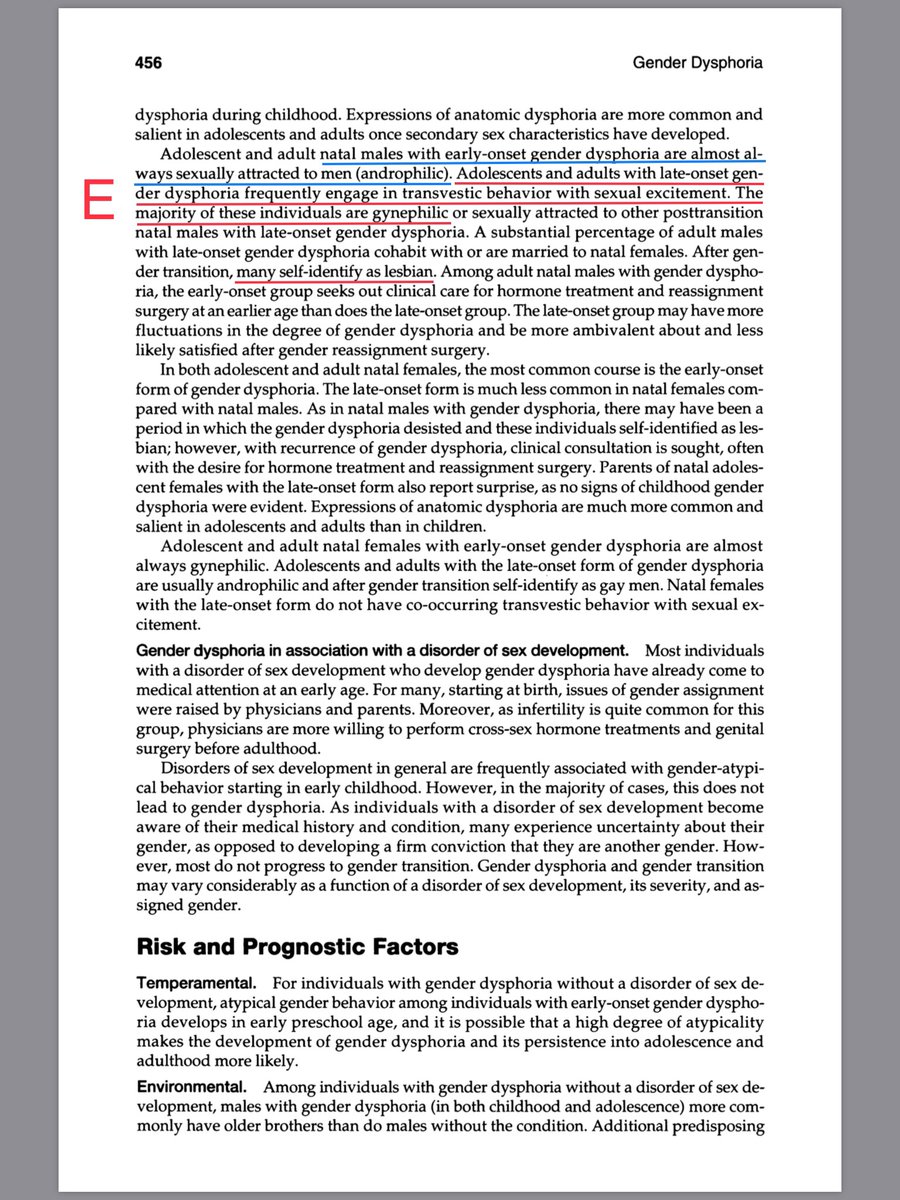
D. Gender Dysphoria (GD) in natal males is categorized as either early-onset or late-onset.
4/

E. Natal males with early-onset GD are almost always androphilic. The majority of natal males with late-onset GD are gynephilic; additionally, they frequently [have histories of] engaging in transvestic behavior with sexual excitement.
5/

F. In many cases of natal males with late-onset GD, transvestic behavior with sexual excitement is a precursor to their GD.
6/

Observation 1:
There appears to be a strong correlation between the “early-onset GD” group in the DSM-5 and the “homosexual transsexual” (HSTS) group in the Blanchard typology.
7/

Observation 2:
There appears to be a strong correlation between the “late-onset GD” group in the DSM-5 and the “nonhomosexual transsexual” (autogynephilic/AGP) group in the Blanchard typology.
8/

Observation 3:
The DSM-5 categorizes its GD groups based on age of onset, while the Blanchard typology categorizes its groups
based on sexual orientation.
9/

Although this creates room for incongruence between the DSM-5 groups and the Blanchard typology groups, it also demonstrates a strong resemblance, given that the DSM-5 indicates such a strong relationship between age of GD onset and sexual orientation.
10/

Observation 4:
The DSM-5 draws a clear link between transvestic AGP and the late-onset GD group.

The other subtypes of AGP (anatomic, behavioral and physiologic) aren’t really covered, but it seems plausible that they are similarly linked to the late-onset GD group.
11/

Summary:
There is a strong resemblance between the DSM-5 and the Blanchard typology. One would not expect to see such a strong resemblance if the Blanchard typology had truly been debunked.

On a final note:

More from Society

You May Also Like

THREAD: 12 Things Everyone Should Know About IQ

1. IQ is one of the most heritable psychological traits – that is, individual differences in IQ are strongly associated with individual differences in genes (at least in fairly typical modern environments). https://t.co/3XxzW9bxLE


2. The heritability of IQ *increases* from childhood to adulthood. Meanwhile, the effect of the shared environment largely fades away. In other words, when it comes to IQ, nature becomes more important as we get older, nurture less.
https://t.co/UqtS1lpw3n


3. IQ scores have been increasing for the last century or so, a phenomenon known as the Flynn effect. https://t.co/sCZvCst3hw (N ≈ 4 million)

(Note that the Flynn effect shows that IQ isn't 100% genetic; it doesn't show that it's 100% environmental.)


4. IQ predicts many important real world outcomes.

For example, though far from perfect, IQ is the single-best predictor of job performance we have – much better than Emotional Intelligence, the Big Five, Grit, etc. https://t.co/rKUgKDAAVx https://t.co/DWbVI8QSU3


5. Higher IQ is associated with a lower risk of death from most causes, including cardiovascular disease, respiratory disease, most forms of cancer, homicide, suicide, and accident. https://t.co/PJjGNyeQRA (N = 728,160)