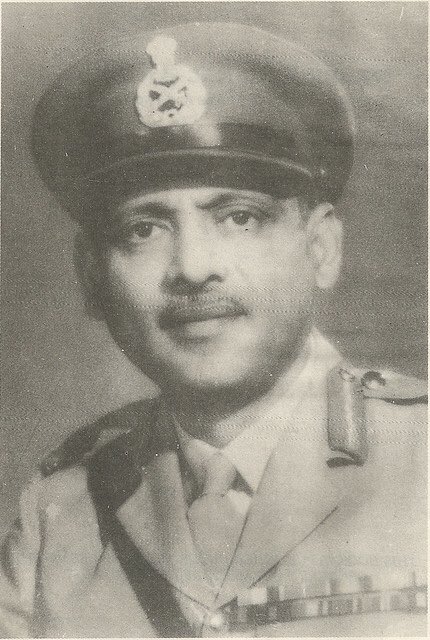
Some 1300 years ago in Karnataka there lived a genius who wrote "Gaṇitasārasan̄graha" (which is earliest text devoted entirely to mathematics)

The man who's work later borrowed by Arabs & Europeans

Thread on "Mahāvīracharya" astounding but forgotten legacy

Mahāvirachārya was patronised by rashtrakuta king amoghavarasha

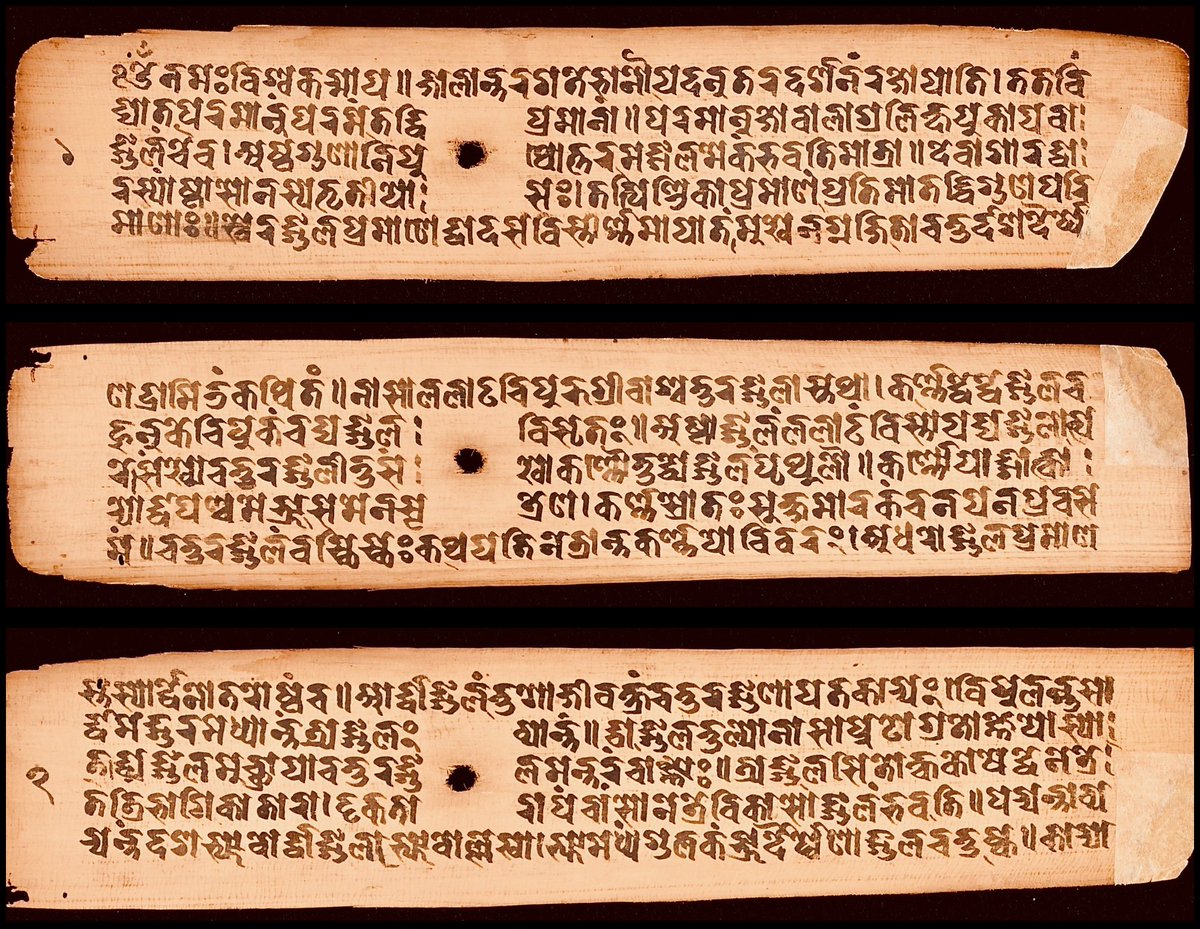
His book"Gaṇita-sāra-saṅgraha"is earliest text devoted entirely to Mathematics

He has described the currently used method of calculating(LCM)of given numbers.The same method was used in Europe later in1500CE

Mahavira wrote "Gaṇita-sāra-saṅgraha" (GSS) in 8th century CE which contains some 1100 slokās & contains elementary topics in arithmetic , algebra , geometry , measurements , logic , number theory , dynamical systems etc

A sheer mathematical genius
He was devout jain
His magnum opus "Ganit sara sangraha " start with a sloka bowing to the glory of the jinas

"संख्याज्ञानप्रदिपेन जैनेंद्रन महत्वेशा,
प्रकाशितम जगतसर्व येन तम प्रणमाम्यहम"

He also praised his predecessor aryabhata , brahmagupta & other greats in his works
The importance & popularity of "Gaṇita-sāra-saṅgraha"was so huge that it enjoyed statues of most important textbook of mathematics in South Indian for over 3 centuries

A large no of manuscript copies of
"Gaṇita-sāra-saṅgraha"whr discovered in Kerala shows it's popularity
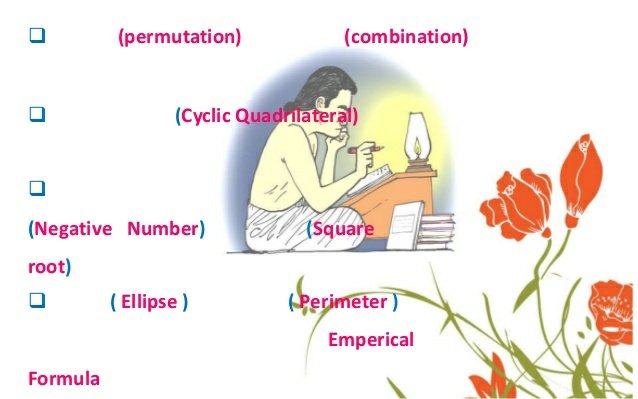
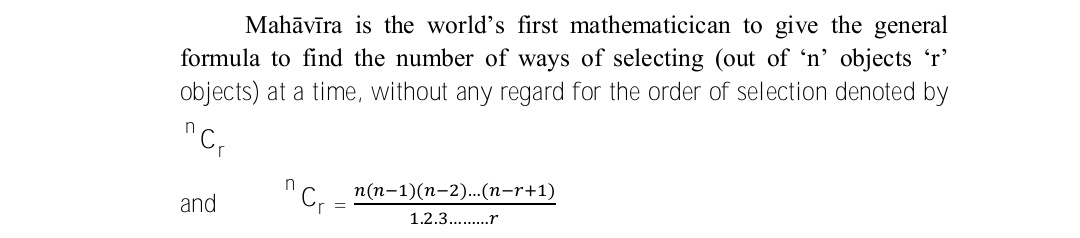
Mahāvira was the world's first mathematician to give the general formula for n C r in combinations .

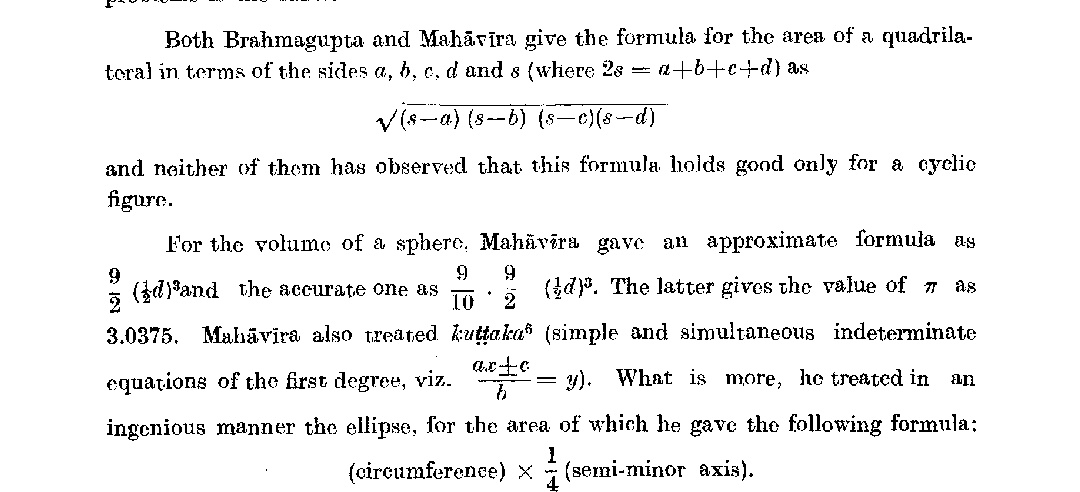
Further he was one of the first mathematician to have given an approximate expression for the circumference of an ellipse(aayata vritta)
Mahāvira also made an important remark in connection with "root of negative number" .

He clearly mentioned in his work that a "negative number cannot have a square root" . This is the first remark on clear recognition of the imaginary quantities in mathematics .
He was the first one to write arithmetic in present day form , he described in details the current method of finding lowest common multiple. therefore, it was an invention not by John napier but by our very own scholar mahaviracharya in its actual form.
Mahaviracharya work was an important link in the continuous chain of Indian mathematics ,it acquired pride place particularly in South India

His work was recognised by great chalukyan ruler Raja Raja narendra who got it translated in telugu by mathematician pavuluri mallana
The credit tht Mahavira rightly deserves for discovery of various methods in the field of mathematics hs gone almost unnoticed by historians

Mahavira by his sheer achievements in several branches of mathematics has a distinct position in the history of indian & world mathematics

More from Science

https://t.co/hXlo8qgkD0
Look like that they got a classical case of PCR Cross-Contamination.
They had 2 fabricated samples (SRX9714436 and SRX9714921) on the same PCR run. Alongside with Lung07. They did not perform metagenomic sequencing on the “feces” and they did not get


A positive oral or anal swab from anywhere in their sampling. Feces came from anus and if these were positive the anal swabs must also be positive. Clearly it got there after the NA have been extracted and were from the very low-level degraded RNA which were mutagenized from

The Taq.
https://t.co/yKXCgiT29w to see SRX9714921 and SRX9714436.
Human+Mouse in the positive SRA, human in both of them. Seeing human+mouse in identical proportions across 3 different sequencers (PRJNA573298, A22, SEX9714436) are pretty straight indication that the originals

Were already contaminated with Human and mouse from the very beginning, and that this contamination is due to dishonesty in the sample handling process which prescribe a spiking of samples in ACE2-HEK293T/A549, VERO E6 and Human lung xenograft mouse.

The “lineages” they claimed to have found aren’t mutational lineages at all—all the mutations they see on these sequences were unique to that specific sequence, and are the result of RNA degradation and from the Taq polymerase errors accumulated from the nested PCR process
Hard agree. And if this is useful, let me share something that often gets omitted (not by @kakape).

Variants always emerge, & are not good or bad, but expected. The challenge is figuring out which variants are bad, and that can't be done with sequence alone.


You can't just look at a sequence and say, "Aha! A mutation in spike. This must be more transmissible or can evade antibody neutralization." Sure, we can use computational models to try and predict the functional consequence of a given mutation, but models are often wrong.

The virus acquires mutations randomly every time it replicates. Many mutations don't change the virus at all. Others may change it in a way that have no consequences for human transmission or disease. But you can't tell just looking at sequence alone.

In order to determine the functional impact of a mutation, you need to actually do experiments. You can look at some effects in cell culture, but to address questions relating to transmission or disease, you have to use animal models.

The reason people were concerned initially about B.1.1.7 is because of epidemiological evidence showing that it rapidly became dominant in one area. More rapidly that could be explained unless it had some kind of advantage that allowed it to outcompete other circulating variants.

You May Also Like