
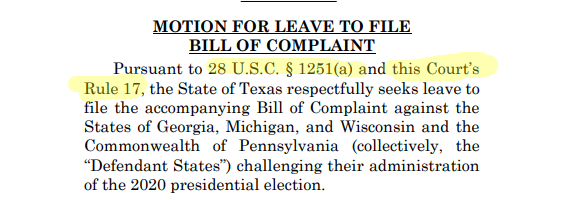
Goddamn it, Texas, I don't have time for this today.
Fine. Fine. A brief thread. (Yesterday I said I'd do a brief thread on the Michigan decision and finished an hour and a half later. Can't let this be that, today).
1) Violation of the Electors Clause of the Constitution ("the Constitution gives state legislatures exclusive control of the manner of selecting electors and judicial action can't change it)
2) "Counties applied different rules"

That's it. That's the case

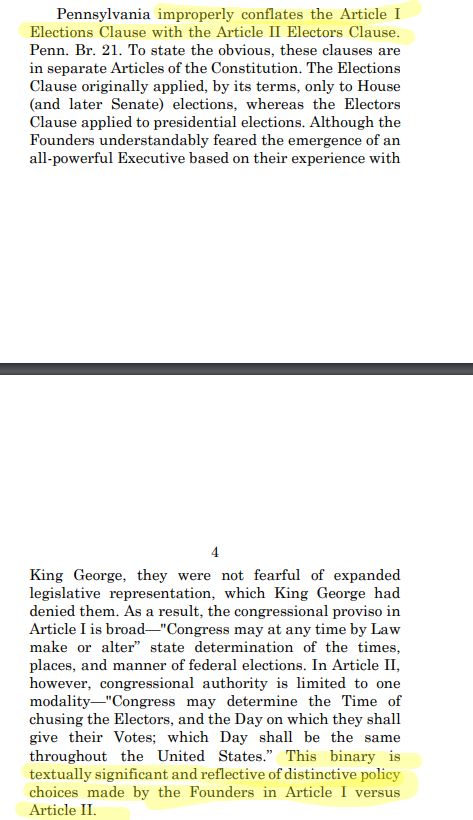
The core of their complaint is that when the Constitution gives state legislatures the right to direct the "Manner" of appointing electors, that right is exclusive, and the "Manner" set by the legislature can't be varied *at all* by courts or executives


First, Congress already set the day for choosing electors as November 3. No state can choose electors on any subsequent date
And if the delegation of "Manner" to state legislatures means that state courts can't, for example, extend ballot receipt deadlines because the delegation is EXCLUSIVE and only state legislatures can set those rules, then ...


More from Akiva Cohen
OK, #Squidigation fans, I think we need to talk about the new Wisconsin suit Donald Trump filed - personally - in Federal Court last night. The suit is (as usual) meritless. But it's meritless in new and disturbing ways. This thread will be
Not, I hope, Seth Abramson long. But will see.
I apologize in advance to my wife, who would very much prefer I be billing time (today's a light day, though) and to my assistant, to whom I owe some administrative stuff this will likely keep me from 😃
First, some background. Trump's suit essentially tries to Federalize the Wisconsin Supreme Court complaint his campaign filed, which we discussed here.
If you haven't already, go read that thread. I'm not going to be re-doing the same analysis, and I'm not going to be cross-linking to that discussion as we go. (Sorry, I like you guys, and I see this as public service, but there are limits)
Also, @5DollarFeminist has a good stand-alone thread analyzing the new Federal complaint - it's worth reading as well, though some of the analysis will overlap.
\U0001f6a8BREAKING: Trump files new federal court lawsuit in Wisconsin challenging the results of the election.https://t.co/LfKb2PUIkq
— Marc E. Elias (@marceelias) December 3, 2020
Not, I hope, Seth Abramson long. But will see.
I apologize in advance to my wife, who would very much prefer I be billing time (today's a light day, though) and to my assistant, to whom I owe some administrative stuff this will likely keep me from 😃
First, some background. Trump's suit essentially tries to Federalize the Wisconsin Supreme Court complaint his campaign filed, which we discussed here.
OK, #squidigation fans. This is a new Wisconsin case not filed by the Krake[n/d] team of Powell and Wood and NOT focusing on wild conspiracy theories. It's a competent and professional filing that raises things that would be real issues ... if you don't understand why they aren't https://t.co/ETvUiWV5du
— Akiva Cohen (@AkivaMCohen) December 1, 2020
If you haven't already, go read that thread. I'm not going to be re-doing the same analysis, and I'm not going to be cross-linking to that discussion as we go. (Sorry, I like you guys, and I see this as public service, but there are limits)
Also, @5DollarFeminist has a good stand-alone thread analyzing the new Federal complaint - it's worth reading as well, though some of the analysis will overlap.
Every one of these Trump election suits is the same gobbledygook garbage barge:
— Liz Dye (@5DollarFeminist) December 3, 2020
FRAUD!
It coulda happened.
Well, no, we can't prove it.
But just to be safe, best let the gerrymandered legislature give us all the electoral votes!https://t.co/Z926668H05 pic.twitter.com/xGZsJKIO7Y
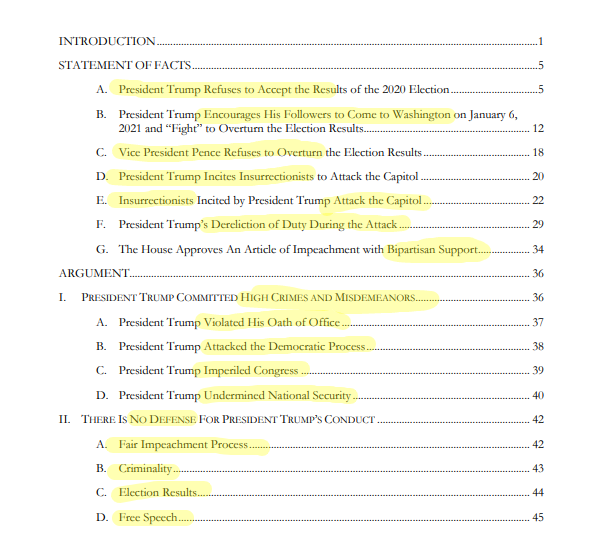

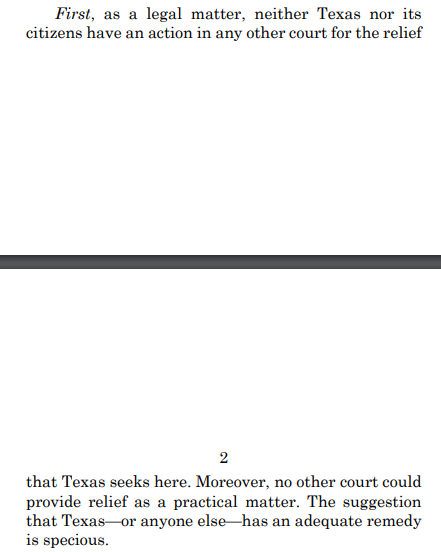


In the cold light of morning, I'm still completely amazed by the legal belly flop that @ThomasMoreSoc filed in the DC District Court. It's the legal equivalent of watching the butt fumble, live
EVERYTHING you could possibly get wrong in a complaint, they managed
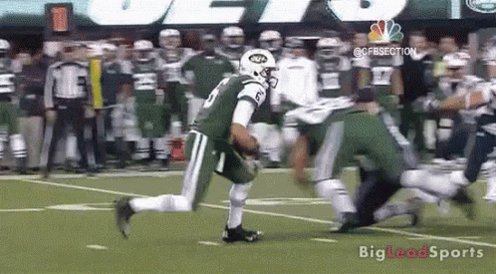
Start with the plaintiffs. The ONLY claims in the lawsuit are that the Constitution gives state legislatures the right to set the manner of elections, which they have allegedly (we'll get to this insanity) failed to do.
There's oodles of caselaw saying "since that's a right of the state legislature, only state legislatures, as a body, can bring such a claim"
Are the plaintiffs state legislatures?
https://t.co/KJGEvm8Owp
OK, what about the Defendants? They've sued Defendants from, IIRC, five states (GA, PA, WI, MI, AZ) based on claims that the State Legislatures there didn't pass election rules that the plaintiffs insist the Constitution requires (I promise, we'll get there).
EVERYTHING you could possibly get wrong in a complaint, they managed
Start with the plaintiffs. The ONLY claims in the lawsuit are that the Constitution gives state legislatures the right to set the manner of elections, which they have allegedly (we'll get to this insanity) failed to do.
There's oodles of caselaw saying "since that's a right of the state legislature, only state legislatures, as a body, can bring such a claim"
Are the plaintiffs state legislatures?
https://t.co/KJGEvm8Owp
OK, what about the Defendants? They've sued Defendants from, IIRC, five states (GA, PA, WI, MI, AZ) based on claims that the State Legislatures there didn't pass election rules that the plaintiffs insist the Constitution requires (I promise, we'll get there).
More from Politics


This idea - that elections should translate into policy - is not wrong at all. But political science can help explain why it's not working this way. There are three main explanations: 1. mandates are constructed, not automatic, 2. party asymmetry, 3. partisan conpetition 1/
First, party/policy mandates from elections are far from self-executing in our system. Work on mandates from Dahl to Ellis and Kirk on the history of the mandate to mine on its role in post-Nixon politics, to Peterson Grossback and Stimson all emphasize that this link is... 2/
Created deliberately and isn't always persuasive. Others have to convinced that the election meant a particular thing for it to work in a legislative context. I theorized in the immediate period of after the 2020 election that this was part of why Repubs signed on to ...3/
Trump's demonstrably false fraud nonsense - it derailed an emerging mandate news cycle. Winners of elections get what they get - institutional control - but can't expect much beyond that unless the perception of an election mandate takes hold. And it didn't. 4/
Let's turn to the legislation element of this. There's just an asymmetry in terms of passing a relief bill. Republicans are presumably less motivated to get some kind of deal passed. Democrats are more likely to want to do *something.* 5/
I\u2019m sorry it\u2019s just insane that Democrats are like, \u201cwe won everything and our opening position on relief is $1.9T\u201d and Republicans are like, \u201cwe lost and our opening position is $600B,\u201d and the media will be like, \u201cDemocrats say they want unity but reject this bipartisan deal.\u201d
— Meredith Shiner (@meredithshiner) January 31, 2021
First, party/policy mandates from elections are far from self-executing in our system. Work on mandates from Dahl to Ellis and Kirk on the history of the mandate to mine on its role in post-Nixon politics, to Peterson Grossback and Stimson all emphasize that this link is... 2/
Created deliberately and isn't always persuasive. Others have to convinced that the election meant a particular thing for it to work in a legislative context. I theorized in the immediate period of after the 2020 election that this was part of why Repubs signed on to ...3/
Trump's demonstrably false fraud nonsense - it derailed an emerging mandate news cycle. Winners of elections get what they get - institutional control - but can't expect much beyond that unless the perception of an election mandate takes hold. And it didn't. 4/
Let's turn to the legislation element of this. There's just an asymmetry in terms of passing a relief bill. Republicans are presumably less motivated to get some kind of deal passed. Democrats are more likely to want to do *something.* 5/
You May Also Like





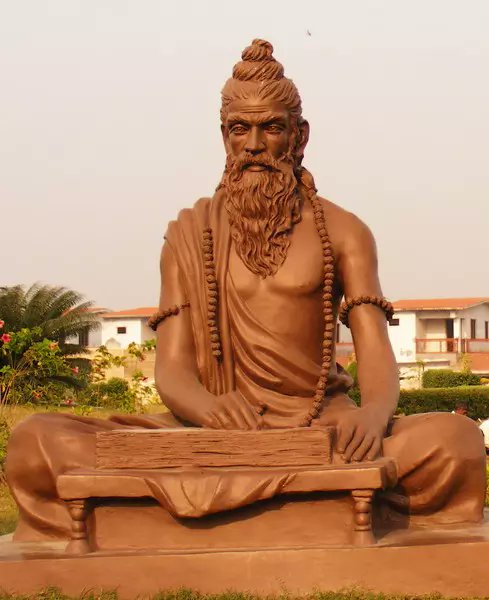


The UN just voted to condemn Israel 9 times, and the rest of the world 0.
View the resolutions and voting results here:
The resolution titled "The occupied Syrian Golan," which condemns Israel for "repressive measures" against Syrian citizens in the Golan Heights, was adopted by a vote of 151 - 2 - 14.
Israel and the U.S. voted 'No' https://t.co/HoO7oz0dwr
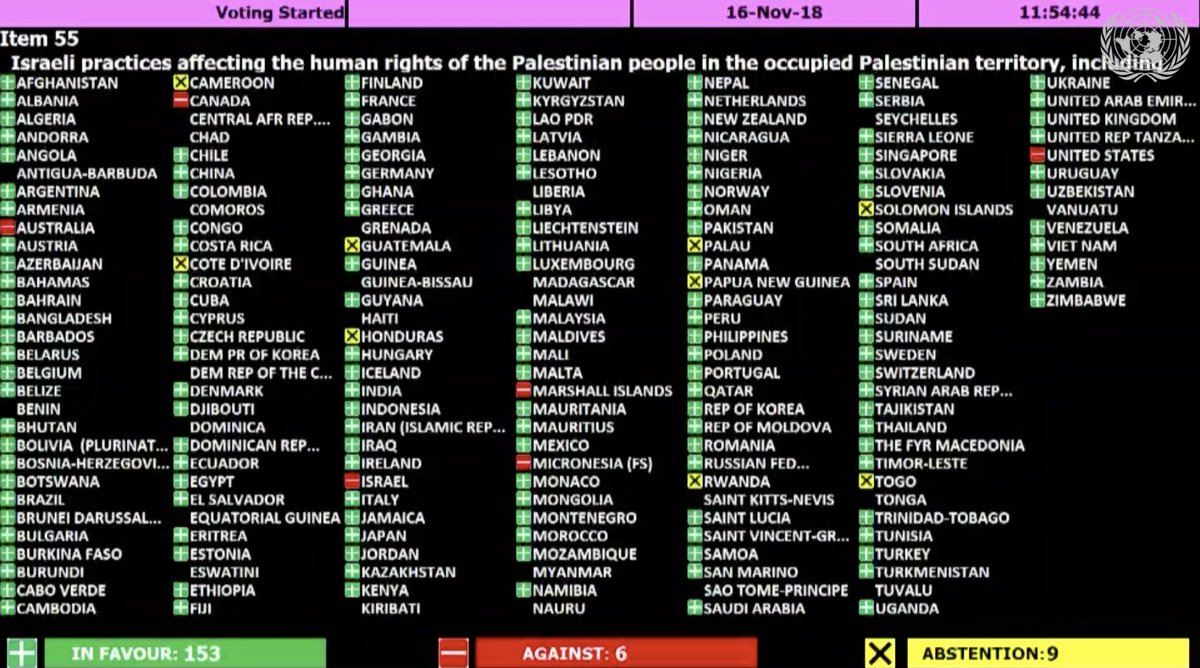
The resolution titled "Israeli practices affecting the human rights of the Palestinian people..." was adopted by a vote of 153 - 6 - 9.
Australia, Canada, Israel, Marshall Islands, Micronesia, and the U.S. voted 'No' https://t.co/1Ntpi7Vqab
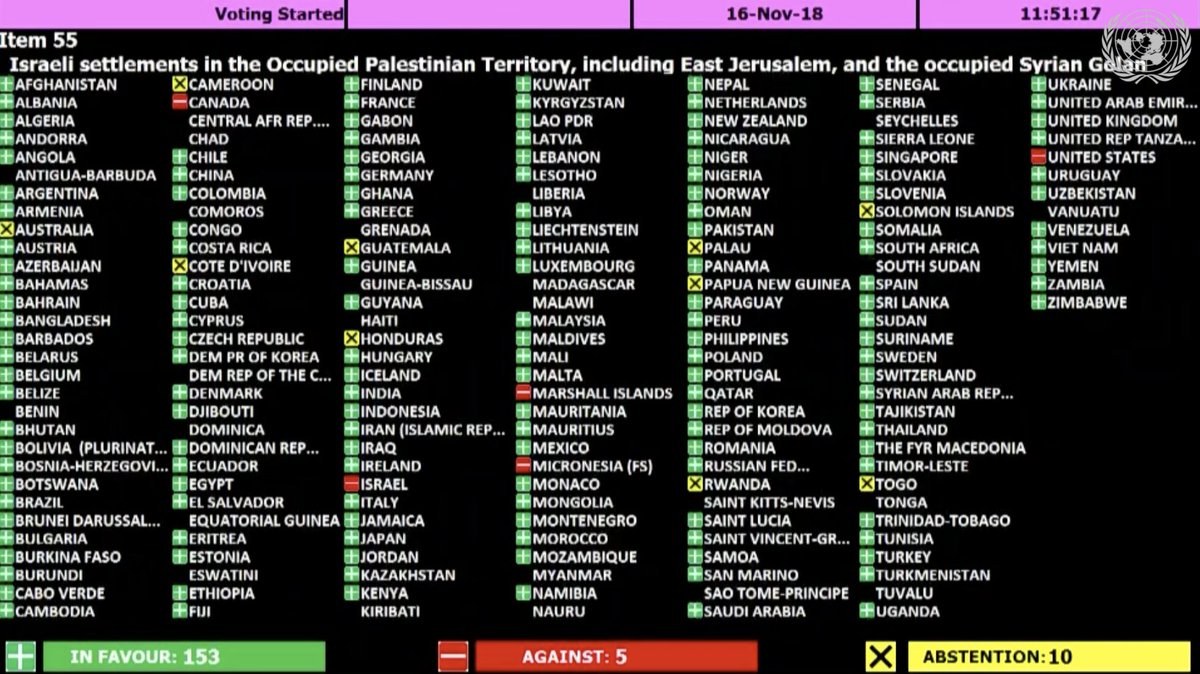
The resolution titled "Israeli settlements in the Occupied Palestinian Territory, including East Jerusalem, and the occupied Syrian Golan" was adopted by a vote of 153 – 5 – 10.
Canada, Israel, Marshall Islands, Micronesia, and the U.S. voted 'No'
https://t.co/REumYgyRuF
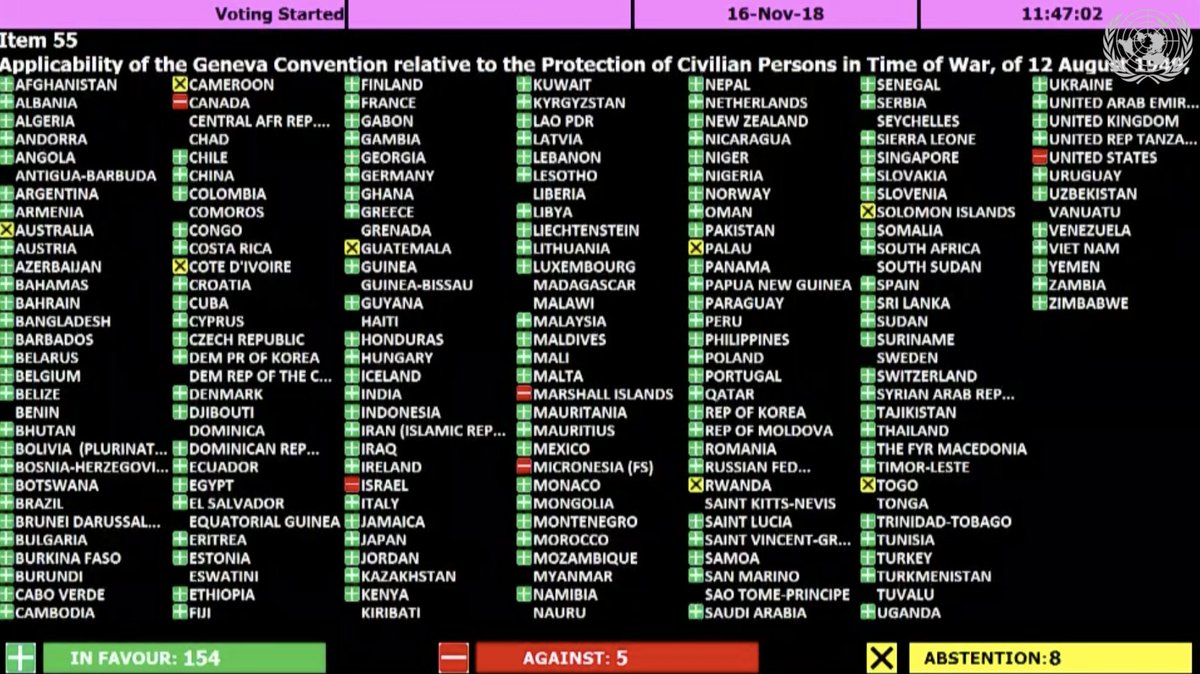
The resolution titled "Applicability of the Geneva Convention... to the
Occupied Palestinian Territory..." was adopted by a vote of 154 - 5 - 8.
Canada, Israel, Marshall Islands, Micronesia, and the U.S. voted 'No'
https://t.co/xDAeS9K1kW
View the resolutions and voting results here:
The resolution titled "The occupied Syrian Golan," which condemns Israel for "repressive measures" against Syrian citizens in the Golan Heights, was adopted by a vote of 151 - 2 - 14.
Israel and the U.S. voted 'No' https://t.co/HoO7oz0dwr
The resolution titled "Israeli practices affecting the human rights of the Palestinian people..." was adopted by a vote of 153 - 6 - 9.
Australia, Canada, Israel, Marshall Islands, Micronesia, and the U.S. voted 'No' https://t.co/1Ntpi7Vqab
The resolution titled "Israeli settlements in the Occupied Palestinian Territory, including East Jerusalem, and the occupied Syrian Golan" was adopted by a vote of 153 – 5 – 10.
Canada, Israel, Marshall Islands, Micronesia, and the U.S. voted 'No'
https://t.co/REumYgyRuF
The resolution titled "Applicability of the Geneva Convention... to the
Occupied Palestinian Territory..." was adopted by a vote of 154 - 5 - 8.
Canada, Israel, Marshall Islands, Micronesia, and the U.S. voted 'No'
https://t.co/xDAeS9K1kW