Cultivating ideas is a process.
You have to build a system to cultivate impactful ideas consistently.
I will share a 4-part framework that you can use to cultivate ideas.
1. Idea generation
2. Idea selection
3. Idea validation
4. Idea implementation
In this thread, I'll dive into "Idea Generation" & describe a simple framework that you can implement right away!
The following threads will cover the remaining 3 parts to cultivate ideas.
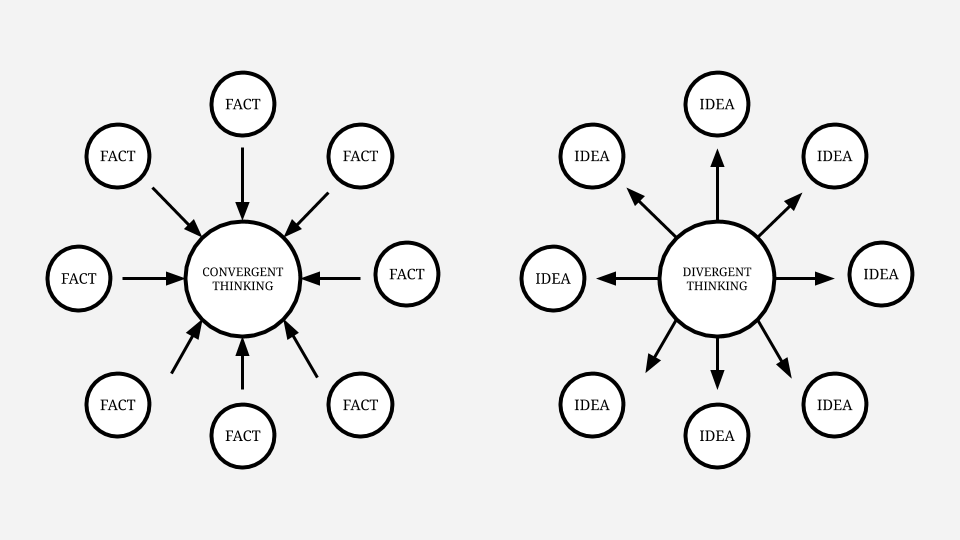
Lateral thinking is key - first, diverge & then converge.
Overview:
1/ PROBLEM - a question proposed for a solution, a matter stated for examination or proof.
Reframe problems into well-defined & clear "How might we.." statements.
This prioritises intention over tech/process.
But 1st, it is very important to be at the right problem level.
Example problem:
Our customers don't order pizza.
GO NARROW:
Ask "what's stopping you?" to get to the real problem.
What's stopping customers from ordering pizza?
- stale toppings?
- bad sauce?
Problem statement:
How might we ensure that the pizza toppings are fresh?
GO BROAD:
Use the 5 Whys framework to get to the real problem.
Why don't customers order pizza?
- Unhealthy?
- Expensive?
Problem statement:
How might we help customers pick our pizza?
@dklineii explains this framework well:
https://t.co/iMEHmCh4Kz
@dklineii Is narrow better or broad? Depends on your goal.
Validate the problem with at least 5-10 people who face it, understand the nuances.
Frame a proper "How Might We" statement.
Don't proceed until you have the problem statement figured out properly, spend enough time!
@dklineii 2/ DIVERGE - quality through quantity.
This phase is all about avoiding errors of omission.
Follow as many lines of thought as possible to generate a large list of solutions to the problem.
Expand & go wider. Don't exclude anything.
All ideas are good ideas.
Defer judgment.
@dklineii To diverge & generate ideas, use:
1. Mindmapping - Branch out with relations
2. SCAMPER model - Which elements can you Substitute, Combine, Adapt, Minify/Magnify, Put to another use, Eliminate, Reverse?
3. Business model canvas - What can you add/remove in each box of the BMC?
@dklineii You now have a huge list of ideas.
You've effectively improved the odds of having a great idea somewhere in that list.
The point is to ensure that you get high quality & impactful ideas by forcing a high quantity of ideas.
Hence, quality through quantity.
@dklineii 3/ CONVERGE - filter down
This phase is all about avoiding errors of commission.
Think of this stage as a funnel.
Apply judgement & find relations between ideas.
Analyse your list of ideas & bucket similar ideas into categories.
@dklineii Go through each category & score every idea against:
- meeting user needs
- effort to develop
- impact on the customer
Involve decision makers & discuss the top 10-20 ideas.
Feedback is key.
Pick ideas, maintain a list & review it every 3-4 months.
@dklineii KEY POINTS for making this process effective:
1. Diversity in the team is extremely useful.
Assemble people with different:
- perspectives
- problem-solving styles
- mindsets (introverted & extroverted)
- proximity to the problem
- expertise (cross-functional & subject matter)
@dklineii 2. While diverging, stop saying things like:
- we already tried that
- our competitors failed at it
- it's ahead of its time
- seems complicated, etc
3. Define the thought process - accommodate people who ideate within constraints & without.
@dklineii 4. Use an outside facilitator to eliminate bias & enable thinking.
5. Communicate upwards about the idea generation system.
Present your ideas properly to get buy-ins:
- Explain the problem
- Explain the process
- Introduce selected ideas/solutions
Tip: Lobby votes beforehand.
@dklineii Perspective is important to come up with high-impact ideas.
Check out the following threads:
1. Using the Socratic Method to reclaim your curiosity, stimulate critical thinking, and establish first principles by
@SahilBloom: https://t.co/6kr6J5ktkf
@dklineii @SahilBloom @anafabrega11 3. Why do smart product people & teams often build products with mediocre or no impact? by
@shreyas: https://t.co/jBGzD4V7AI
@dklineii @SahilBloom @anafabrega11 @shreyas Tools I've used & can recommend for this process:
@NotionHQ - Build pages to accommodate your specific requirements.
@MiroHQ - Great templates to enable creative & critical thinking.
@aha_io Ideas - Advanced, expensive & extremely powerful for large teams.
This thread on idea generation is the 1st stage of a 4-part framework to cultivate ideas.
Follow me for more threads on concepts that will help you become a better entrepreneur.
If you found this useful, RT the 1st tweet to share it with others.
https://t.co/rYNfQiPyS6
Summary:
1. Define the problem statement clearly & at the right level.
2. Diverge to generate a large list of ideas.
3. Converge to select specific ideas.
4. Maintain the list & review it every 3-4 months.
5. Communicate your ideas properly.