If you use it right, your Twitter account is worth more than your degree.

But 98.8% suck at it.

Here are 9 unique ways to turn Twitter into a crazy valuable asset:

Highly Curate Your Following

99% of users follow real-time news on Twitter.

That's okay. But you won't make Twitter an asset then.

To make it an asset, build a high-signal information diet.

You'll see it as a whole new opportunity.

Let me show you...
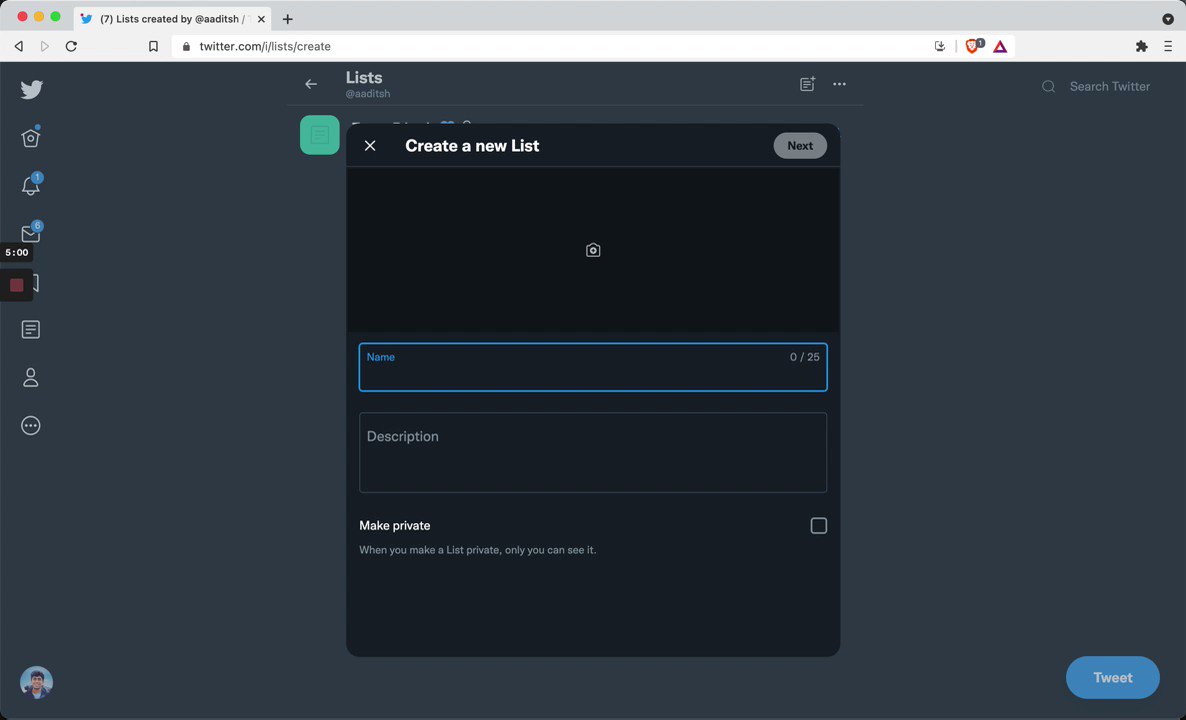
Use Twitter Lists

I find way too much news, drama and irrelevant ideas on the Twitter timeline.

I use Twitter lists to cut the noise and amplify the signal.

Bonus: Lists aren't affected by the algorithm.

Here's a video to get started on Lists:
Use Advanced Search

Scrape the internet to find what you want:

"(from:aaditsh) min_faves:1000 marketing"

Tweets with "marketing" from @aaditsh with more than 1000 likes.

Another favorite:

"(from:aaditsh) until:2021-09-01 since:2021-05-01"

Between May and September.
Mute Trolls

Trust me. They're not worth your time.

Click on a profile that annoys you.

Click "more" → "mute profile".

You won't "block" them but their content will become hidden on your timeline.

It's so peaceful.
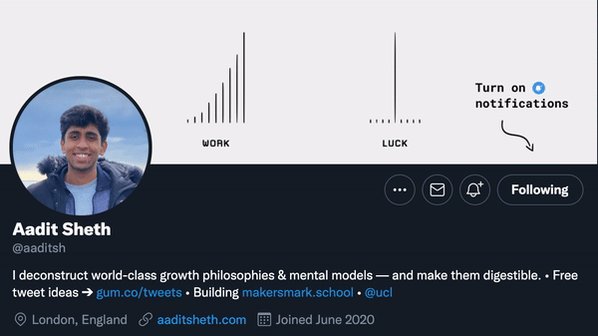
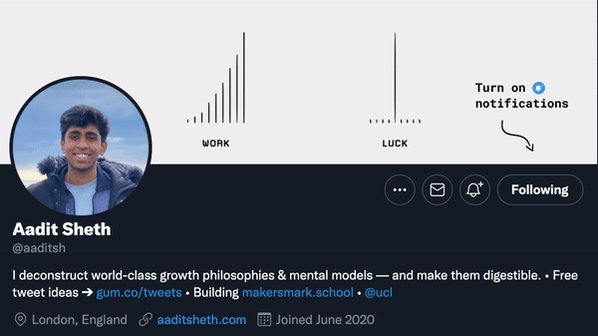
Polish Your Bio

It's a 1 line identity on the internet.

Make it crisp.

Mine: "I deconstruct world-class growth philosophies & mental models"

People now expect related content.

They like to see when you meet expectations (and go beyond).
Integrate Your Revue Newsletter

Use your newsletter to write more in-depth content.

That's what I do at mine.

I have seen 2x subscribers arriving at my newsletter.

Seriously - this is a game-changer.
Write Twitter Threads

Deconstruct complex topics into simple actionable tips for others.

This act (itself) will turn your followers into "superfans".

High-affinity audience = Valuable asset.
Network like you were born to.

You've heard this a million times.

If not, I'll say it again: You can literally reach anyone via Twitter DMs.

Think Gary Vee, Tony Robbins, Tim Ferriss (omg, this is crazy).

Don't shy away. Grow your network:
https://t.co/qgio4Ij7yz
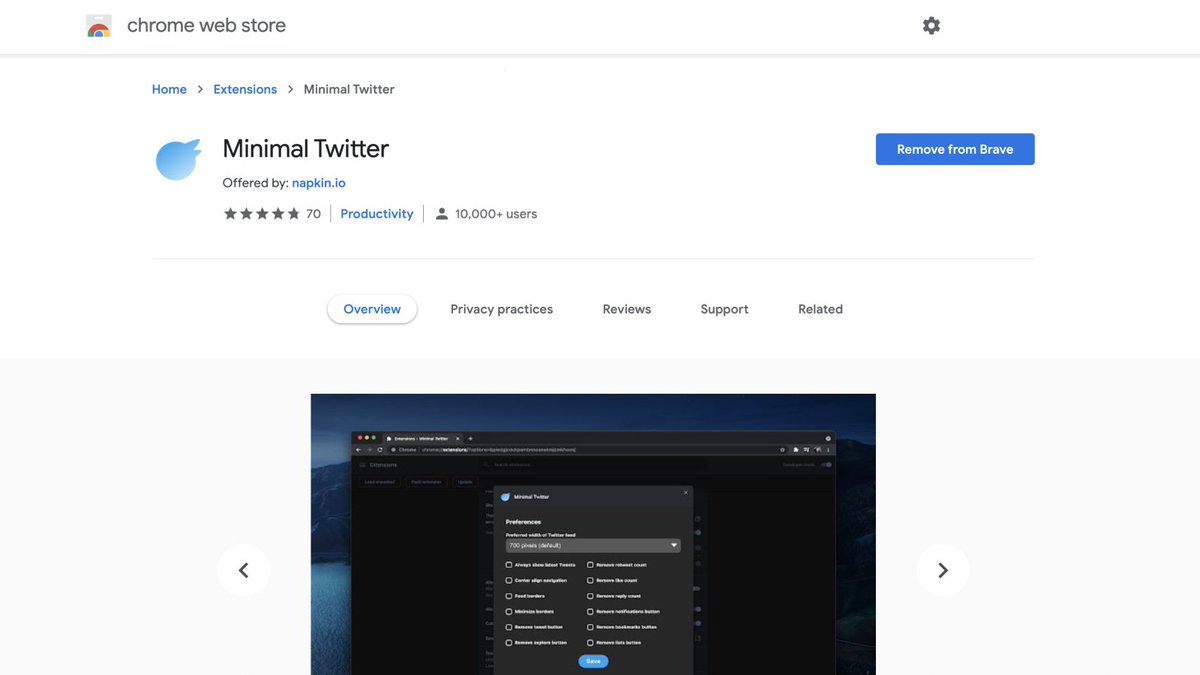
Install Minimal Twitter:

I hate the "explore" section on Twitter. It's usually filled with news and garbage found in my location.

I use the "Minimal Twitter" chrome extension to remove Explore.

My entire Twitter experience has become 10x better.
Share this thread with others:

1. Quote retweet the first tweet & let me know your thoughts.

2. Turn on notifications for @aaditsh — it's free!

I write a lot about how to leverage Twitter to impact more people positively.
Recap:

1. Heavily curate who you follow.

2. Use Twitter Lists (video tutorial included).

3. Use advanced search to scavenge Twitter.

4. Mute trolls (simple as that).

5. How to polish your bio.
6. Double your daily newsletter subscribers (2x).

7. Turn followers into "super fans".

8. Network like you were born to.

9. Make your Twitter distraction-free.
Level up your content game:

3 week cohort based course with @brandonthezhang

• Supercharge your Twitter.
• Write for the internet.
• Network like you were made for it.
• Build your content flywheel.

https://t.co/n1CvdQ0qzf
To help others make Twitter an asset:

1. Quote tweet the thread below.

2. Share your thoughts. https://t.co/LoQOw1CqUb

More from Aadit Sheth

How to accelerate your career, save 60 hrs/week, and lead better.

🧵 My 10 favorite tweets of the week (that you may have missed):

How to save 60 hrs/week of work (by


Why kids should play more video games (by


A 4-step writing process (by


26 incredible internet finds (by

More from Learning

Trading Strategies 101

14 "must-try" trading strategies you can start using today: 🧵

Collaborated with @niki_poojary

We'll break these into portions of:

1. Intraday Trading Techniques
2. Positional Trading Techniques
3. Indicator Applications

1/ 6 Intraday Strategies 🧵

How to Filter Stocks for Intraday


2/ Intraday BNF strangle based on OI data. 🧵


3/ A few setups to make intraday trading easy.
After reading 100s of short and long ebooks,

We have shortlisted these ebooks every no-code learner should read:

#1 The No-code Revolution

https://t.co/reOSvnTOs6

The ebook from @webflow will provide an overview of the no-code movement and its importance.

It also provides insights on bringing no-code to your company and how it will impact the world!

#2 Zero to MVP with No-code

https://t.co/7JD6RQvocZ

The book written by @MakadiaHarsh, with 21 chapters, provides a complete guide to building no-code apps.

It also explains the difference between no-code, code, & low-code, and 120+ tools to build MVPs.

#3 The What's, How's, and Why's of No-code

https://t.co/YH5L6pJrW0

This book from @QuixyOfficial provides insights on no-code development, how it's different from other development, and why it is essential for stakeholders of an organization.

#4 No-code Ebook

https://t.co/PV6M9oMZCF

The book developed by @NeotaLogic explains the importance of no-code and provides advice on selecting the correct no-code platforms according to requirements.

You May Also Like

1/ Some initial thoughts on personal moats:

Like company moats, your personal moat should be a competitive advantage that is not only durable—it should also compound over time.

Characteristics of a personal moat below:


2/ Like a company moat, you want to build career capital while you sleep.

As Andrew Chen noted:


3/ You don’t want to build a competitive advantage that is fleeting or that will get commoditized

Things that might get commoditized over time (some longer than


4/ Before the arrival of recorded music, what used to be scarce was the actual music itself — required an in-person artist.

After recorded music, the music itself became abundant and what became scarce was curation, distribution, and self space.

5/ Similarly, in careers, what used to be (more) scarce were things like ideas, money, and exclusive relationships.

In the internet economy, what has become scarce are things like specific knowledge, rare & valuable skills, and great reputations.