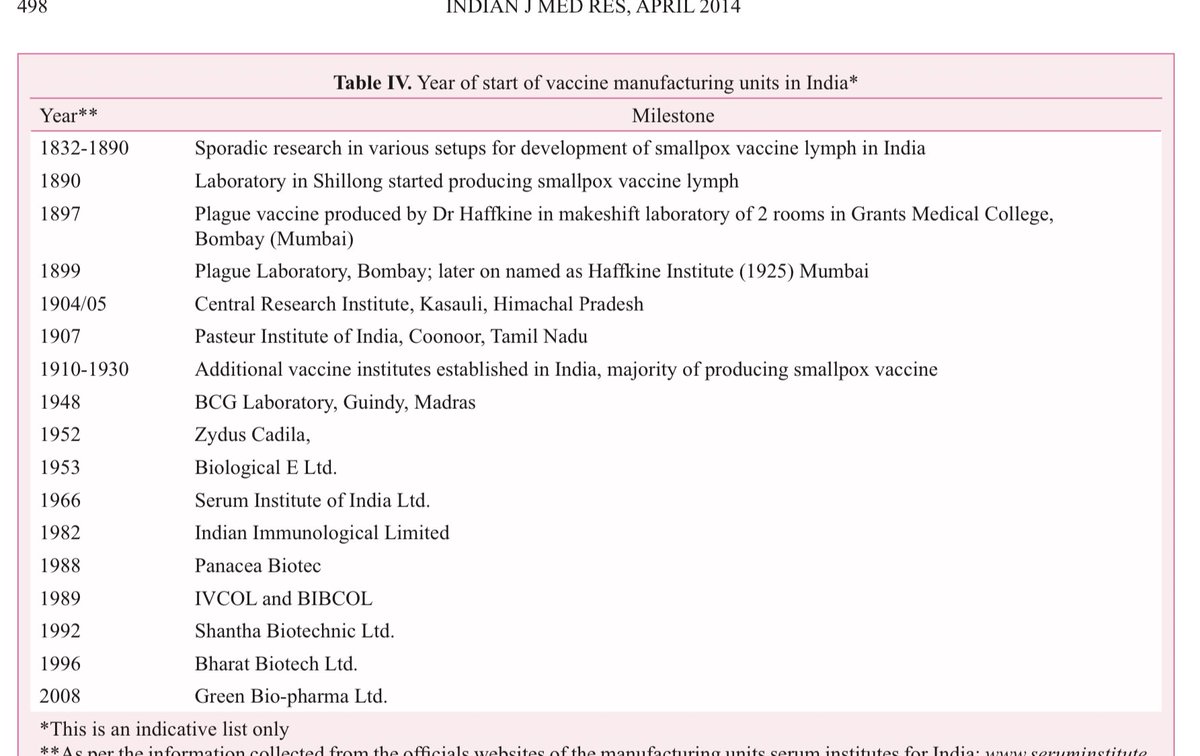
India produces over 60% of the total vaccines sold globally.
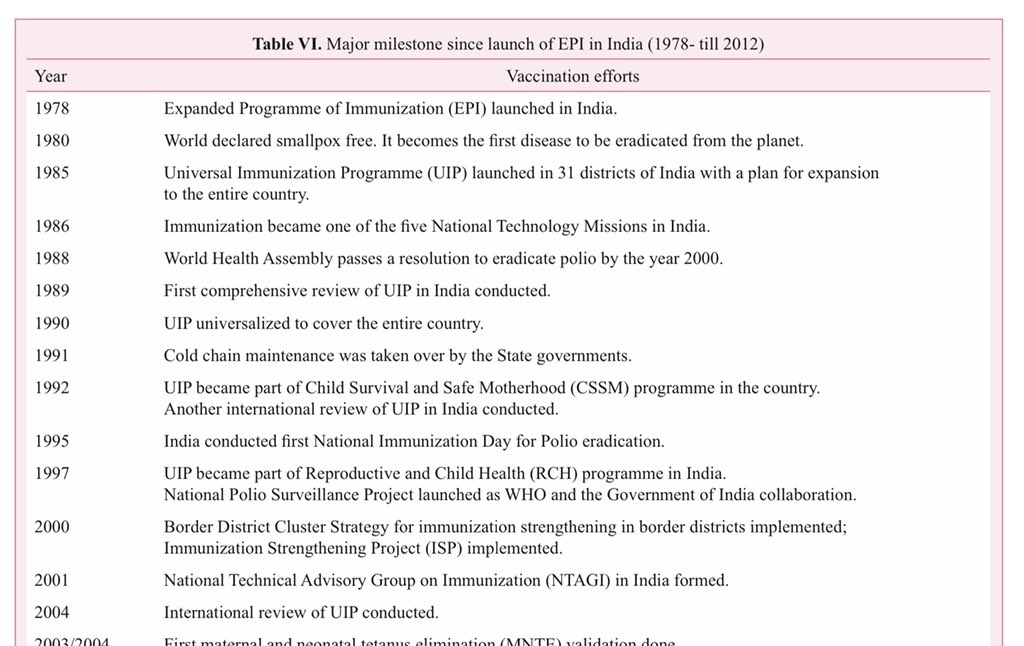
Free Universal Immunisation Programme was launched way back in 1985.
As Covid vaccination rolls out, let applause this great Indian success story, that must be handled with great care to ensure continued credibility
People of my age remember the extensive free vaccination in schools and all still have marks of vaccination on our arms.
Small pox to Polio have been eradicated.
free universal immunisation was expanded in 2005
International Centre for Genetic Engineering & Biotechnology (ICGEB),Delhi
National Institute of Immunology (NII), Delhi 5/n
National Institute of Virology (NIV), Pune
National Aids Research Institute (NARI), Pune
National Institute of Cholera and Enteric Diseases (NICED), Kolkata
Tuberculosis Research Centre (TRC), Chennai
Regional Medical Research Centre (BBSR), Bhuvaneshwar
6/n
Institute of Microbial Technology (IMTECH) Chandigarh
Centre for cellular and Molecular Biology (CCMB), Hyderabad
Indian Institute of Chemical Technology (IICT), Hyderabad
Indian Institute of Chemical Biology (IICB), Kolkata 7/n
Indian Institute of Sciences (IISC), Banglore
Anna University, Chennai
Mahatma Gandhi Institute of Medical Sciences (MGIMS), Wardha
Indian Immunologicals Ltd. (IIL), Hyderabad
8/n
Delhi university(DU), South Campus
Pasteur Institute of India, (PII), Coonoor
Haffkine Institute (HI), Mumbai
Tata Memorial Cancer Hospital (TMC), Mumbai
9/n
More from India


You May Also Like


Following @BAUDEGS I have experienced hateful and propagandist tweets time after time. I have been shocked that an academic community would be so reckless with their publications. So I did some research.
The question is:
Is this an official account for Bahcesehir Uni (Bau)?

Bahcesehir Uni, BAU has an official website https://t.co/ztzX6uj34V which links to their social media, leading to their Twitter account @Bahcesehir
BAU’s official Twitter account

BAU has many departments, which all have separate accounts. Nowhere among them did I find @BAUDEGS
@BAUOrganization @ApplyBAU @adayBAU @BAUAlumniCenter @bahcesehirfbe @baufens @CyprusBau @bauiisbf @bauglobal @bahcesehirebe @BAUintBatumi @BAUiletisim @BAUSaglik @bauebf @TIPBAU
Nowhere among them was @BAUDEGS to find

The question is:
Is this an official account for Bahcesehir Uni (Bau)?
Bahcesehir Uni, BAU has an official website https://t.co/ztzX6uj34V which links to their social media, leading to their Twitter account @Bahcesehir
BAU’s official Twitter account
BAU has many departments, which all have separate accounts. Nowhere among them did I find @BAUDEGS
@BAUOrganization @ApplyBAU @adayBAU @BAUAlumniCenter @bahcesehirfbe @baufens @CyprusBau @bauiisbf @bauglobal @bahcesehirebe @BAUintBatumi @BAUiletisim @BAUSaglik @bauebf @TIPBAU
Nowhere among them was @BAUDEGS to find