What does it take to sustain screwiness in the way the world works? Mostly, it's just good people, trying their best to get us to a better place... within constraints which pretty much preclude us actually getting anywhere! A case in point with
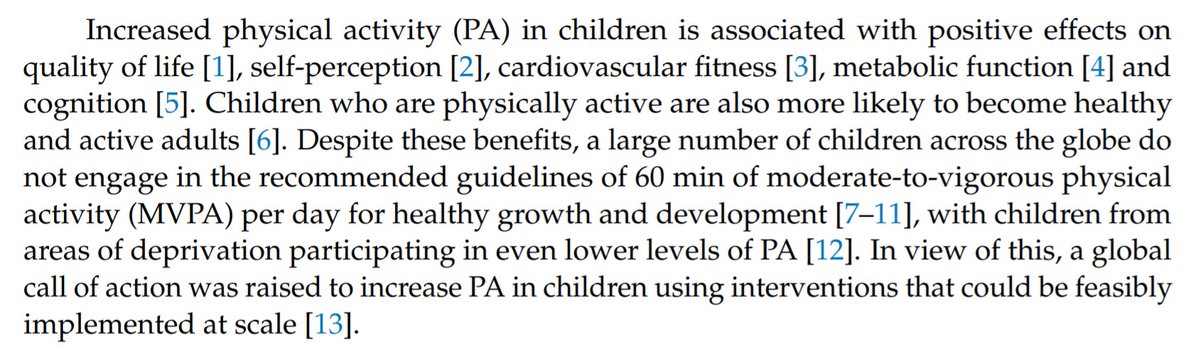
These authors come across as hugely committed to something we might all agree upon: improving young people's experiences of physical education through better school-based-interventions. Sounds great? Agreed, & pretty much everything about their study models best practice 🥳
Sadly, established "best practice" involves further embedding the medicalisation of PE as if it should be about the potential contribution of physical activity to everything from quality of life, self-perception & cognition to the likelyhood of becoming healthy & active adults 🤯
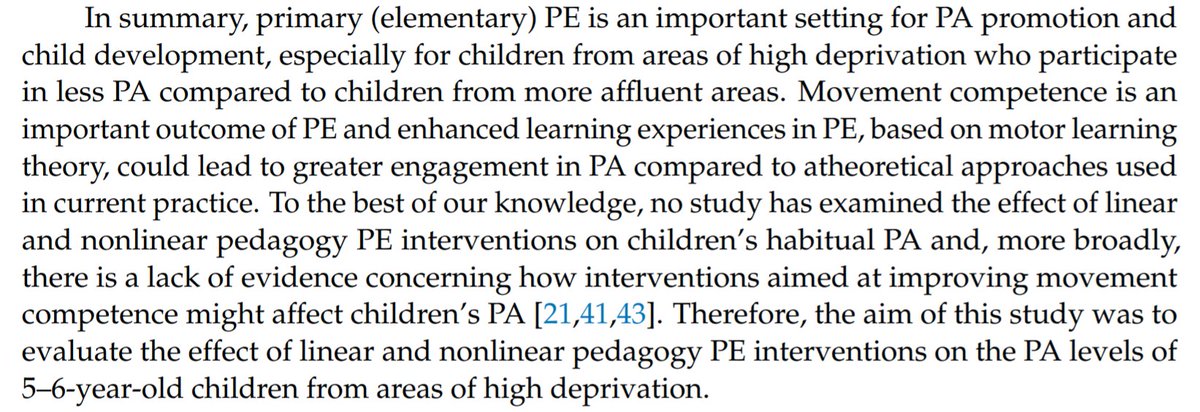
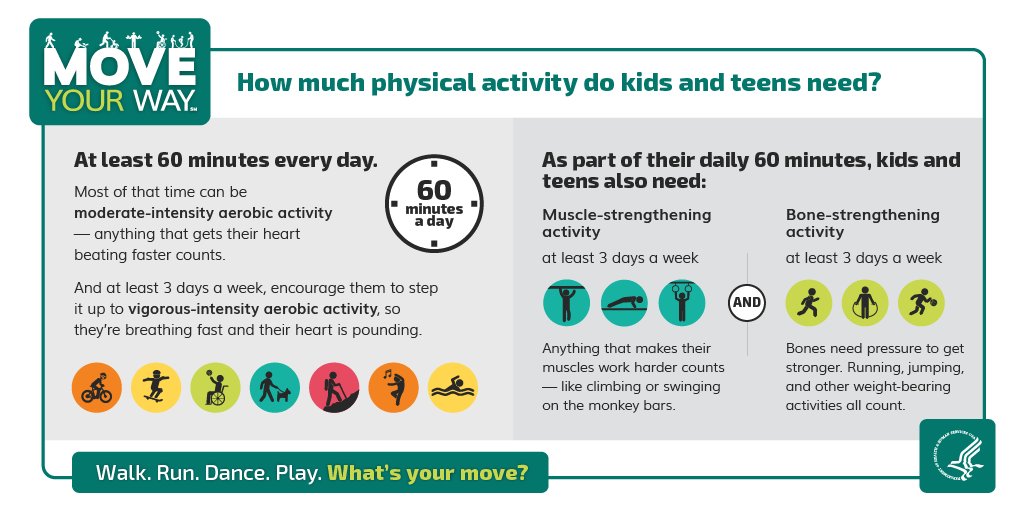
We're reminded of the Chief Medical Officer's "recommended guidelines of 60 min of moderate-to-vigorous physical activity (MVPA) per day for healthy growth and development" 👇 This is a focus on what we can easily measure (generic) rather than on what we might value (individual).
We get recognition that PE "is not merely an opportunity for children to engage in PA" but that's linked to its role in "the development of knowledge & skills to foster their PA engagement throughout life" - so further focus on health outcomes. A long way from @meaningfulPE 🙄
We're reminded of the role of International & national PE curriculum guidelines in relation to "movement competence" & of evidence showing "children possessing high movement competence being more likely to engage in PA during their adolescence and adulthood" - @MeaningfulSport?
We get an absolutely exemplary introduction to linear & non-linear pedagogy. The paper is worth highlighting for this alone! The writing is clear, engaging & authoritative, & evaluating theoretically informed approaches is surely a good thing if we seek evidence based practice 👇
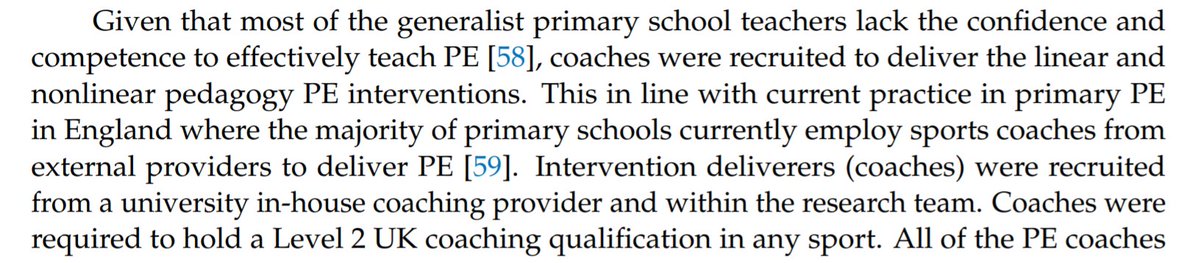
Sadly, we're then assured "generalist primary school teachers lack the confidence and competence to effectively teach PE" 🙄 Misguided initiatives associated with London 2012 strike again! Does anyone REALLY think coaches can replace teachers? Well, maybe if you think PE = PA 🤯
So experts in coaching, who didn't know the children, collaborated to produce a scheme of work and lesson plans & trained coaches to deliver sessions in schools.

In one sentence, that's pretty much everything that's currently screwy with British PE 🤯
https://t.co/jn1OInfpxc
As ever, a focus on what's easily measured (e.g. Physical Activity as tracked on ActiGraph GT9X accelerometers) runs the risk of us missing what we truly value (e.g. visceral responses, young people finding meaning in movement, connection to a pastime) 🙄
https://t.co/biZcCRl75G
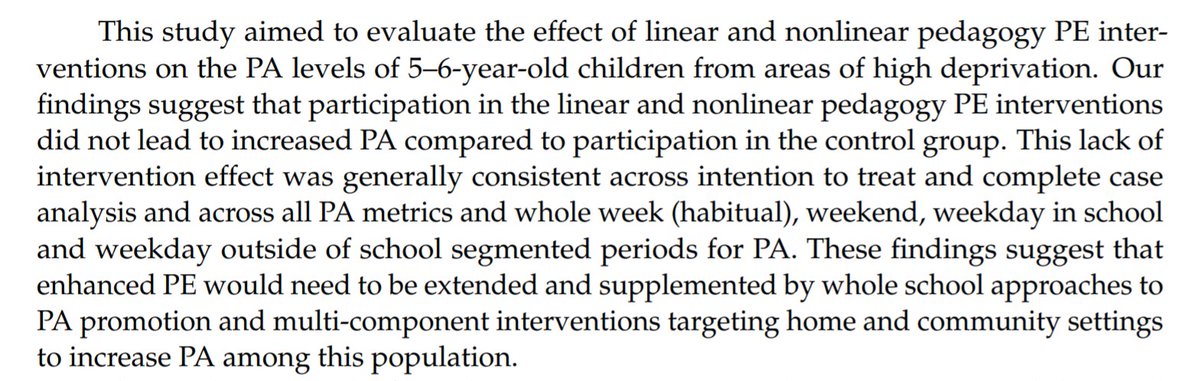
Shock: the researchers found EXACTLY what any teacher would anticipate - "enhanced PE would need to be extended & supplemented by whole school approaches to PA promotion & multi-component interventions targeting home & community settings to increase PA among this population" 🙄
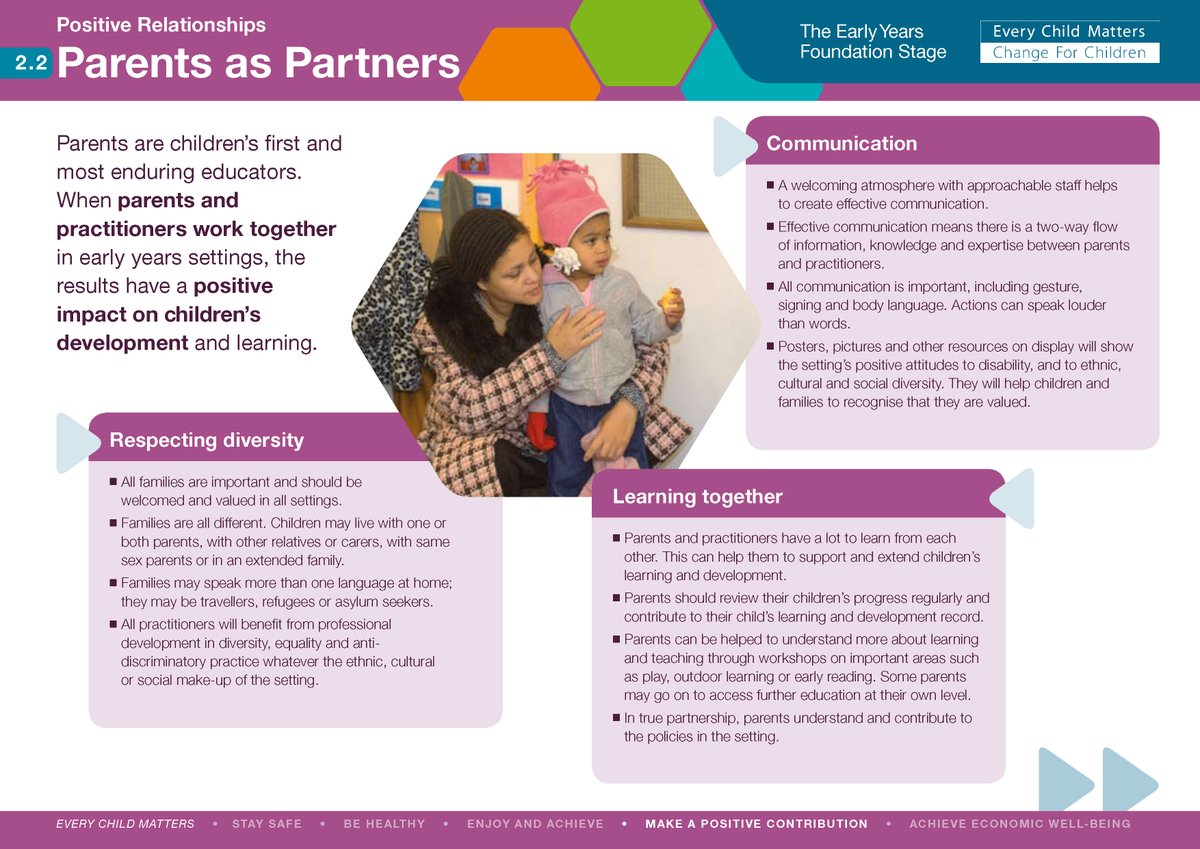
The authors suggest "for children this age, daily activities are generally dictated by adults" & highlight parents-as-partners as a strategic priority - but whilst perhaps news to coaches, that's already a long-standing priority for Early Years Professionals & Primary Teachers!
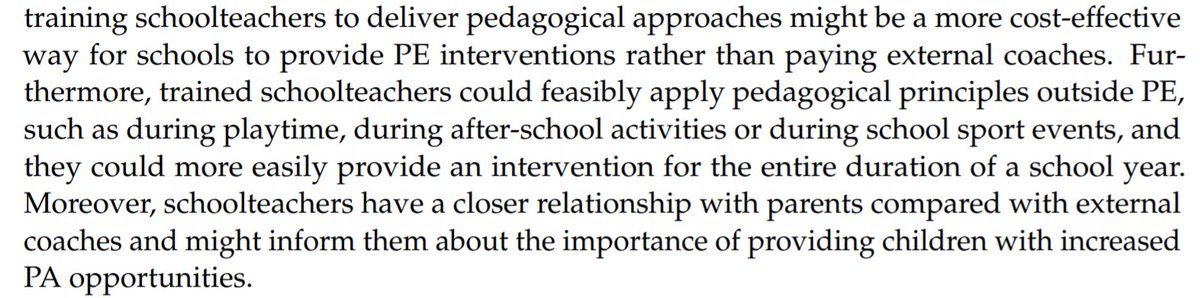
In the end, the paper concedes that teachers *might* actually offer more than coaches for PE... but what sort of academy have we shaped if *that* is news? We've always known this, & people like @Greg_Dryer, @VicksRandall82 & @Jools_CP have been saying so - loudly & consistently!
Our academic output also needs to connect with real-world values. No-one can ethically build "partnership" by "informing" parents about anything - least of all the "expert" view of "the importance of providing children with increased PA opportunities" 🙄
https://t.co/LrBXWCNowt
What might be better? For starters, an academy & wider sector which actually took the educational world & teaching expertise (rather than PA, sport & coaching) as a starting point - one which connected with @fhcappg & with people like @jackiemmusgrave 👇
https://t.co/CFC61gNrsG
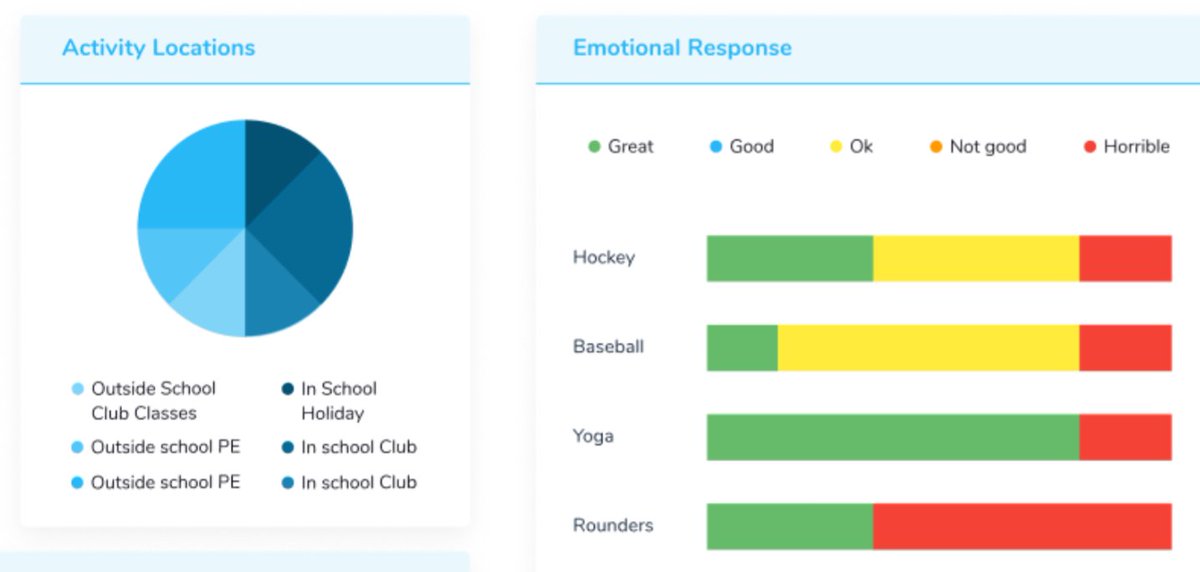
What might we measure? Maybe start with the question asked by @miMoveApp: how did the activity feel? Though needing development, the self-interpretation of "emotional response" is a massive step towards having a lead-indicator measuring attitudes & dispositions 😍 #becausehuman
For more substantial studies, research needs to connect to lead indicators rather than to lag indicators & to build on decades of progress in sense-making - e.g. this approach to crowd-sourcing human judgement, meaning, and feeling @snowded/@CynefinCentre
https://t.co/QK4bmOz4LK
Please note: I am not suggesting this paper is anything other than an exemplary product of our current system. The authors should be applauded for excellent work - but when the context in which research is done leads to such work, we need to ask questions!
https://t.co/uAAJzNvzFh

More from Health

I applaud the #EUCancerPlan *BUT* caution: putting #meat 🥩 (a nourishing, evolutionary food) in the same box as 🚬 to solve a contemporary health challenge, would be basing policy on assumptions rather than robust data.

#FollowTheScience yes, but not just part of it!
THREAD👇


1/ Granted, some studies have pointed to ASSOCIATIONS of HIGH intake of red & processed meats with (slightly!) increased colorectal cancer incidence. Also, @WHO/IARC is often mentioned in support (usually hyperbolically so).

But, let’s have a closer look at all this! 🔍


2/ First, meat being “associated” with cancer is very different from stating that meat CAUSES cancer.

Unwarranted use of causal language is widespread in nutritional sciences, posing a systemic problem & undermining credibility.

3/ That’s because observational data are CONFOUNDED (even after statistical adjustment).

Healthy user bias is a major problem. Healthy middle classes are TOLD to eat less red meat (due to historical rather than rational reasons, cf link). So, they

4/ What’s captured here is sociology, not physiology.

Health-focused Westerners eat less red meat, whereas those who don’t adhere to dietary advice tend to have unhealthier lifestyles.

That tells us very little about meat AS SUCH being responsible for disease.

You May Also Like

1/ Some initial thoughts on personal moats:

Like company moats, your personal moat should be a competitive advantage that is not only durable—it should also compound over time.

Characteristics of a personal moat below:


2/ Like a company moat, you want to build career capital while you sleep.

As Andrew Chen noted:


3/ You don’t want to build a competitive advantage that is fleeting or that will get commoditized

Things that might get commoditized over time (some longer than


4/ Before the arrival of recorded music, what used to be scarce was the actual music itself — required an in-person artist.

After recorded music, the music itself became abundant and what became scarce was curation, distribution, and self space.

5/ Similarly, in careers, what used to be (more) scarce were things like ideas, money, and exclusive relationships.

In the internet economy, what has become scarce are things like specific knowledge, rare & valuable skills, and great reputations.