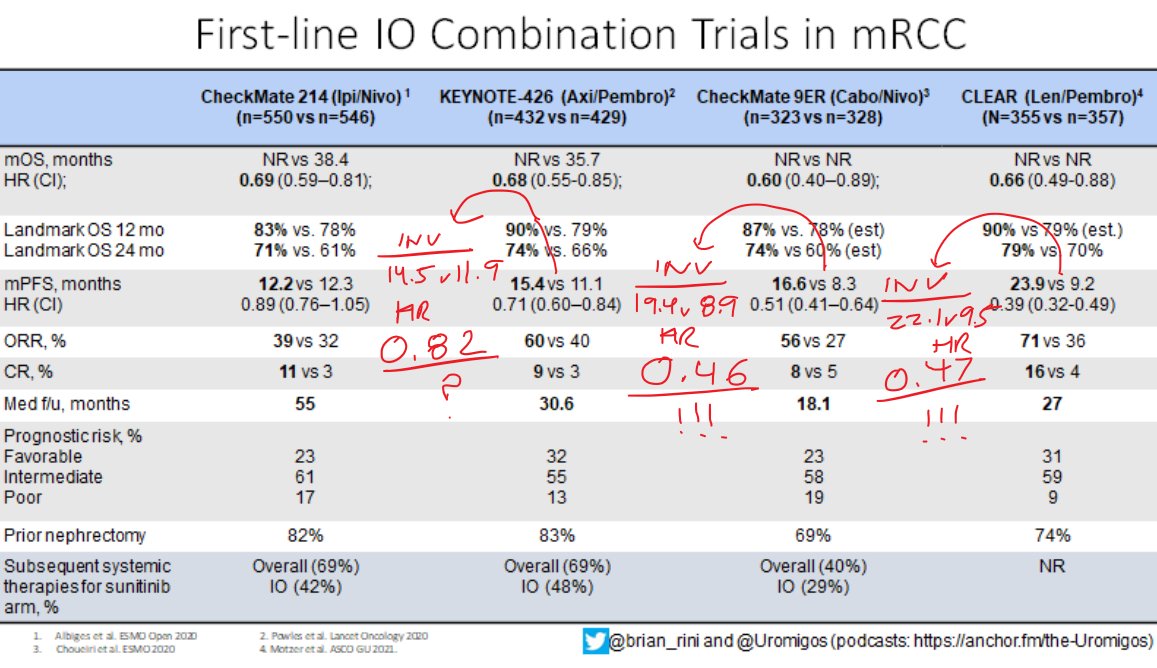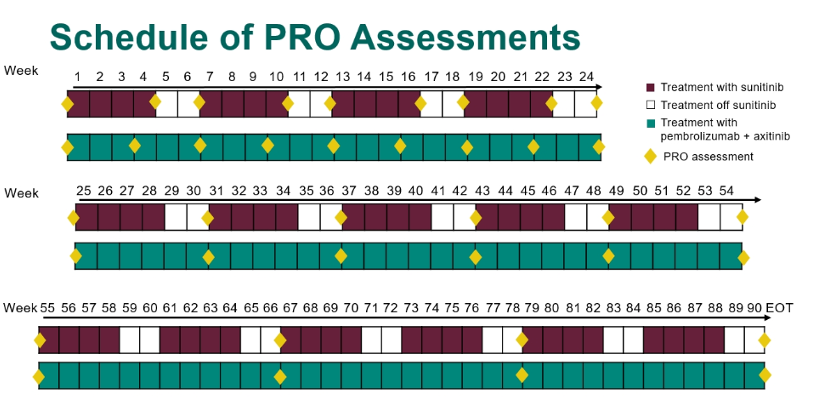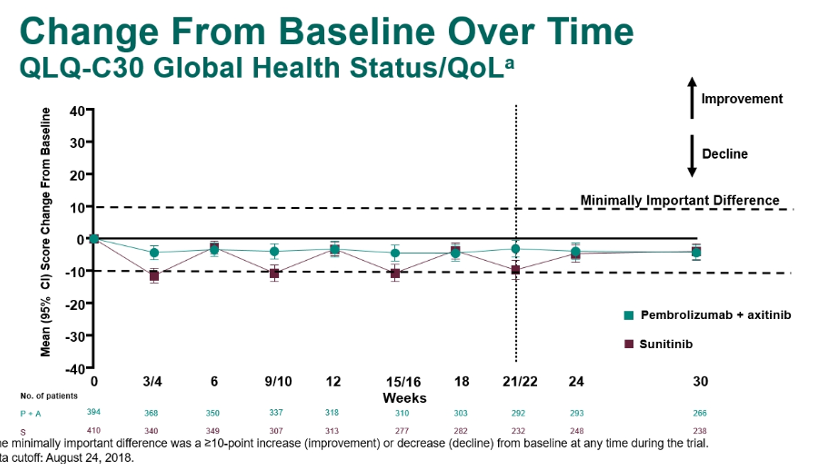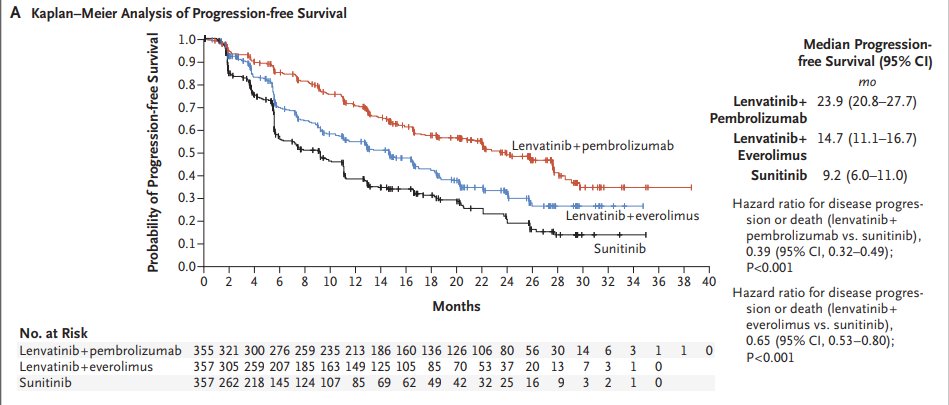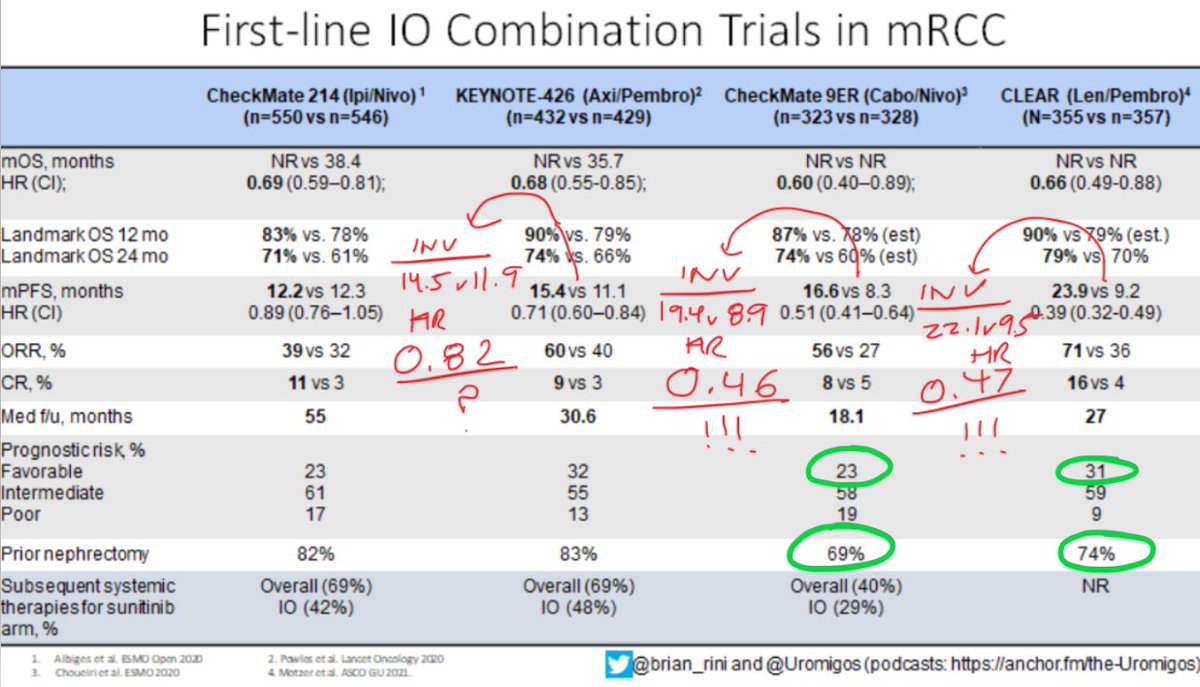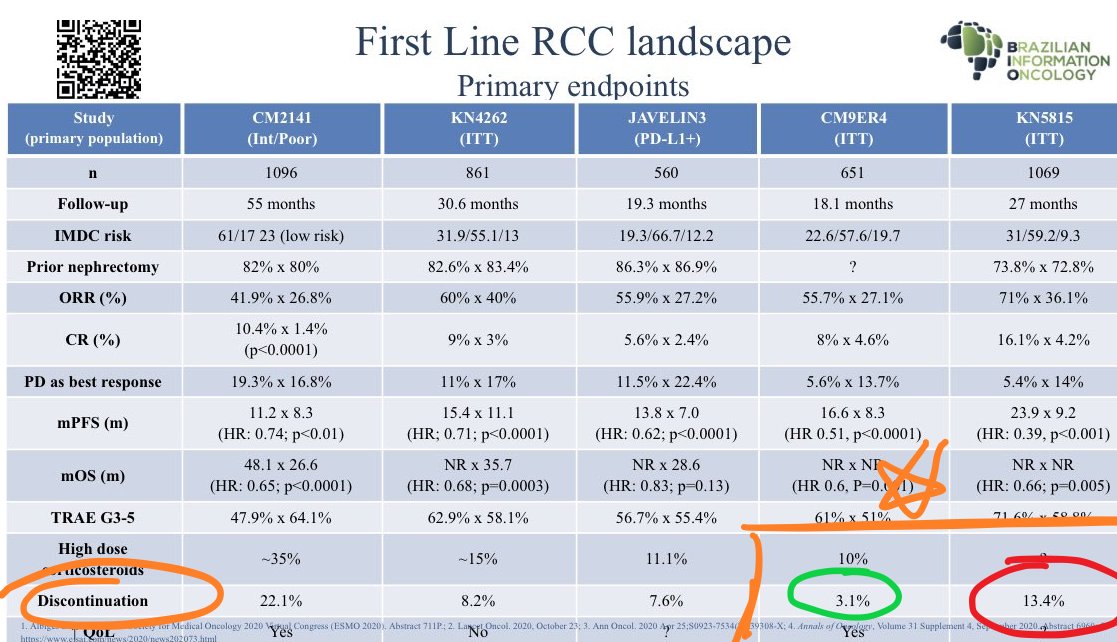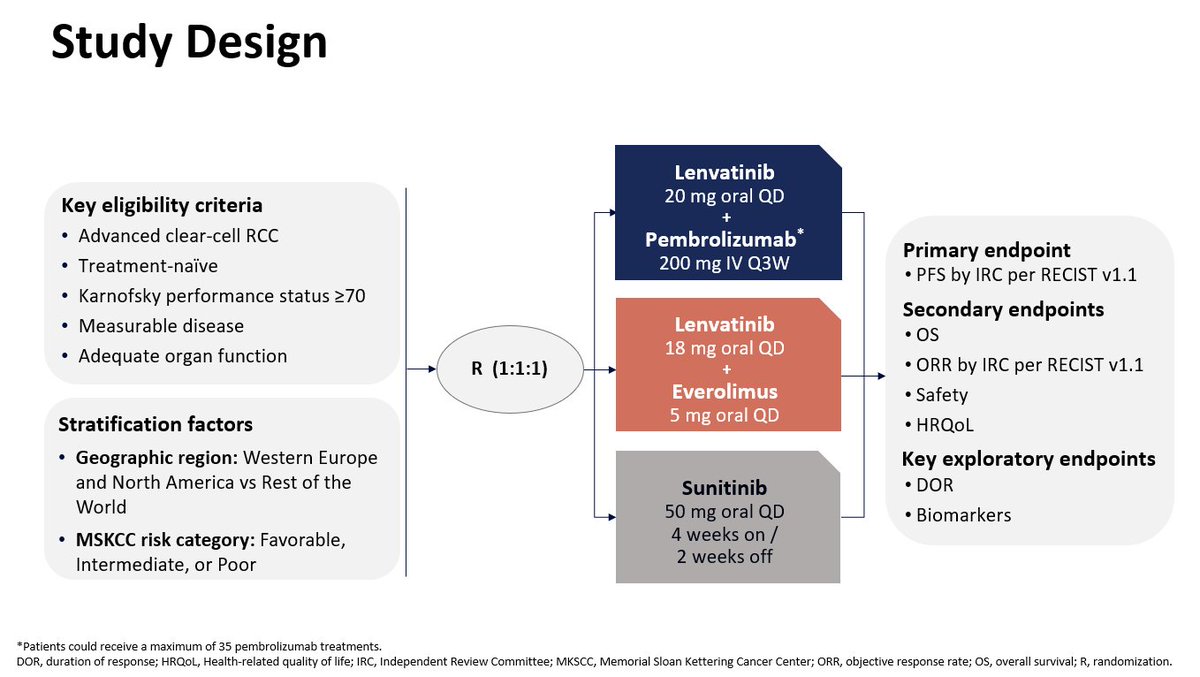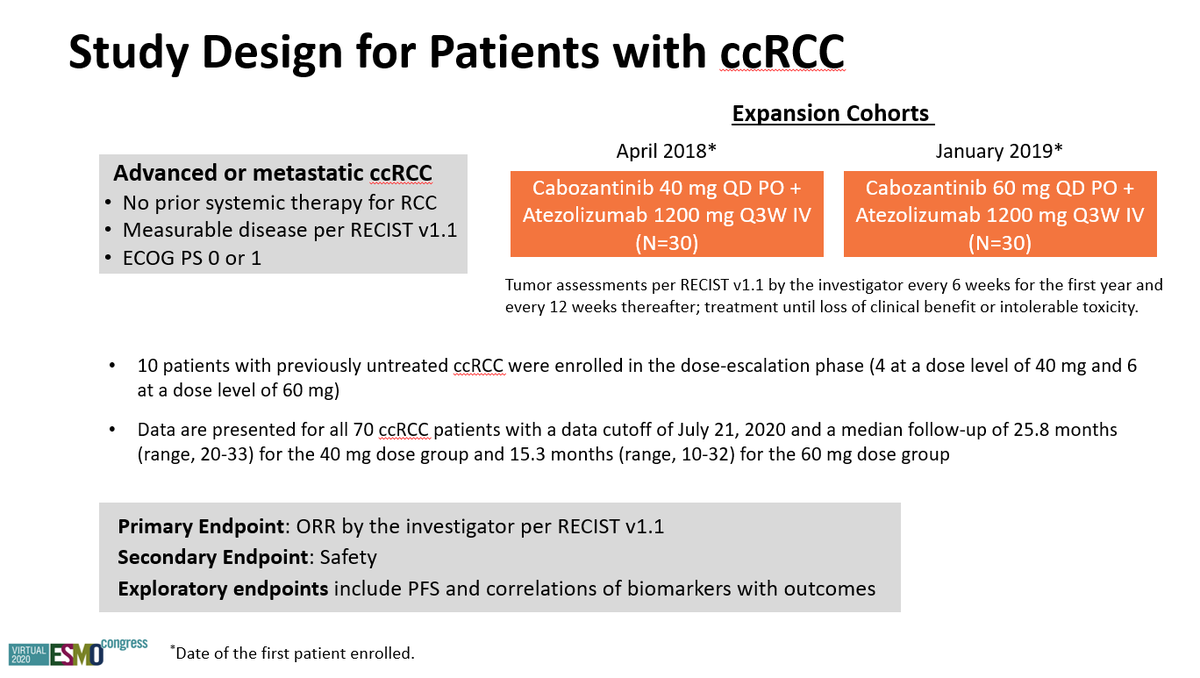
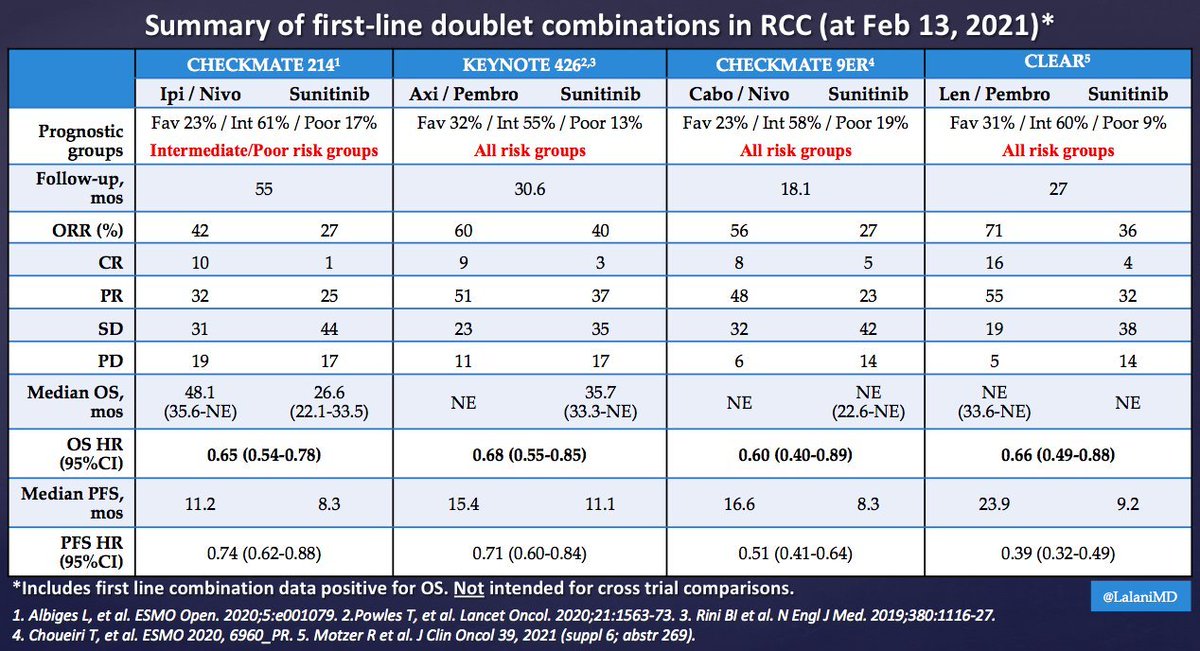
It's Monday AM post-@ASCO #GU21 & clinic starts in a couple of hours! Lots to process - I'll try to tackle optimal 1L tx for #kidneycancer. I'll make a case for cabo/nivo, leaning on the beautiful (& timely) tables below from @lalaniMD, @SoaresAndrey & @brian_rini (1/15)
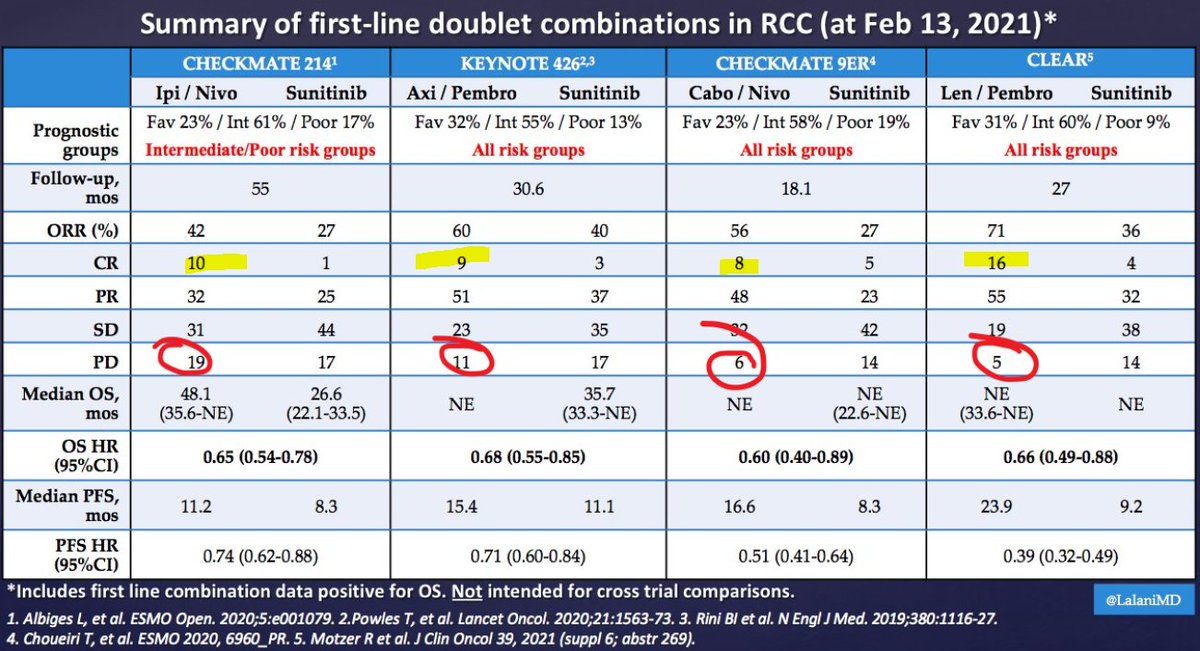
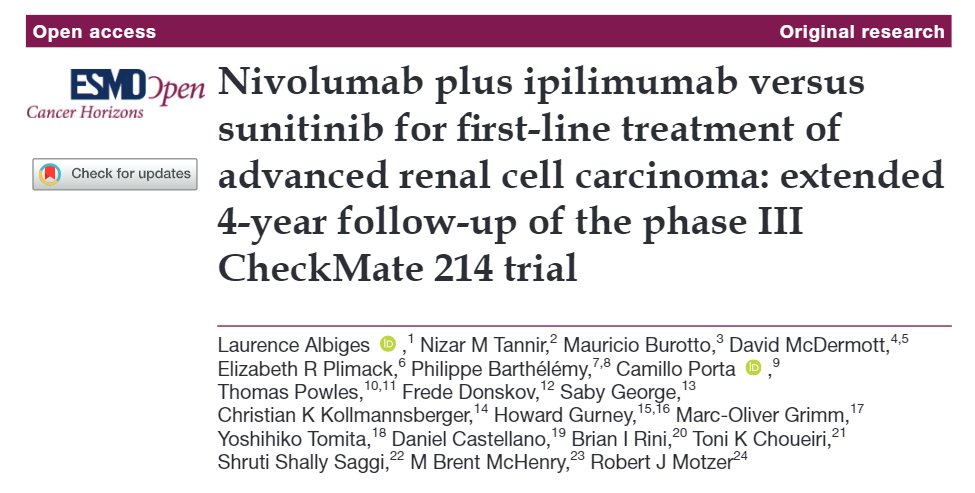
What about IO/IO? We have long f/u w #CM214 data w nivo/ipi, no doubt (@AlbigesL et al in @myESMO Open). And treatment-free interval discussed by McDermott @BIDMChealth is no doubt impt. But we've known data not as impressive for favorable risk (2/15)
And furthermore, as @ERPlimackMD points out in another tweet, impt to look at primary PD rates (seen in @lalaniMD's table) - nivo/ipi at 19%!!! CR rate used to be something we highlighted w nivo/ipi, but now comparable across studies (3/15)
Okay now to the really tough stuff - comparing TKI/IO regimens. Something interesting I will add to @brian_rini @uromigos table above is the HR for PFS by INVESTIGATOR review. If the diff in HR for PFS by IND review caught your eye, this is even more striking (4/15)
I think INV-assessed PFS is impt, but if you're a skeptic, forget that argument. Turn instead to #QOL with axi/pembro. Kudos to @brian_rini @tompowles1 @ERPlimackMD et al for advocating for QOL in KN-426. @crisbergerot et al have taughts us the importance of these metrics. (5/15)
Unfortunately, we're not seeing any improvement in QOL w axi/pembro. This is a bit concerning - if balanced between arms, are we prolonging PFS at the expense of the patient's overall well-being? Inc tumor regression should be accompanied by some symptomatic improvement. (6/15)
Okay, now on to one of the headliners at @ASCO #GU21 this past weekend. The CLEAR study presented by @motzermd @DrChoueiri @DrTHut @tompowles1 @CPRT65 et al. Simultaneously published in @NEJM - congrats friends! (7/15)
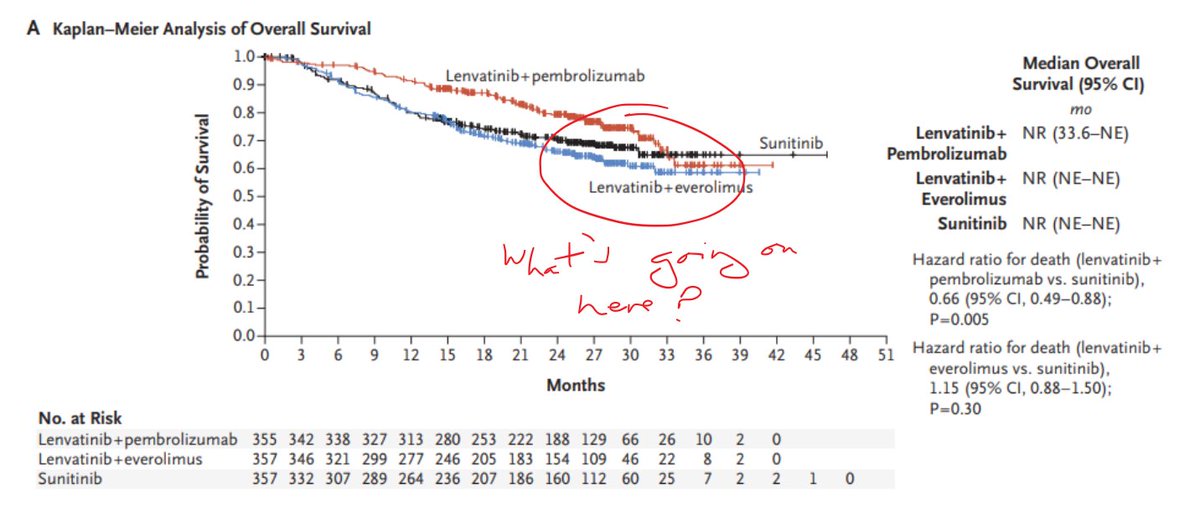
Just one point on the curves, which I heard @tompowles1 bring up on a @Uromigos podcast w @DrChoueiri (of note, I also saw @manuelmaiamd bring this up during @motzermd's presentation in the @ASCO #GU21 pres). Why do the OS curves merge? Not so in #CheckMate9ER! (8/15)
Regardless, some may be swayed by the 16% CR rate with len/pembro. Now HERE is where we need to dive into baseline characteristics. Nearly 10% more fav risk in CLEAR, and also, more pts with prior neph. So, the odds of getting CR (or even PR) stacked against #CheckMate9ER (9/15)
I'll next make the point that LEN IS HARD TO TOLERATE. I'm glad @SoaresAndrey highlights the rate of discontinuation in #CLEAR, which appears much higher than in #CheckMate9ER. I've seen 7al versions of the data, but no matter how you slice it, d/c rate⬆️with len/pembro. (10/15)
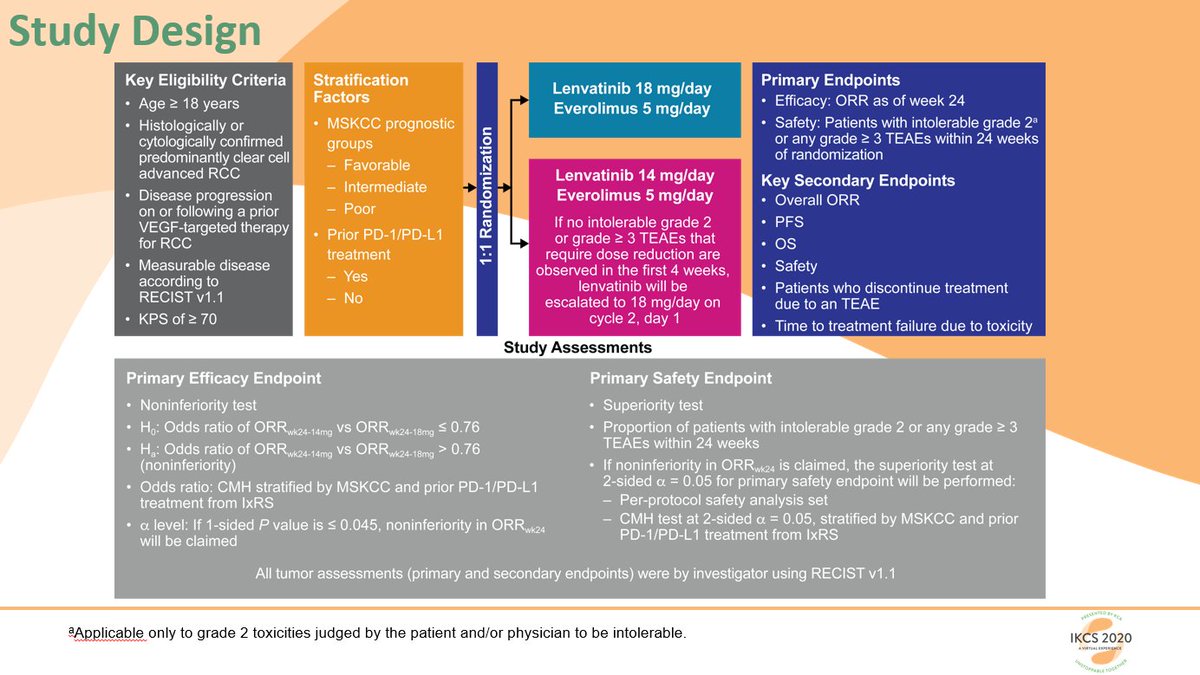
What's my experience with len? I ran a RP2 study w @DrDanielHeng @hipsytips @docjavip et al. We tried to lower dose from 18 to 14 mg & preserve efficacy, but with the caveat of this being a small non-inferiority study, it didn't appear feasible. 👀rates of d/c due to AEs! (11/15)
Remember, I was comparing 18 and 14 mg. The dose in #CLEAR even HIGHER at 20 mg! This is one of those settings where QOL data ESSENTIAL. Remember, our pts are thankfully doing better & will be on drug longer - we need to look out for their GLOBAL well-being! (12/15)
Now THIS is what we need to see. Improved QOL with cabo/nivo, as @DrChoueiri presented at #ESMO20. Remember, the dose of 40 mg is used in #CheckMate9ER - LOWER than the dose of 60 mg used in #METEOR, with cabo as 2L/3L tx. (13/15).
Confession: I was skeptical when @DrChoueiri @motzermd @tompowles1 @apolo_andrea & the brilliant team for #CheckMate9ER chose 40. But @neerajaiims & I have since reported data from #COSMIC021 (cabo/atezo across multiple settings). Efficacy at both doses seems quite good (14/15)
SUMMARY: In 2021, we are blessed w gr8 data from mult 1L trials in #kidneycancer. I feel that cabo/nivo is the way to go; the goalpost is shifted beyond just PFS/RR/OS, we now need QOL! Thx to the amazing data summaries that facilitated this thread. Open to all comments. (15/15)

More from Health

Some thoughts on this: Firstly, it might be personal preference, but I am not keen on this kind of campaign as I feel like it trivialises cancer. Sometimes the serious message gets lost because people are sharing pics of cats or whatever and the important context is gone.


More importantly, the statistic being used in the campaign is misleading. It says 57% of women put off cervical screening if they can't get waxed. But on further investigation, that's not accurate.

The page here goes on to say "57% of women who regularly have their pubic hair professionally removed would put off attending their cervical screening appointment if they hadn’t been able to visit a beauty salon."

So the 57% represents a concern not across the whole population of women, but only those who regularly get waxed. So how big of an issue is this across the whole population? And what else is stopping people getting smears?

I think campaigns for cancer screening are really tricky because there is so much nuance that often doesn't fit into a catchy headline or hashtag. It's certainly not easy and is part of a bigger conversation.

You May Also Like

One of the most successful stock trader with special focus on cash stocks and who has a very creative mind to look out for opportunities in dark times

Covering one of the most unique set ups: Extended moves & Reversal plays

Time for a 🧵 to learn the above from @iManasArora

What qualifies for an extended move?

30-40% move in just 5-6 days is one example of extended move

How Manas used this info to book


Post that the plight of the


Example 2: Booking profits when the stock is extended from 10WMA

10WMA =


Another hack to identify extended move in a stock:

Too many green days!

Read