Categories For later read

6. What about the exception for \u201ccases of impeachment\u201d?
— Steve Vladeck (@steve_vladeck) January 19, 2021
Some argue that this means that no pardons can be issued *while* the President is under impeachment or for offenses by others that are *related* to the basis for an impeachment.
I (and most scholars) strongly disagree.
Is it only limited when the president is impeached and removed? Clinton’s pardons were allowed to stand, after he was impeached by the House—but the impeachment cause was so trivial—& they were also unrelated to the causes of his impeachment.
I actually think that allowing Clinton to grant pardons after impeachment was a big mistake, one that went against the intention of the Constitution, & one that helped to create the current mess. But that narrow precedent stands. What about the longer history & larger question?
After impeachment, President Johnson gave at least two pardons but they were reversed by President Grant immediately afterwards. How many did he give once impeached? Can other historians pipe in?
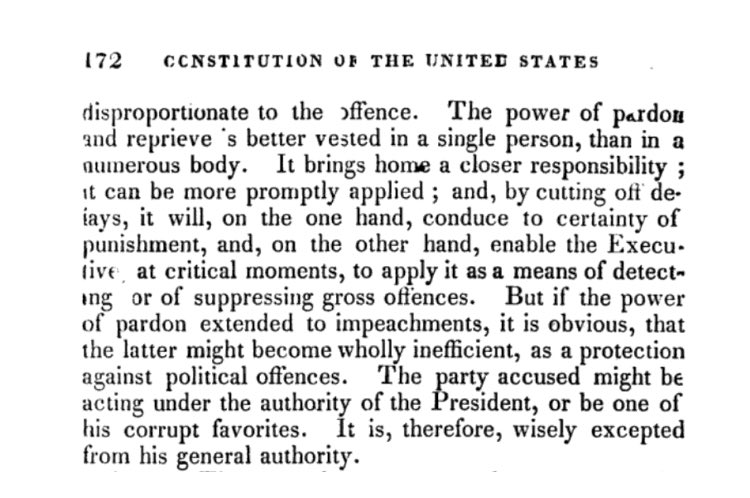
The revised edition of Joseph Story’s textbook of constitutional interpretation, published in 1868, said that presidents cannot pardon after impeachment as such a power “might become ... a protection against political offenses...the party accused might be acting under ...”

Safe? Doesnt exist? No evidence? Decide for yourself I have things to show you...
Dont say I didnt try to tell you...
Over 1900 post & counting...
Parts 1-17 attached...

Part 1 🤔🧐⬇️ 🚨Active Thread🚨

\U0001f914\U0001f9d0\u2b07\ufe0f
— TXgrlWatching \U0001f4bb\U0001f6e1\u2694 (@VeritasTXgem) November 5, 2020
\U0001f6a8Active Thread\U0001f6a8 if you have more please add to the comments but give me a minute this is long.... if you see something say something...
1. Woman arrested in Vanderburgh county for pre checking boxes on 400+ ballotshttps://t.co/TyeyRT72cw


It has made me think through multiple conflicts I have had at work and how "real talk" basically shuts down management.
Did y'all know that a lot of white people don't have the cultural concept of "real talk"? You know where you stop saying the diplomatic thing and tell people what's really going on. They just don't have it. You try to have a moment of "real talk" and they freak the fuck out.
— Marco Rogers (@polotek) January 26, 2021
Like when I was drowning in work, asking for help, and my boss asked me point blank if I wanted to quit and why didn't I ask for help.
I showed her the emails and call logs where I did.
She shut down and walked away.
Or the time a project was going off the rails and I asked my team lead for help.
I explained everything I did so far and was looking for direction on what else to do.
And he said, "I don't want this time to be just you complaining."
So I stopped telling him anything negative.


Great to see AWS providing direct data coupling as a service. https://t.co/TEk8ybPTro
— Sam Newman (@samnewman) January 5, 2021
The service as advertised makes it simple to map a GraphQL definition against a database. Now, what’s the problem with this? Well, the devil here is in the detail. But fundamentally it comes down to how important information hiding is to you.
Information hiding is the concept whereby you expose as little information as possible to external parties. Anything you expose over a boundary becomes part of the contract between provider and consumer.
Anything I hide inside a boundary can be changed freely. Anything I expose must be maintained if I want to maintain backwards compatibility.
Why is backwards compatibility important? If I break compatibility with external consumers of an interface, then such a change can lead to the need to lock step releases of consumer and producer, or even worse accidental breakages in prod.


https://t.co/nx8ZfDB5Bc
Maintaining open-source is brutal, and feeling obligated to acknowledge, review, and respond to every attempt to contribute is a huge burden to carry.
When I saw this tweet from @dhh the other day I couldn't help but s/email/open source contribution/, but it makes me feel horribly guilty to suggest that anyone should feel anything but grateful for unsolicited free work from
You are not obligated to spend even a moment of your precious time on this planet dealing with emails you did not ask for, do not want, and aren't interested in responding to. The unsolicited email is an assault on our natural proclivity to reciprocity.
— DHH (@dhh) January 25, 2021
But the reality is even though folks are generally trying to help by contributing, those contributions still cost the maintainer more than they cost the contributor, in terms of time to review, stress worrying about making time to review, and long term maintenance.
And unlike email where as long as you can convince yourself it's totally fair to not respond to unsolicited email it's okay, on GitHub there's a public counter signaling to the rest of the world that you are a poor steward of your project if you can't keep the number low.
And also unlike email, the only way to ignore something while also dismissing it from your "inbox" is to take an explicit action (closing the issue/PR) that sends a notification to the person, highlighting how rude you are if you don't craft a thoughtful reason for closing.


