Ever hear that old saying "Time is money"? I am about to take you on a journey to show you how [they] have used our understanding of time by connecting it to money to keep US in the matrix.

More from For later read

How I created content in 2020
A thread...
Back in Aug 2016, I started creating content to share my experiences as an entrepreneur.
Over 3 years I had put out 1,200+ hours of content - posting every week without
Little did I know that something I started almost 4 years back would give my life an entirely new direction.
At the end of 2019, my biggest platform was LinkedIn with ~700K followers.
In Jan 2020, I decided to build a team that would help me with the content.
I ran a month long recruitment drive to hire a team of interns.
It comprised 4 detailed rounds - starting with my loved 20 questions, then an assignment, then a WhatsApp video round and finally F2F.
Through 1,200+ applications, I finally selected 6 profiles, starting March.
I am a firm believer in @peterthiel's one task, one person philosophy
So the team was structured such that everyone was responsible for ONLY one task
1. Content ideas
2. Videography
3. Video editing
4. LinkedIn (+TikTok) distribution
5. FB+IG distribution
6. YouTube distribution
A thread...
Back in Aug 2016, I started creating content to share my experiences as an entrepreneur.
Over 3 years I had put out 1,200+ hours of content - posting every week without
August 2016.
— Ankur Warikoo (@warikoo) October 2, 2020
It has been 3 months since LinkedIn had launched its video feature.
And I had been waiting for it to be activated on my profile.
A thread...
Little did I know that something I started almost 4 years back would give my life an entirely new direction.
At the end of 2019, my biggest platform was LinkedIn with ~700K followers.
In Jan 2020, I decided to build a team that would help me with the content.
I ran a month long recruitment drive to hire a team of interns.
It comprised 4 detailed rounds - starting with my loved 20 questions, then an assignment, then a WhatsApp video round and finally F2F.
Through 1,200+ applications, I finally selected 6 profiles, starting March.
I am a firm believer in @peterthiel's one task, one person philosophy
So the team was structured such that everyone was responsible for ONLY one task
1. Content ideas
2. Videography
3. Video editing
4. LinkedIn (+TikTok) distribution
5. FB+IG distribution
6. YouTube distribution





Excited we finally have a draft of this paper, which attempts to provide a 'unifying theory' of the long economic divergence between the Middle East & Western Europe
As we see it, there are 3 recent theories that hit on important aspects of the divergence...
1/
One set of theories focus on the legitimating power of Islam (Rubin, @prof_ahmetkuru, Platteau). This gave religious clerics greater power, which pulled political resources away form those encouraging economic development
But these theories leave some questions unanswered...
2/
Religious legitimacy is only effective if people
care what religious authorities dictate. Given the economic consequences, why do people remain religious, and thereby render religious legitimacy effective? Is religiosity a cause or a consequence of institutional arrangements?
3/
Another set of theories focus on the religious proscriptions of Islam, particular those associated with Islamic law (@timurkuran). These laws were appropriate for the setting they formed but had unforeseeable consequences and failed to change as economic circumstances changed
4/
There are unaddressed questions here, too
Muslim rulers must have understood that Islamic law carried proscriptions that hampered economic development. Why, then, did they continue to use Islamic institutions (like courts) that promoted inefficiencies?
5/
As we see it, there are 3 recent theories that hit on important aspects of the divergence...
1/
New CEPR Discussion Paper - DP15802
— CEPR (@cepr_org) February 14, 2021
Culture, Institutions & the Long Divergence@albertobisin @nyuniversity, Jared Rubin @jaredcrubin @ChapmanU, Avner Seror @SerorAvner @amseaixmars @univamu, Thierry Verdier @PSEinfohttps://t.co/lhs6AJb7jE#CEPR_DE, #CEPR_EH, #CEPR_ITRE pic.twitter.com/FtMzAELljJ
One set of theories focus on the legitimating power of Islam (Rubin, @prof_ahmetkuru, Platteau). This gave religious clerics greater power, which pulled political resources away form those encouraging economic development
But these theories leave some questions unanswered...
2/
Religious legitimacy is only effective if people
care what religious authorities dictate. Given the economic consequences, why do people remain religious, and thereby render religious legitimacy effective? Is religiosity a cause or a consequence of institutional arrangements?
3/
Another set of theories focus on the religious proscriptions of Islam, particular those associated with Islamic law (@timurkuran). These laws were appropriate for the setting they formed but had unforeseeable consequences and failed to change as economic circumstances changed
4/
There are unaddressed questions here, too
Muslim rulers must have understood that Islamic law carried proscriptions that hampered economic development. Why, then, did they continue to use Islamic institutions (like courts) that promoted inefficiencies?
5/

You May Also Like


#sculpture #story -
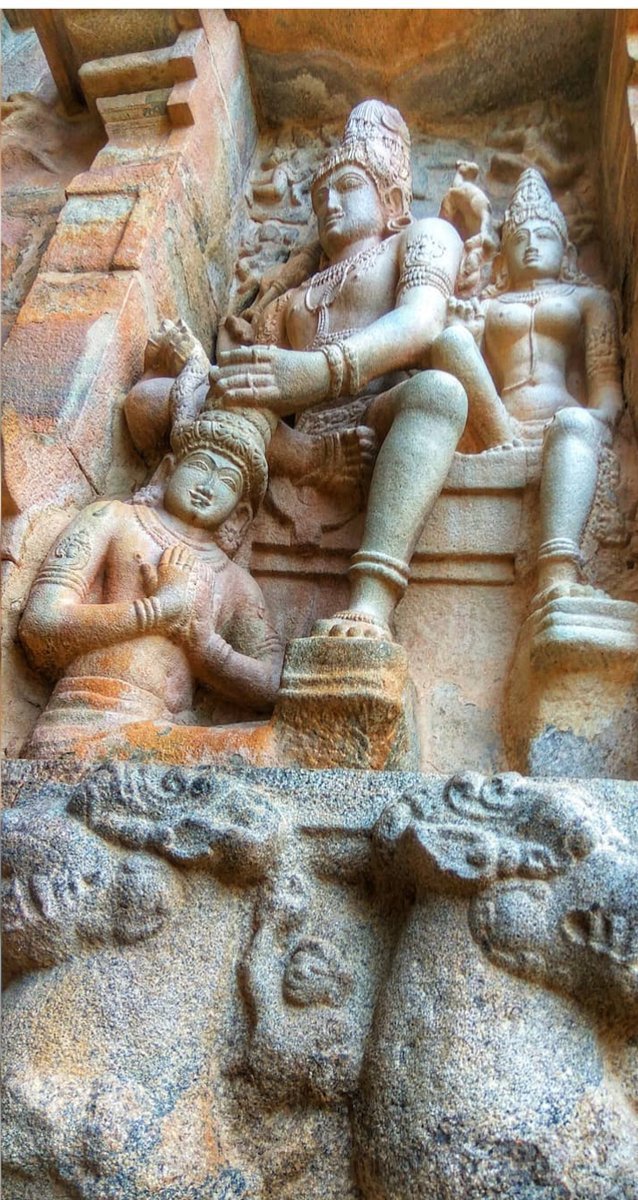
Chandesha-Anugraha Murti - One of the Sculpture in Brihadeshwara Temple at Gangaikonda Cholapuram - built by Raja Rajendra Chola I
This Sculpture depicts Bhagwan Shiva along with Devi Paravathi blessing Chandeshwara - one of the 63 Nayanmars.
#Thread
Chandeshwara/Chandikeshwara is regarded as custodian of Shiva Temple's wealth&most of Shiva temples in South India has separate sannathi for him.
His bhakti for Bhagwan Shiva elevated him as one of foremost among Nayanmars.
He gave importance to Shiva Pooja&protection of cows.
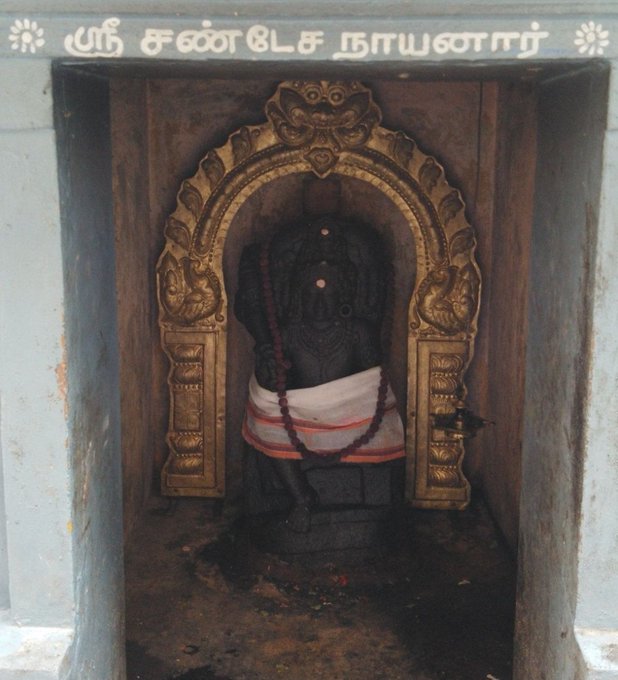
There are series of paintings, illustrating the #story of Chandikeshwar in the premises of
Sri Sathiyagireeswarar #Temple at Seinganur,near Kumbakonam,TN
Chandikeshwara's birth name
is Vichara sarman.He was born in the village of Senganur on the banks of River Manni.
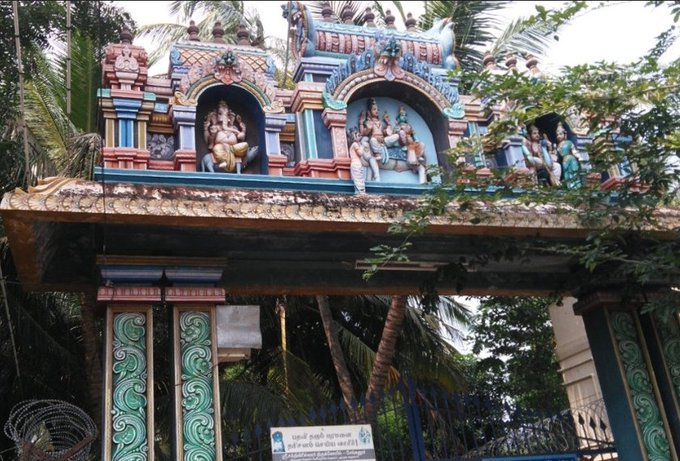
His Parent names were Yajnathatan and Pavithrai.
Vichara Sarman was a gifted child and he learnt Vedas and Agamas at a very young age.
He was very devout and would always think about Bhagwan Shiva.
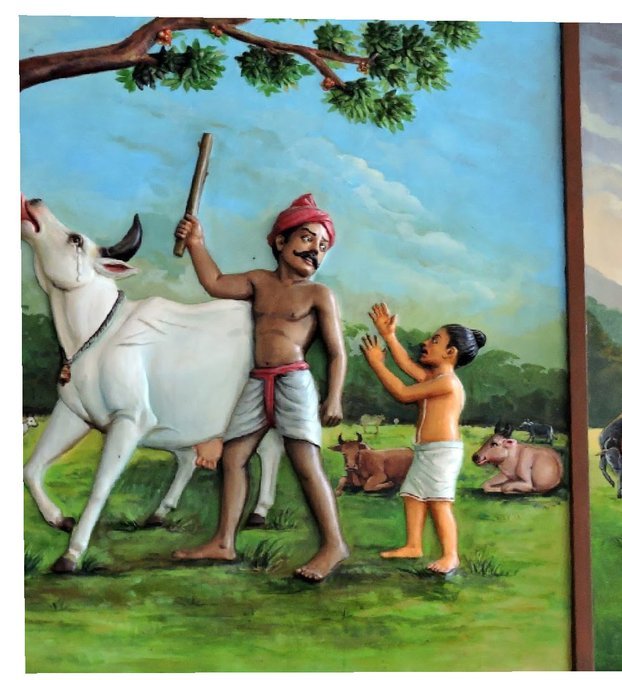
One day he saw a cowherd man brutally assaulting a cow,Vichara Sarman could not tolerate this. He spoke to cowherd: ‘Do you not know that the cow is worshipful & divine? All gods & Devas reside in https://t.co/ElLcI5ppsK it is our duty to protect cows &we should not to harm them.
Chandesha-Anugraha Murti - One of the Sculpture in Brihadeshwara Temple at Gangaikonda Cholapuram - built by Raja Rajendra Chola I
This Sculpture depicts Bhagwan Shiva along with Devi Paravathi blessing Chandeshwara - one of the 63 Nayanmars.
#Thread
Chandeshwara/Chandikeshwara is regarded as custodian of Shiva Temple's wealth&most of Shiva temples in South India has separate sannathi for him.
His bhakti for Bhagwan Shiva elevated him as one of foremost among Nayanmars.
He gave importance to Shiva Pooja&protection of cows.
There are series of paintings, illustrating the #story of Chandikeshwar in the premises of
Sri Sathiyagireeswarar #Temple at Seinganur,near Kumbakonam,TN
Chandikeshwara's birth name
is Vichara sarman.He was born in the village of Senganur on the banks of River Manni.
His Parent names were Yajnathatan and Pavithrai.
Vichara Sarman was a gifted child and he learnt Vedas and Agamas at a very young age.
He was very devout and would always think about Bhagwan Shiva.
One day he saw a cowherd man brutally assaulting a cow,Vichara Sarman could not tolerate this. He spoke to cowherd: ‘Do you not know that the cow is worshipful & divine? All gods & Devas reside in https://t.co/ElLcI5ppsK it is our duty to protect cows &we should not to harm them.