https://t.co/ZNEBudrssi
Thread: A look back at the top 10 most-read @undarkmag stories published in 2020, starting with…
https://t.co/ZNEBudrssi
https://t.co/KR1xW0qt8H
https://t.co/6jx7sEptGB
https://t.co/ZzLihsMtaQ
https://t.co/SKbk0dAagj
https://t.co/U8gNoGY5KB
https://t.co/XnPyBckR0V
https://t.co/JqjXpqjmLt
https://t.co/NiaXrDO485
https://t.co/Osh0NX7Zkl
https://t.co/Hp0GgmXPSU
More from For later read

1. A little DRASTIC Project you may be able to help with?
We want to collate all references to DRASTIC in academic papers & media articles
Here are a few:
medium article by @emmecola
thorough report by @netpoette
@ColinDavdButler 's Paper
Please add any links to this thread. Tks!

2. More References
Papers by @MonaRahalkar and @BahulikarRahul
Papers by @Rossana38510044 and @ydeigin
Medium articles & papers by
@gdemaneuf & @Rdemaistre
Papers by @flavinkins (Daoyu Zhang)
Papers by "Anon" & "interneperson"
French News - le Monde
Can anyone remember any more?
3. More References
Papers & Blog Posts by @Harvard2H (Sirotkin & Sirotkin)
260 Questions for WHO collated by @billybostickson
If you find mentions of our individual names or "DRASTIC" in Papers or News, please forward here to this thread as links or screenshots.
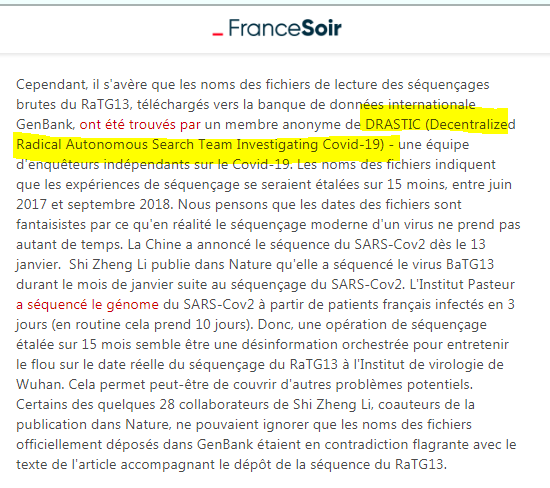
Histoire du COVID-19 – chapitre 6 - Partie 2 : Pourquoi le séquençage complet du virus RaTG13 n'a pas été communiqué par Shi Zheng Li avant février 2020 ? https://t.co/MYEZZSAzaE
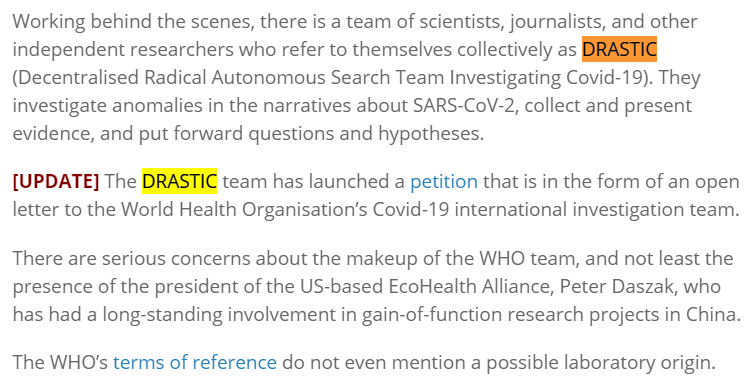
SARS-CoV-2: lab-origin hypothesis gains traction
BY ANNETTE GARTLAND ON OCTOBER 12, 2020
https://t.co/sPs1y8Herg
We want to collate all references to DRASTIC in academic papers & media articles
Here are a few:
medium article by @emmecola
thorough report by @netpoette
@ColinDavdButler 's Paper
Please add any links to this thread. Tks!
2. More References
Papers by @MonaRahalkar and @BahulikarRahul
Papers by @Rossana38510044 and @ydeigin
Medium articles & papers by
@gdemaneuf & @Rdemaistre
Papers by @flavinkins (Daoyu Zhang)
Papers by "Anon" & "interneperson"
French News - le Monde
Can anyone remember any more?
3. More References
Papers & Blog Posts by @Harvard2H (Sirotkin & Sirotkin)
260 Questions for WHO collated by @billybostickson
If you find mentions of our individual names or "DRASTIC" in Papers or News, please forward here to this thread as links or screenshots.
Histoire du COVID-19 – chapitre 6 - Partie 2 : Pourquoi le séquençage complet du virus RaTG13 n'a pas été communiqué par Shi Zheng Li avant février 2020 ? https://t.co/MYEZZSAzaE
SARS-CoV-2: lab-origin hypothesis gains traction
BY ANNETTE GARTLAND ON OCTOBER 12, 2020
https://t.co/sPs1y8Herg


@snip96581187 @Daoyu15 @lab_leak @walkaboutrick @ydeigin @Ayjchan @franciscodeasis @TheSeeker268 @angie_rasmussen Clearly, because as I have been saying for 8 months now, DTRA and DARPA have been using Ecohealth and UC Davis to collect novel pathogens for gain of function work back in the USA. I have documented this in many threads which I will post here just to annoy everyone.
@Daoyu15 @lab_leak @walkaboutrick @ydeigin @Ayjchan @franciscodeasis @TheSeeker268 @angie_rasmussen
@Daoyu15 @lab_leak @walkaboutrick @ydeigin @Ayjchan @franciscodeasis @TheSeeker268 @angie_rasmussen
@Daoyu15 @lab_leak @walkaboutrick @ydeigin @Ayjchan @franciscodeasis @TheSeeker268 @angie_rasmussen
@Daoyu15 @lab_leak @walkaboutrick @ydeigin @Ayjchan @franciscodeasis @TheSeeker268 @angie_rasmussen
@Daoyu15 @lab_leak @walkaboutrick @ydeigin @Ayjchan @franciscodeasis @TheSeeker268 @angie_rasmussen
28. Before moving on to DARPA, let's look at DTRA:
— Billy Bostickson \U0001f3f4\U0001f441&\U0001f441 \U0001f193 (@BillyBostickson) July 31, 2020
A must read!
It is astonishing the number of pies they had their dirty little fingers poking into:
Note John Epstein and Kevin Olival from EcoHealth Alliance are key figures in DTRA:https://t.co/O4QwVWrm7m pic.twitter.com/cnNGZ7AApj
@Daoyu15 @lab_leak @walkaboutrick @ydeigin @Ayjchan @franciscodeasis @TheSeeker268 @angie_rasmussen
24. DTRA Network for Collection of Viruses
— Billy Bostickson \U0001f3f4\U0001f441&\U0001f441 \U0001f193 (@BillyBostickson) January 9, 2021
7. DTRA - Metabiota - One Health - Ecohealth
Bat Research Networks and Viral Surveillance: Gaps and Opportunities in Western Asia pic.twitter.com/SOqSSXF3pa
@Daoyu15 @lab_leak @walkaboutrick @ydeigin @Ayjchan @franciscodeasis @TheSeeker268 @angie_rasmussen
That is the key question
— Billy Bostickson \U0001f3f4\U0001f441&\U0001f441 \U0001f193 (@BillyBostickson) January 5, 2021
1. DARPA/DTRA use NGOs like Ecohealth or Metabiota to collect new pathogens
2. They are sent to US labs (Mailman, Rocky Mountain, Atlanta CDC, UNC, USAMRIID) for GOF work by Lipkin, Nichols, Rasmussen, Baric, Dension, Munster, etchttps://t.co/wqhHK7uZO6
@Daoyu15 @lab_leak @walkaboutrick @ydeigin @Ayjchan @franciscodeasis @TheSeeker268 @angie_rasmussen
1. I wonder why Dr. Angela Rasmussen is so so upset & full of almost palpable venom about a Hypothesis and a "What if" question by @nicholsonbaker8 in the @NYMag https://t.co/a6lxtJLpKR
— Billy Bostickson \U0001f3f4\U0001f441&\U0001f441 \U0001f193 (@BillyBostickson) January 5, 2021
Did I hear someone say "DARPA"?
Did I hear someone say "DTRA"?https://t.co/i27mpxJDw2 pic.twitter.com/x4X3QPnTMS