
Going to have to disagree with my learned friend here. If anyone moved on level playing field it was the UK, on the principle of a ratchet, or tariffs for divergence which was still being denied midweek. Changing the way in this might be achieved (many options) is insignificant.
Fish was never a deal breaker. Level playing field was
— Mujtaba Rahman (@Mij_Europe) December 14, 2020
But LPF now more likely to come together after @EU_Commission move (on trade test for unlocking remedial measures & scope of arbitration over remedial measures)
If it does, expect deal on \U0001f420\U0001f421 too
Second, I still maintain that Johnson has not made a decision here. Some days he leans towards Deal, sometimes towards No Deal
— Jon Worth (@jonworth) December 14, 2020
He has been stuck for weeks, and still is. He\u2019d ideally just not decide *anything*
Is it reasonable to argue there was a movement of principle (UK) and a movement of process (EU)?
— Objective Columnist (@Sime0nStylites) December 14, 2020
Mention in @alexwickham London Playbook for the Boris Johnson TV interview yesterday - and heard similar about the half a dozen outstanding issues mentioned in my 10pm live \U0001f447 https://t.co/oC4jRedx2z pic.twitter.com/ogDpDL3jHg
— Sam Coates Sky (@SamCoatesSky) December 14, 2020
More from David Henig
So many stories of new barriers to trade between UK and EU, but you might be thinking at some point these will run out. The government is certainly hoping so. Well they may slow down, but trade relations and regulations are not static, and changes will lead to further problems.
The likelihood of continued trade problems for a £650 bn trade relationship is why there should be a huge cross-government effort led by the Foreign Office and Department for International Trade to put in place the necessary resources to seek best results.
There isn't.
So the UK's relationship with the EU currently consists of two not particularly good deals and no consistent effort to manage current problems or prevent future ones. Joint committees are a second order problem to putting in place the right internal structures.
But that's been the consistent UK problem in relations with the EU since 2016. Lack of focus on getting the right internal structures, people, asks, strategy, too much attention on being tough and a single leader.
News just in. This doesn't necessarily mean the right structure being put into UK-EU relations. I suspect Frost's main role is to ensure no renegotiations with the EU.
Also, wonder what this says about the PM's trust in Michael Gove?
The likelihood of continued trade problems for a £650 bn trade relationship is why there should be a huge cross-government effort led by the Foreign Office and Department for International Trade to put in place the necessary resources to seek best results.
There isn't.
So the UK's relationship with the EU currently consists of two not particularly good deals and no consistent effort to manage current problems or prevent future ones. Joint committees are a second order problem to putting in place the right internal structures.
But that's been the consistent UK problem in relations with the EU since 2016. Lack of focus on getting the right internal structures, people, asks, strategy, too much attention on being tough and a single leader.
News just in. This doesn't necessarily mean the right structure being put into UK-EU relations. I suspect Frost's main role is to ensure no renegotiations with the EU.
Also, wonder what this says about the PM's trust in Michael Gove?
NEW: David Frost is joining Boris Johnson\u2019s Cabinet! The peer has been appointed a minister at the Cabinet Office, effective March 1.
— Sebastian Payne (@SebastianEPayne) February 17, 2021
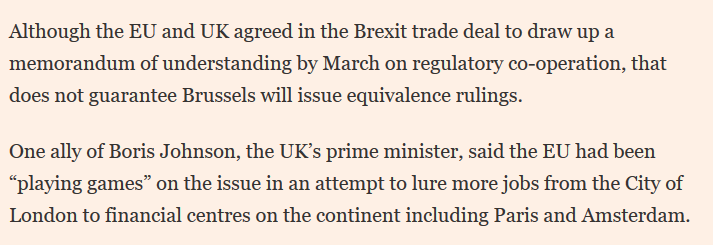
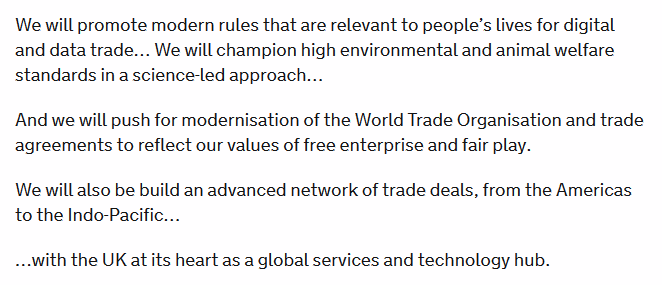
Frost will also chair the partnership council overseeing the UK-EU trade deal and oversee reform to "maximise on the opportunities of Brexit"

More from For later read


Humans inherently like the act of solidarity. We are social beings. We like to huddle up and be together.
They used this against us.
They convinced us that it was an act of solidarity to flatten the curve, to wear a mask for others, to take the vaccines for others,
and to reach #covidzero for others. They convinced us that this was for the greater good of society.
In reality, this couldn't be further away from the truth. They have divided us and broken the core structure of our society. They have dehumanized us with their masks.
They set us against each other into clans on opposite sides of a spectrum. They have turned us into aggressive beings fighting for our survival. Some of us fear harm from the virus, others fear harm from the vaccine, and yet others fear harm from the attack on our civilization.
We are all on a flight or fight mode. We are all operating under the influence of fear. We must collect ourselves and reflect on what has happened over the last year.
How is this for the greater good of society?
They used a tactical warfare strategy against us.
'Divide and conquer'.
We fell for it.
Now we must become aware of it and fight back.
We must reunite. We must find true solidarity to save our world. To free ourselves. To regain our autonomy.
They used this against us.
They convinced us that it was an act of solidarity to flatten the curve, to wear a mask for others, to take the vaccines for others,
If there was ever a time in our lifetime to be non-partisan and for citizens of all walks of life globally to unite behind the basic fundamentals of humanity, freedoms, liberties, human rights, sovereignty, autonomy, dignity, empathy and compassion: it is now. https://t.co/Fa3ieEq51x
— Kulvinder Kaur MD (@dockaurG) January 9, 2021
and to reach #covidzero for others. They convinced us that this was for the greater good of society.
In reality, this couldn't be further away from the truth. They have divided us and broken the core structure of our society. They have dehumanized us with their masks.
They set us against each other into clans on opposite sides of a spectrum. They have turned us into aggressive beings fighting for our survival. Some of us fear harm from the virus, others fear harm from the vaccine, and yet others fear harm from the attack on our civilization.
We are all on a flight or fight mode. We are all operating under the influence of fear. We must collect ourselves and reflect on what has happened over the last year.
How is this for the greater good of society?
They used a tactical warfare strategy against us.
'Divide and conquer'.
We fell for it.
Now we must become aware of it and fight back.
We must reunite. We must find true solidarity to save our world. To free ourselves. To regain our autonomy.

Nice to discover Judea Pearl ask a fundamental question. What's an 'inductive bias'?
I crucial step on the road towards AGI is a richer vocabulary for reasoning about inductive biases.
explores the apparent impedance mismatch between inductive biases and causal reasoning. But isn't the logical thinking required for good causal reasoning also not an inductive bias?
An inductive bias is what C.S. Peirce would call a habit. It is a habit of reasoning. Logical thinking is like a Platonic solid of the many kinds of heuristics that are discovered.
The kind of black and white logic that is found in digital computers is critical to the emergence of today's information economy. This of course is not the same logic that drives the general intelligence that lives in the same economy.
Help! What precisely is "inductive bias"? Some ML researchers are in the opinion that the machine learning category of \u2018inductive biases\u2019 can allow us to build a causal understanding of the world. My Ladder of Causation says: "This is mathematically impossible". Who is right? 1/
— Judea Pearl (@yudapearl) February 14, 2021
I crucial step on the road towards AGI is a richer vocabulary for reasoning about inductive biases.
explores the apparent impedance mismatch between inductive biases and causal reasoning. But isn't the logical thinking required for good causal reasoning also not an inductive bias?
An inductive bias is what C.S. Peirce would call a habit. It is a habit of reasoning. Logical thinking is like a Platonic solid of the many kinds of heuristics that are discovered.
The kind of black and white logic that is found in digital computers is critical to the emergence of today's information economy. This of course is not the same logic that drives the general intelligence that lives in the same economy.

I’ve asked Byers to clarify, but as I read this tweet, it seems that Bret Stephens included an unredacted use of the n-word in his column this week to make a point, and the column got spiked—maybe as a result?
Four times. The column used the n-word (in the context of a quote) four times. https://t.co/14vPhQZktB
For context: In 2019, a Times reporter was reprimanded for several incidents of racial insensitivity on a trip with high school students, including one in which he used the n-word in a discussion of racial slurs.
That incident became public late last month, and late last week, after 150 Times employees complained about how it had been handled, the reporter in question resigned.
In the course of all that, the Times' executive editor said that the paper does not "tolerate racist language regardless of intent.” This was the quote that Bret Stephens was pushing back against in his column. (Which, again, was deep-sixed by the paper.)
Stephens goes on in his column (which never saw light of day) to cite famous Lee Atwater quote that uses racial slur, and which NYT has cited \u201cat least seven times.\u201d
— Dylan Byers (@DylanByers) February 11, 2021
"Is this now supposed to be a scandal?\u201d he asks.
...
Four times. The column used the n-word (in the context of a quote) four times. https://t.co/14vPhQZktB
That is correct. In his draft he quotes Atwater using the word (4 times) and he does not redact it.
— Dylan Byers (@DylanByers) February 11, 2021
For context: In 2019, a Times reporter was reprimanded for several incidents of racial insensitivity on a trip with high school students, including one in which he used the n-word in a discussion of racial slurs.
That incident became public late last month, and late last week, after 150 Times employees complained about how it had been handled, the reporter in question resigned.
In the course of all that, the Times' executive editor said that the paper does not "tolerate racist language regardless of intent.” This was the quote that Bret Stephens was pushing back against in his column. (Which, again, was deep-sixed by the paper.)
You May Also Like

1/x Fort Detrick History
Mr. Patrick, one of the chief scientists at the Army Biological Warfare Laboratories at Fort Detrick in Frederick, Md., held five classified US patents for the process of weaponizing anthrax.
2/x
Under Mr. Patrick’s direction, scientists at Fort Detrick developed a tularemia agent that, if disseminated by airplane, could cause casualties & sickness over 1000s mi². In a 10,000 mi² range, it had 90% casualty rate & 50% fatality rate
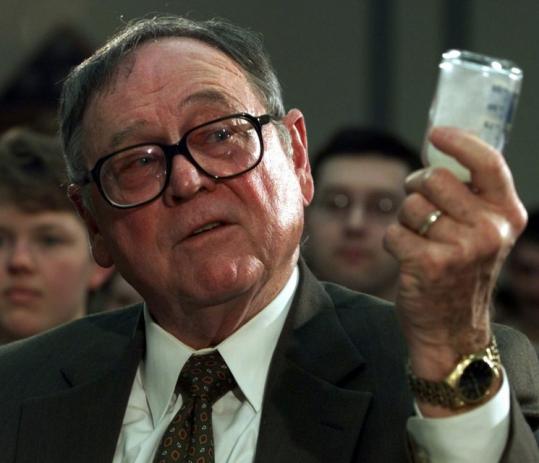
3/x His team explored Q fever, plague, & Venezuelan equine encephalitis, testing more than 20 anthrax strains to discern most lethal variety. Fort Detrick scientists used aerosol spray systems inside fountain pens, walking sticks, light bulbs, & even in 1953 Mercury exhaust pipes

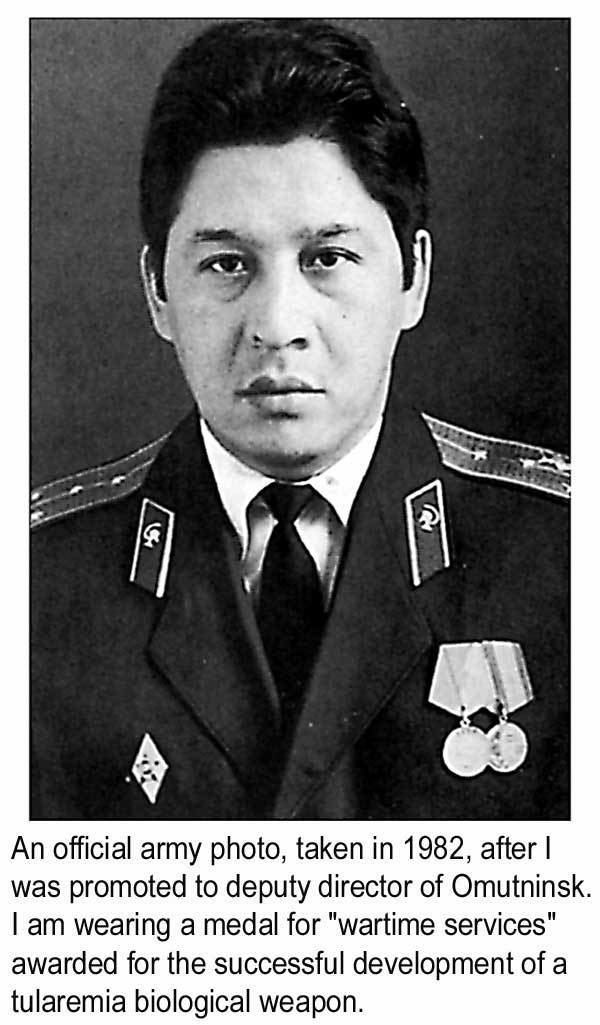
4/x After retiring in 1986, Mr. Patrick remained one of the world’s foremost specialists on biological warfare & was a consultant to the CIA, FBI, & US military. He debriefed Soviet defector Ken Alibek, the deputy chief of the Soviet biowarfare program
https://t.co/sHqSaTSqtB
5/x Back in Time
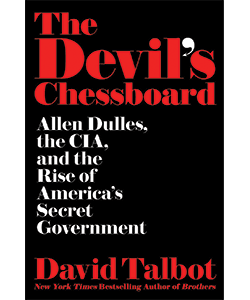
In 1949 the Army created a small team of chemists at "Camp Detrick" called Special Operations Division. Its assignment was to find military uses for toxic bacteria. The coercive use of toxins was a new field, which fascinated Allen Dulles, later head of the CIA
Mr. Patrick, one of the chief scientists at the Army Biological Warfare Laboratories at Fort Detrick in Frederick, Md., held five classified US patents for the process of weaponizing anthrax.
2/x
Under Mr. Patrick’s direction, scientists at Fort Detrick developed a tularemia agent that, if disseminated by airplane, could cause casualties & sickness over 1000s mi². In a 10,000 mi² range, it had 90% casualty rate & 50% fatality rate
3/x His team explored Q fever, plague, & Venezuelan equine encephalitis, testing more than 20 anthrax strains to discern most lethal variety. Fort Detrick scientists used aerosol spray systems inside fountain pens, walking sticks, light bulbs, & even in 1953 Mercury exhaust pipes
4/x After retiring in 1986, Mr. Patrick remained one of the world’s foremost specialists on biological warfare & was a consultant to the CIA, FBI, & US military. He debriefed Soviet defector Ken Alibek, the deputy chief of the Soviet biowarfare program
https://t.co/sHqSaTSqtB
5/x Back in Time
In 1949 the Army created a small team of chemists at "Camp Detrick" called Special Operations Division. Its assignment was to find military uses for toxic bacteria. The coercive use of toxins was a new field, which fascinated Allen Dulles, later head of the CIA

"I lied about my basic beliefs in order to keep a prestigious job. Now that it will be zero-cost to me, I have a few things to say."
We know that elite institutions like the one Flier was in (partial) charge of rely on irrelevant status markers like private school education, whiteness, legacy, and ability to charm an old white guy at an interview.
Harvard's discriminatory policies are becoming increasingly well known, across the political spectrum (see, e.g., the recent lawsuit on discrimination against East Asian applications.)
It's refreshing to hear a senior administrator admits to personally opposing policies that attempt to remedy these basic flaws. These are flaws that harm his institution's ability to do cutting-edge research and to serve the public.
Harvard is being eclipsed by institutions that have different ideas about how to run a 21st Century institution. Stanford, for one; the UC system; the "public Ivys".
As a dean of a major academic institution, I could not have said this. But I will now. Requiring such statements in applications for appointments and promotions is an affront to academic freedom, and diminishes the true value of diversity, equity of inclusion by trivializing it. https://t.co/NfcI5VLODi
— Jeffrey Flier (@jflier) November 10, 2018
We know that elite institutions like the one Flier was in (partial) charge of rely on irrelevant status markers like private school education, whiteness, legacy, and ability to charm an old white guy at an interview.
Harvard's discriminatory policies are becoming increasingly well known, across the political spectrum (see, e.g., the recent lawsuit on discrimination against East Asian applications.)
It's refreshing to hear a senior administrator admits to personally opposing policies that attempt to remedy these basic flaws. These are flaws that harm his institution's ability to do cutting-edge research and to serve the public.
Harvard is being eclipsed by institutions that have different ideas about how to run a 21st Century institution. Stanford, for one; the UC system; the "public Ivys".






Facebook originally a CIA program called "LifeLog".
LifeLog, via DARPA, terminated on Feb 4th, 2004.
Facebook was launched on Feb 4th, 2004.
Many of the LifeLog team became execs at FB.
Zuckerberg is a figurehead.
CIA allowed Cambridge to help Trump win
https://t.co/enzOXDCogV

Pentagon Kills LifeLog
LifeLog, via DARPA, terminated on Feb 4th, 2004.
Facebook was launched on Feb 4th, 2004.
Many of the LifeLog team became execs at FB.
Zuckerberg is a figurehead.
CIA allowed Cambridge to help Trump win
https://t.co/enzOXDCogV
Project: Lifelog
— Robert Horan (@Robby12692) December 13, 2018
Started by DARPA in 1999, the goal of Lifelog was to create a database on civilians without their knowledge, and track everything they do.
The project "ended" on Feb 4th, 2004.
Facebook began the exact same day.
The CIA funneled tens of millions into Facebook. pic.twitter.com/r7hwF0v9kh
Pentagon Kills LifeLog