
So what is a cult? What are the hallmarks of extremism? The Oxford Dictionary defines a cult as “a system of religious veneration and devotion /2
“Fanatical Remainers and the FBPE cult”: a thread
The populist right seems to be intensifying its efforts to portray supporters of EU membership as some sort of lunatic fringe. (Never-knowingly-impartial @afneil and billionaires’ stooge @darrengrimes_ are among (1/20-ish)
So what is a cult? What are the hallmarks of extremism? The Oxford Dictionary defines a cult as “a system of religious veneration and devotion /2
According to Janja Lalich PhD, a sociologist who specialises in cults and extremist groups, a cult is “a group or movement held together by a shared commitment to a charismatic leader or ideology. It has a belief system /4
“Cults tend to be founded by charismatic leaders … great manipulators. They know how to read people. They come along and offer a message /5
Further signs of culthood as identified by Dr Lalich and other experts may include, but are not limited to:
• Inculcation of loyalty and unity by inventing and exaggerating external threats. Outgroups are demonised and dehumanised, and /6
• As well as messianic leader figures and satanic enemies, cults often feature speculation about some sort of apocalypse.
• Stereotyping and caricaturing of perceived ideological foes. /7
• Reductive, Manichean view of the world: believers are the good guys, and everyone else is either evil, stupid, or brainwashed.
• Vague promises about making things better, but little detail. /8
• Simple solutions to complex problems.
• Language heavily laden with emotion.
• Frequent appeals to glorious former times, tradition, and culture.
• Prohibition of challenging, questioning or disbelieving their high priests. /9
• Discouragement of independent thought. Cult followers are not permitted to have insights, /10
• Cult members are invited to frequent mass gatherings where the charismatic leaders give rousing, /11
• There is no truth but the cultists’ truth. Followers must believe the word of their high priests over the evidence of their own eyes.
Now, who does all this remind you of?
Charismatic leaders: Farage, Rees-Mogg, Johnson /12
Antichrists: Jean-Claude Juncker, Angela Merkel, Sadiq Khan, George Soros, Bill Gates
Apocalypse: “The EU is collapsing”, “Our culture is being destroyed”, /13
Emotional language: “freedom”, “I’m PROUD of my country”, “You HATE Britain”, “You LOVE the EU”
Invocation of past: “We’ve survived worse”, “We won the war”, “We civilised the world” /14
Slogans: “You lost, get over it”, “No deal is better than a bad deal”, “EU shackles”, “You hate democracy”, “Love Europe, hate EU”, “Global Britain”, “We hold all the cards”, “Will of the people”
Abstract concepts: “sovereignty”, “freedom”, /15
Mindless repetition: retweeting
Quasi-religious mass gatherings: Brexit party rallies.
Meanwhile, Remainers look at facts and listen to expert opinion. What’s fanatical about that? Remainers care about the details, about the real impacts on real people. /16
Remainers don’t venerate or blindly worship the EU (despite what Brexiters think). Instead they have a rational certainty – or at the very least, a high probability – that staying in the EU makes better economic, social and political sense. /17
It is, of course, Euroscepticism – or rather, the Europhobia that it always pretended it wasn’t – that is the real cult. /19
But it is all too obvious who the crackpots are. /E
But it is a passion rooted in fact, not in a formless rage that waves flags and screams slogans to try to conceal its lack of substance.
More from Eu


You May Also Like





@EricTopol @NBA @StephenKissler @yhgrad B.1.1.7 reveals clearly that SARS-CoV-2 is reverting to its original pre-outbreak condition, i.e. adapted to transgenic hACE2 mice (either Baric's BALB/c ones or others used at WIV labs during chimeric bat coronavirus experiments aimed at developing a pan betacoronavirus vaccine)
@NBA @StephenKissler @yhgrad 1. From Day 1, SARS-COV-2 was very well adapted to humans .....and transgenic hACE2 Mice
@NBA @StephenKissler @yhgrad 2. High Probability of serial passaging in Transgenic Mice expressing hACE2 in genesis of SARS-COV-2
@NBA @StephenKissler @yhgrad B.1.1.7 has an unusually large number of genetic changes, ... found to date in mouse-adapted SARS-CoV2 and is also seen in ferret infections.
https://t.co/9Z4oJmkcKj

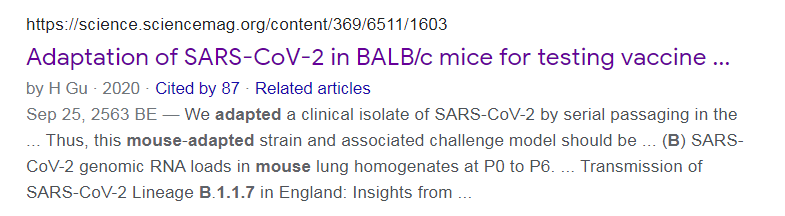
@NBA @StephenKissler @yhgrad We adapted a clinical isolate of SARS-CoV-2 by serial passaging in the ... Thus, this mouse-adapted strain and associated challenge model should be ... (B) SARS-CoV-2 genomic RNA loads in mouse lung homogenates at P0 to P6.
https://t.co/I90OOCJg7o
@NBA @StephenKissler @yhgrad 1. From Day 1, SARS-COV-2 was very well adapted to humans .....and transgenic hACE2 Mice
1. From Day 1, SARS-COV-2 was very well adapted to humans .....and transgenic hACE2 Mice
— Billy Bostickson \U0001f3f4\U0001f441&\U0001f441 \U0001f193 (@BillyBostickson) January 30, 2021
"we generated a mouse model expressing hACE2 by using CRISPR/Cas9 knockin technology. In comparison with wild-type C57BL/6 mice, both young & aged hACE2 mice sustained high viral loads... pic.twitter.com/j94XtSkscj
@NBA @StephenKissler @yhgrad 2. High Probability of serial passaging in Transgenic Mice expressing hACE2 in genesis of SARS-COV-2
1. High Probability of serial passaging in Transgenic Mice expressing hACE2 in genesis of SARS-COV-2!
— Billy Bostickson \U0001f3f4\U0001f441&\U0001f441 \U0001f193 (@BillyBostickson) January 2, 2021
2 papers:
Human\u2013viral molecular mimicryhttps://t.co/irfH0Zgrve
Molecular Mimicryhttps://t.co/yLQoUtfS6s https://t.co/lsCv2iMEQz
@NBA @StephenKissler @yhgrad B.1.1.7 has an unusually large number of genetic changes, ... found to date in mouse-adapted SARS-CoV2 and is also seen in ferret infections.
https://t.co/9Z4oJmkcKj
@NBA @StephenKissler @yhgrad We adapted a clinical isolate of SARS-CoV-2 by serial passaging in the ... Thus, this mouse-adapted strain and associated challenge model should be ... (B) SARS-CoV-2 genomic RNA loads in mouse lung homogenates at P0 to P6.
https://t.co/I90OOCJg7o