Is it better to split up dominant networks (like social/communication networks) or keep them whole to maximize network effects? I’ve spent 8 years creating a way to use data to answer this for Rwanda’s mobile network, using 5.3b transaction records (1/15) https://t.co/hKC8Vj2PIE


The punchline: allowing an additional competitor in Rwanda\u2019s mobile phone system earlier could have reduced prices and increased incentives to invest in rural towers, increasing welfare by the equivalent of 1% of GDP. (2/15)
— Daniel Bj\xf6rkegren (@danbjork) December 21, 2020
More from Economy


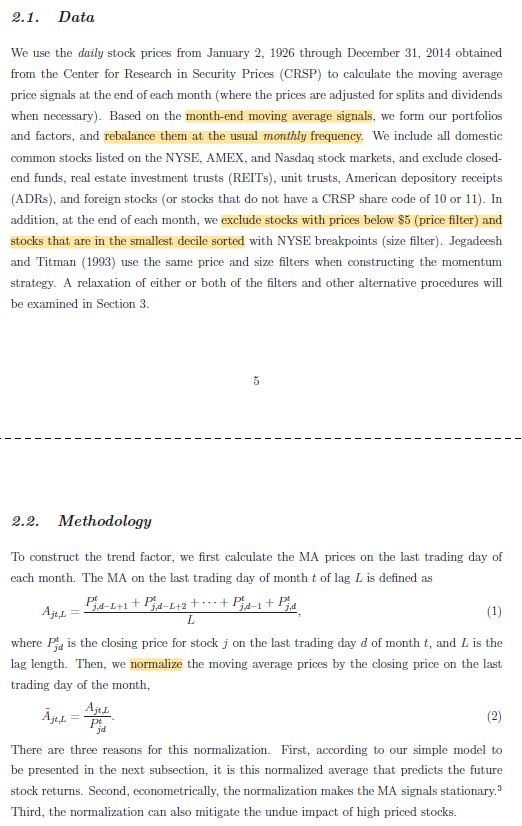
1/ Trend Factor: Any Economic Gains from Using Information over Investment Horizons? (Han, Zhou, Zhu)
"A trend factor using multiple time lengths outperforms ST reversal, momentum, and LT reversal, which are based on the three price trends separately."
https://t.co/udkvsdw2Lz
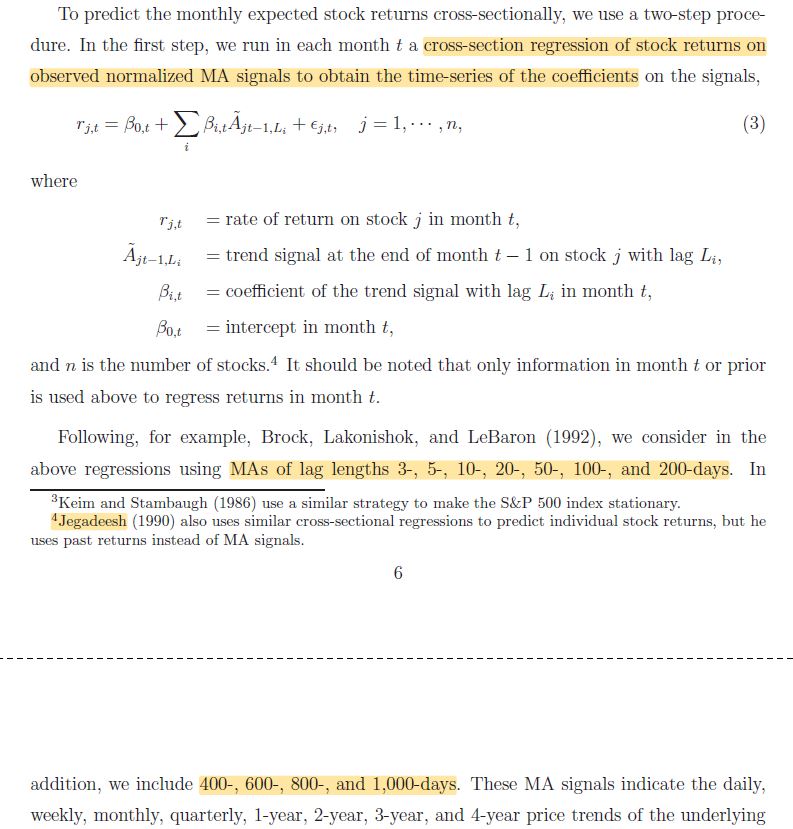
2/ This resembles combining multiple measures of ST reversal, momentum, and LT reversal (forecasts determined by walking forward rather than using signs from the full sample).
Unlike normal moving average signals, these are *cross-sectional.* More below:
https://t.co/wkIFLg9jtK
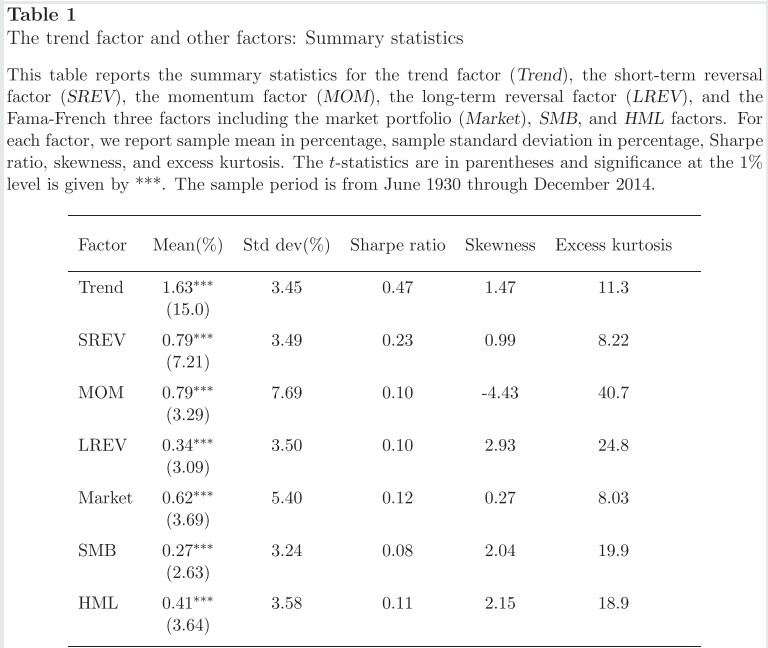
3/ Unsurprisingly, the Trend factor formed by this approach outperforms benchmarks in terms of both Sharpe ratio and tail metrics. It's combining momentum with two factors that are negatively correlated to it AND using multiple specifications.
More here:
https://t.co/x8Tloz3iyL
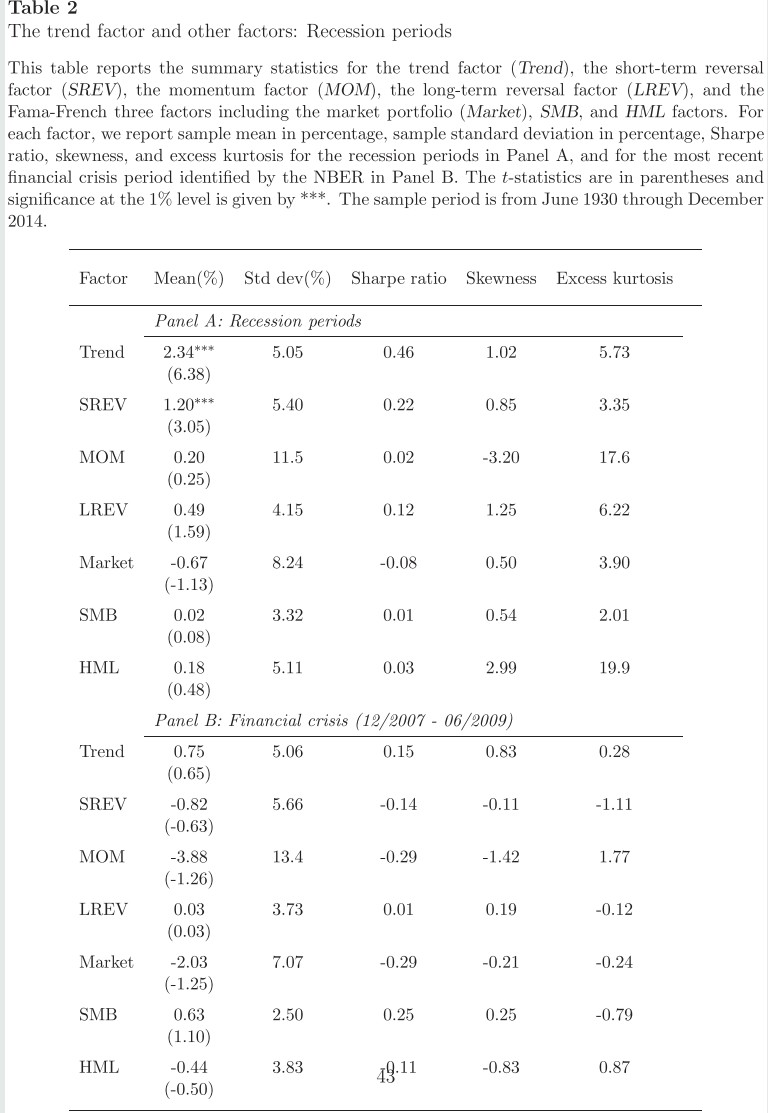
4/ "Average return and volatility of the trend factor are both higher in recession periods. However, the Sharpe ratio is virtually the same.
"Interestingly, all of the factors still have positive average returns.
"Momentum experiences the greatest increase in volatility."
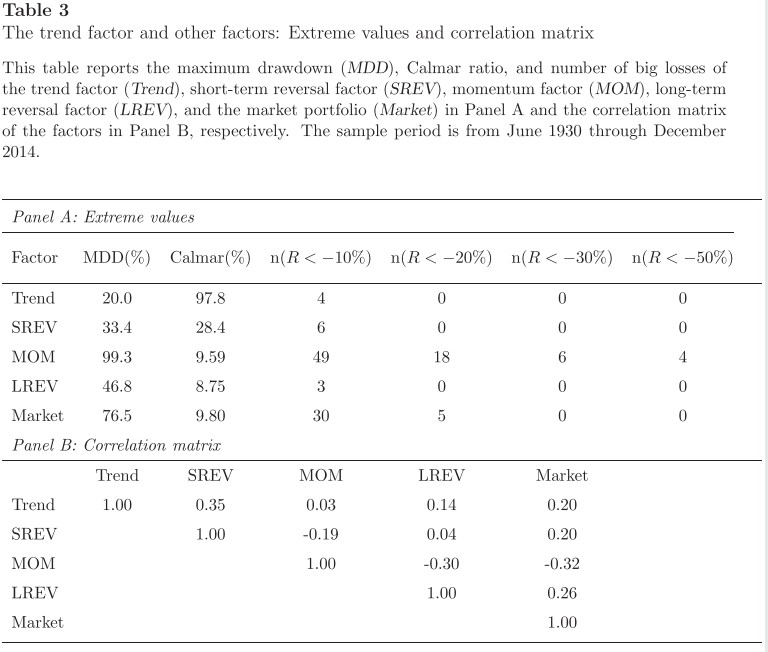
5/ "In terms of maximum drawdown and the Calmar ratio, the trend factor performs the best.
"The trend factor is correlated with the short-term reversal factor (35%), long-term reversal factor (14%), and the market (20%) but is virtually uncorrelated with the momentum factor."
"A trend factor using multiple time lengths outperforms ST reversal, momentum, and LT reversal, which are based on the three price trends separately."
https://t.co/udkvsdw2Lz
2/ This resembles combining multiple measures of ST reversal, momentum, and LT reversal (forecasts determined by walking forward rather than using signs from the full sample).
Unlike normal moving average signals, these are *cross-sectional.* More below:
https://t.co/wkIFLg9jtK
1/ Cross-Sectional and Time-Series Tests of Return Predictability: What Is the Difference? (Goyal, Jegadeesh)
— Darren \U0001f95a (@ReformedTrader) June 18, 2019
"The difference between the performances of TS and CS strategies is largely due to a time-varying net-long investment in risky assets."https://t.co/CSIn3ujN2R pic.twitter.com/XHnVmIart4
3/ Unsurprisingly, the Trend factor formed by this approach outperforms benchmarks in terms of both Sharpe ratio and tail metrics. It's combining momentum with two factors that are negatively correlated to it AND using multiple specifications.
More here:
https://t.co/x8Tloz3iyL
1/ An Executive Summary (in Tweet form) of our new paper
— Adam Butler (@GestaltU) March 27, 2019
Dual Momentum \u2013 A Craftsman\u2019s Perspective
Download here: https://t.co/Y9GlGNohBg
Everything that follows in this thread is based on HYPOTHETICAL AND SIMULATED RESULTS. pic.twitter.com/9m5YJnTdtq
4/ "Average return and volatility of the trend factor are both higher in recession periods. However, the Sharpe ratio is virtually the same.
"Interestingly, all of the factors still have positive average returns.
"Momentum experiences the greatest increase in volatility."
5/ "In terms of maximum drawdown and the Calmar ratio, the trend factor performs the best.
"The trend factor is correlated with the short-term reversal factor (35%), long-term reversal factor (14%), and the market (20%) but is virtually uncorrelated with the momentum factor."

What do a Tory Peer, Selwyn Gummer (Lord Chadlington), David Sumner ( Sumner Group Holdings) and the Sanchez Perez family (drugs money, laundered through Gold mines) have in common?
It’s another company-saving a £50 million PPE contract shaggy dog story
Connections, connections
What a start to the story
“A bulletproof truck trundled down the road in downtown Lima, guarded by 18 policeman
They were wearing body armour & wielding high velocity rifles
No-one was taking any chances
This was a Special delivery for Peruvian Prosecutor for an anti drug trial

That was in 2011, the same year that Lord Chadlington’s daughter got married in Chadlington to Henry Allsopp.
Who was there?
Yes Kirstie Allsopp of Location, location, location and all this Covid nonsense fame) is his sister
Camilla, his Godmother
Jeremy Hunt
Cameron

Well. Come on. Lord Chadlington had been chair of the local Witney Conservative Association. It’s only fair.
Hang on. Julian Wheatland, Director of SCL Group/ Cambridge Analytica had also been chair of Witney Conservative Association...and campaigned for his mate Cameron
Are we sure Julian Wheatland and his side kick Alexander Nix were not there too @JolyonMaugham ?
I mean. They move in the same North Oxford circles.
It’s another company-saving a £50 million PPE contract shaggy dog story
Connections, connections
The *staggering* tale of a Tory Peer and a \xa350m PPE contract. https://t.co/SH2qxOmfQ4
— Jo Maugham (@JolyonMaugham) December 10, 2020
What a start to the story
“A bulletproof truck trundled down the road in downtown Lima, guarded by 18 policeman
They were wearing body armour & wielding high velocity rifles
No-one was taking any chances
This was a Special delivery for Peruvian Prosecutor for an anti drug trial
That was in 2011, the same year that Lord Chadlington’s daughter got married in Chadlington to Henry Allsopp.
Who was there?
Yes Kirstie Allsopp of Location, location, location and all this Covid nonsense fame) is his sister
Camilla, his Godmother
Jeremy Hunt
Cameron
Well. Come on. Lord Chadlington had been chair of the local Witney Conservative Association. It’s only fair.
Hang on. Julian Wheatland, Director of SCL Group/ Cambridge Analytica had also been chair of Witney Conservative Association...and campaigned for his mate Cameron
Are we sure Julian Wheatland and his side kick Alexander Nix were not there too @JolyonMaugham ?
I mean. They move in the same North Oxford circles.