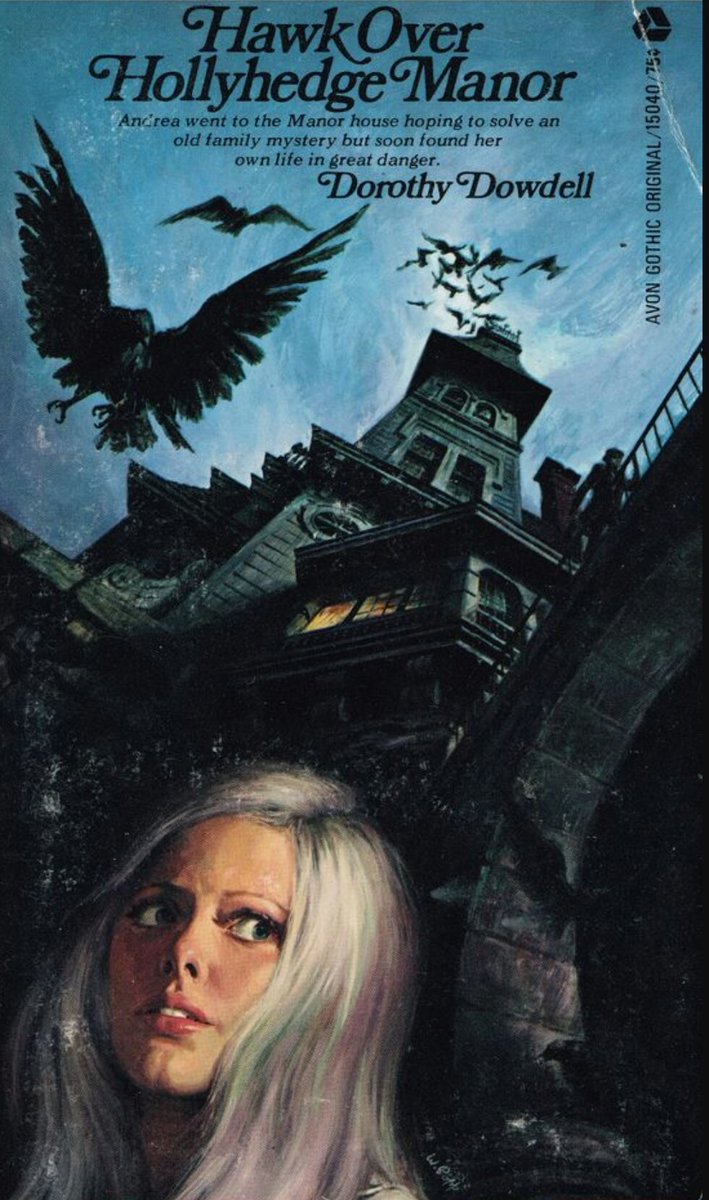
Macarthur fellow and Hugo-award-winner @nkjemisin's 2019 book "The City We Became" is both a fantastic contemporary fantasy novel and a scorching commentary on the infantile nature of the racist dogma of HP Lovecraft and his

It's a quest novel about a group of New Yorkers who awaken one day to discover that they are mystical avatars of the city, which has awakened and been reborn as a kind of powerful colony organism.

2/
There's an avatar for each of the five boroughs, plus a "primary" who represents the city as a whole. As with all births, this one is somewhat traumatic - but NYC's birth is uniquely fraught.

First, the five boroughs must find one another and connect with the primary.

3/
But they must do all this while under sustained assault from a mystical, transdimensional, Lovecraftian horror, a great adversary to all of our Earth's living cities - but an adversary that had been believed to be powerless against cities after their births.

4/
The enemy manifests as a Karen, a white woman clad all in white, dogwhistling racist tropes, summoning police, weaponizing vast fortunes to evict its enemies or distort their culture. It is attended by harbingers - human beings infected with fluttering white tentacles.

5/
The city's avatars are a BIPOC, queer, all-ages group, spiky and disunified, forced to resolve their differences as they quest for one another and battle the adversary in a race to save the city - and ultimately, our universe - from its eldritch horrors.

6/
As Lovecraft pastiches go, this is pretty fucking great stuff. Jemisin invokes Lovecraft's purple prose and vivid imagery to evince the real frisson of his horror, while simultaneously puncturing Lovcraft's noxious racism, which famously manifested in his disgust for cities.

7/
As with @bymattruff's 2016 novel LOVECRAFT COUNTRY, Jemisin does fantastic work in puncturing Lovecraft's atavistic horror of The Other by holding the mirror to it - inviting the reader to empathize with the object of that reflexive fear and disgust.

https://t.co/TtMuSzCgSz

8/
But THE CITY WE BECAME represents an advance on LOVECRAFT COUNTRY in an important regard: the way that it treats with the simplicity of the conservative worldview and the complexity of the real world.

9/
Many have observed that conservativism's nostalgia for "simpler times" is really a yearning for childhood: the reason life was simpler when you were a child isn't because times were simpler - it's because you were a child, sheltered from life's complexities by your parents.

10/
Hence conservativism's daddy issues, its yearning for strongmen who'll make the nation great through discipline, ordering and control.

In this telling, xenophobia is just the adult version of a toddler's unwillingness to eat their peas if they touch the mashed potatoes.

11/
An infantile, irrational fussiness that, in turn, is antithetical to cities - the sprawling, organic, self-organizing, diverse, chaotic places where ideas and languages and peoples and smells and tastes all rub up against each other.

12/
Jemisin's mythical battle of the messy city and the Lovecraftian adversary's desire for sterile order is a kind of eldritch dramatization of the fight between Robert Moses and Jane Jacobs - a fight that goes all the way back to Plato.

13/
Plato's Republic, after all, is the ultimate conservative work - the belief that people are born to virtue, and that virtue determines who is fit to rule and who must be ruled over because they cannot govern themselves.

14/
Plato even presaged Lovecraft's disgust with complex polyrhythms ("maddening drums"), decrying "broken rhythms" for their potential to disorder the listener's self-control - a theme that repeats in Jemisin's book as the avatar of Brooklyn spits weaponized rhymes.

15/
An obsession with neatness, categories, purity and hierarchy are the hallmark of both toddlers and conservatives, and Jemisin reveals that Lovecraft's squamous, rugose revulsions are just three grossed-out toddlers in a trenchcoat throwing their carrots on the floor.

16/
There's many ways to carve our ideological divisions right now. One of the most powerful fracture lines is simplicity-vs-complexity - the need to bleach everything to sterility versus the understanding that complex, thriving, diverse systems are necessary to our survival.

17/
Like all the best "urban fantasy," THE CITY WE BECAME is a love-hymn to cities themselves as living climax systems. More than that, Jemisin wields her city against the forces of infantile reaction.

eof/

More from Cory Doctorow #BLM

There are lots of problems with ad-tech:

* being spied on all the time means that the people of the 21st century are less able to be their authentic selves;

* any data that is collected and retained will eventually breach, creating untold harms;

1/


* data-collection enables for discriminatory business practices ("digital redlining");

* the huge, tangled hairball of adtech companies siphons lots (maybe even most) of the money that should go creators and media orgs; and

2/

* anti-adblock demands browsers and devices that thwart their owners' wishes, a capability that can be exploited for even more nefarious purposes;

That's all terrible, but it's also IRONIC, since it appears that, in addition to everything else, ad-tech is a fraud, a bezzle.

3/

Bezzle was John Kenneth Galbraith's term for "the magic interval when a confidence trickster knows he has the money he has appropriated but the victim does not yet understand that he has lost it." That is, a rotten log that has yet to be turned over.

4/

Bezzles unwind slowly, then all at once. We've had some important peeks under ad-tech's rotten log, and they're increasing in both intensity and velocity. If you follow @Chronotope, you've had a front-row seat to the
Today's Twitter threads (a Twitter thread).

Inside: Thinking through Mitch McConnell's plea for comity; Further, on Mitch McConnell and comity; Understanding the aftermath of r/wallstreetbets; and more!

Archived at: https://t.co/1rRmrJa4FK

#Pluralistic

1/


Thinking through Mitch McConnell's plea for comity: A thoughtful analysis.

https://t.co/2T74ykb3Ws

2/


Further, on Mitch McConnell and comity: I thought about it some more.

https://t.co/mTQ225Lr3X

3/


Understanding the aftermath of r/wallstreetbets: Even if there's no angels, there's still a path to glory.

https://t.co/x7BaqUQ0hj

4/


#10yrsago Morrow’s Diviner’s Tale is a tight, literary ghost story https://t.co/XFW0AGFwhI

#10yrsago ATM skimmer that doesn’t require any modifications to the ATM

More from Culture

Best books I read in 2020

1. Atomic Habits by @JamesClear

“If you show up at the gym 5 days in a row—even for 2 minutes—you're casting votes for your new identity. You’re not worried about getting in shape. Youre focused on becoming the type of person who doesn’t miss workouts”


Good Reasons for Bad Feelings

https://t.co/KZDqte19nG

2. “social anxiety is overwhelmingly common. Natural selection shaped us to care enormously what other people think..We constantly monitor how much others value us..Low self-esteem is a signal to try harder to please others”


The True Believer by Eric Hoffer

https://t.co/uZT4kdhzvZ

“Hatred is the most accessible and comprehensive of all unifying agents...Mass movements can rise and spread without belief in a God, but never without a believe in a devil.”


Grandstanding

https://t.co/4Of58AZUj8

"if politics becomes a morality pageant, then the contestants have an incentive to keep problems intact...politics becomes a forum to show off moral qualities...people will be dedicated to activism for its own sake, as a vehicle to preen"


Warriors and Worriers by Joyce Benenson

https://t.co/yLC4eGHEd4

“Across diverse cultures, a man who lives in the house with another man’s children is about 60 times more likely than the biological father to kill those children.”
I just finished Eric Adler's The Battle of the Classics, and wanted to say something about Joel Christiansen's review linked below. I am not sure what motivates the review (I speculate a bit below), but it gives a very misleading impression of the book. 1/x


The meat of the criticism is that the history Adler gives is insufficiently critical. Adler describes a few figures who had a great influence on how the modern US university was formed. It's certainly critical: it focuses on the social Darwinism of these figures. 2/x

Other insinuations and suggestions in the review seem wildly off the mark, distorted, or inappropriate-- for example, that the book is clickbaity (it is scholarly) or conservative (hardly) or connected to the events at the Capitol (give me a break). 3/x

The core question: in what sense is classics inherently racist? Classics is old. On Adler's account, it begins in ancient Rome and is revived in the Renaissance. Slavery (Christiansen's primary concern) is also very old. Let's say classics is an education for slaveowners. 4/x

It's worth remembering that literacy itself is elite throughout most of this history. Literacy is, then, also the education of slaveowners. We can honor oral and musical traditions without denying that literacy is, generally, good. 5/x

You May Also Like

1/12

RT-PCR corona (test) scam

Symptomatic people are tested for one and only one respiratory virus. This means that other acute respiratory infections are reclassified as


2/12

It is tested exquisitely with a hypersensitive non-specific RT-PCR test / Ct >35 (>30 is nonsense, >35 is madness), without considering Ct and clinical context. This means that more acute respiratory infections are reclassified as


3/12

The Drosten RT-PCR test is fabricated in a way that each country and laboratory perform it differently at too high Ct and that the high rate of false positives increases massively due to cross-reaction with other (corona) viruses in the "flu


4/12

Even asymptomatic, previously called healthy, people are tested (en masse) in this way, although there is no epidemiologically relevant asymptomatic transmission. This means that even healthy people are declared as COVID


5/12

Deaths within 28 days after a positive RT-PCR test from whatever cause are designated as deaths WITH COVID. This means that other causes of death are reclassified as
The entire discussion around Facebook’s disclosures of what happened in 2016 is very frustrating. No exec stopped any investigations, but there were a lot of heated discussions about what to publish and when.


In the spring and summer of 2016, as reported by the Times, activity we traced to GRU was reported to the FBI. This was the standard model of interaction companies used for nation-state attacks against likely US targeted.

In the Spring of 2017, after a deep dive into the Fake News phenomena, the security team wanted to publish an update that covered what we had learned. At this point, we didn’t have any advertising content or the big IRA cluster, but we did know about the GRU model.

This report when through dozens of edits as different equities were represented. I did not have any meetings with Sheryl on the paper, but I can’t speak to whether she was in the loop with my higher-ups.

In the end, the difficult question of attribution was settled by us pointing to the DNI report instead of saying Russia or GRU directly. In my pre-briefs with members of Congress, I made it clear that we believed this action was GRU.