One of the authors of the Policy Exchange report on academic free speech thinks it is "ridiculous" to expect him to accurately portray an incident at Cardiff University in his study, both in the reporting and in a question put to a student sample.

Here is the incident Kaufmann incorporated into his study, as told by a Cardiff professor who was there. As you can see, the incident involved the university intervening to *uphold* free speech principles:
https://t.co/c0aOGU9aUZ
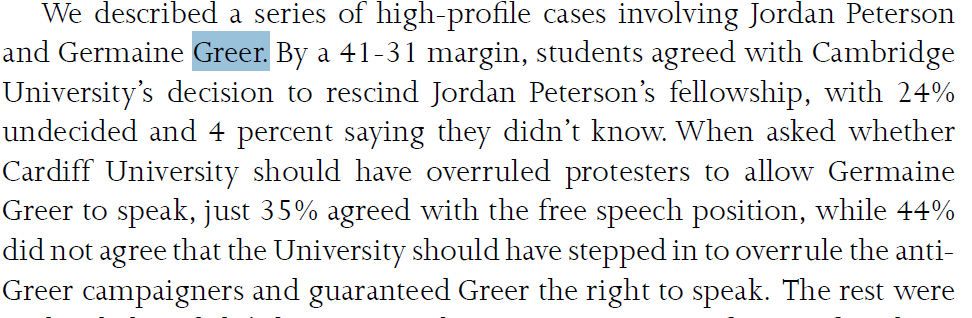
Here is the first mention of the Greer at Cardiff incident in Kaufmann's report. It refers to the "concrete case" of the "no-platforming of Germaine Greer". Any reasonable reader would assume that refers to an incident of no-platforming instead of its opposite.
Here is the next mention of Greer in the report. The text asks whether the University "should have overruled protestors" and "stepped in...and guaranteed Greer the right to speak". Again the strong implication is that this did not happen and Greer was "no platformed".
The authors could easily have added a footnote at this point explaining what actually happened in Cardiff. They did not.
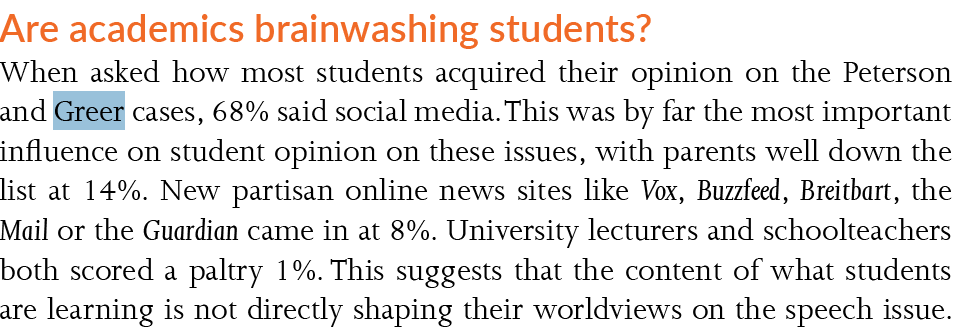
Here is another section of the text, where the authors consider where students "acquired their opinion" about the "Greer case". Again, the implication is that the "Greer case" is, as it was initially described, an incident of university sanctioned no-platforming
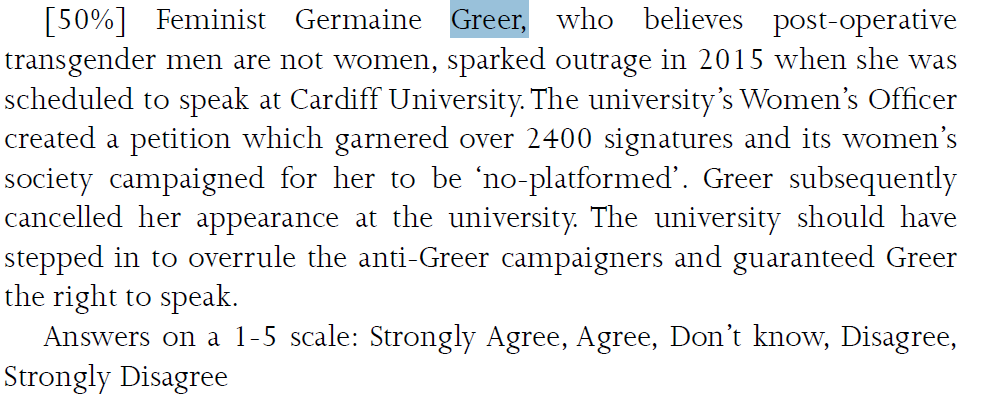
And here is the kicker - the actual question asked to students in the study. This quite clearly presents the Greer incident as a matter of historical fact, which occurred as presented. It is not presented as a scenario or thought experiment.
The question is deceptive. It asks students to pass judgement on an actual university failing to intervene to prevent the actual cancellation of an actual event. But the actual university in question *did* intervene to ensure the actual event *did occur*.
Why does all this matter? Because the report in question is being used to argue for heavy handed government interventions to deal with universities' alleged failure to protect free speech. Kaufmann, one of the main authors, has written in emotive language of "woke sorcerers"
who must be prevented from suppressing free debate. Any academic should be free to criticise university policy and culture. But that criticism should be grounded in factual evidence. The evidence presented as fact in this case is nothing of the sort.
This is not a minor error. The study questionnaire could have presented cases as scenarios or thought experiments. It did not. It presented the case in question as fact. The report could have caveated the findings, explaining the real context. It did not.
These errors, and the reasons they are problematic, have been pointed out to Kaufmann. He has dismissed them as "ridiculous". You can judge for yourselves - I have presented all the evidence here. Personally, I think it is "ridiculous" than an academic misrepresent in this way
Therefore, I ask again that Kaufmann take the step he has so far resisted taking, and amend his report to include a correct statement about the event in Cardiff, making it clear to his readers (who include the Education Secretary, who has cited this report heavily) are aware
that an event he presents to his student sample, and presents to his readers, as an incident of a university failing to stand up to a no-platforming campaign was in fact an incident of a university standing against a no-platforming campaign and ensuring an event happens.
I hope that @epkaufm will reconsider his views on this and amend his report. He should also apologise to Cardiff University for misrepresenting their behaviour repeatedly with regards the Greer case.
Further testimony on this from the individual responsible for organising and managing the Germaine Greer event at Cardiff:
https://t.co/0PxLlWLxxh

More from Culture

You May Also Like

Margatha Natarajar murthi - Uthirakosamangai temple near Ramanathapuram,TN
#ArudraDarisanam
Unique Natarajar made of emerlad is abt 6 feet tall.
It is always covered with sandal paste.Only on Thriuvadhirai Star in month Margazhi-Nataraja can be worshipped without sandal paste.


After removing the sandal paste,day long rituals & various abhishekam will be
https://t.co/e1Ye8DrNWb day Maragatha Nataraja sannandhi will be closed after anointing the murthi with fresh sandal paste.Maragatha Natarajar is covered with sandal paste throughout the year


as Emerald has scientific property of its molecules getting disturbed when exposed to light/water/sound.This is an ancient Shiva temple considered to be 3000 years old -believed to be where Bhagwan Shiva gave Veda gyaana to Parvati Devi.This temple has some stunning sculptures.
Recently, the @CNIL issued a decision regarding the GDPR compliance of an unknown French adtech company named "Vectaury". It may seem like small fry, but the decision has potential wide-ranging impacts for Google, the IAB framework, and today's adtech. It's thread time! 👇

It's all in French, but if you're up for it you can read:
• Their blog post (lacks the most interesting details):
https://t.co/PHkDcOT1hy
• Their high-level legal decision: https://t.co/hwpiEvjodt
• The full notification: https://t.co/QQB7rfynha

I've read it so you needn't!

Vectaury was collecting geolocation data in order to create profiles (eg. people who often go to this or that type of shop) so as to power ad targeting. They operate through embedded SDKs and ad bidding, making them invisible to users.

The @CNIL notes that profiling based off of geolocation presents particular risks since it reveals people's movements and habits. As risky, the processing requires consent — this will be the heart of their assessment.

Interesting point: they justify the decision in part because of how many people COULD be targeted in this way (rather than how many have — though they note that too). Because it's on a phone, and many have phones, it is considered large-scale processing no matter what.