@TheKidneyDocto1 See i m trying to keep here my point of view on Democracy in China.. okay.. China isn't a dictatorship if u exclude this Xi Jinping and Mao era.. They conduct fair elections where every candidate is supported by CCP.. They represent people.. (1/2)
Now ethnic minorities..Okay..You do know that bhutan is the happiest country of the world..Many say that one of its reason is, they sent back the Nepalese ethinic groups back to Nepal and India..4/5
We everytime order from a same restraunt near my home.. and we talk with manager, 7/8
See i don't agree with one ethnic 9/10
See i love Democracy.. I love India as it is.. 10/11
Sorry if i hurt you anywhere.. I just presented my views
(11/11)
More from China


THREAD: Last week, China’s Cabinet announced that, for the first time, fees will be charged for “excessive” freedom of information requests, potentially meaning huge out-of-pocket expenses for lawyers and others who rely heavily on public information from the Chinese government.
According to a notice published Dec. 1, government offices will be able to choose from two different rate schemes: one based on frequency, one based on size. https://t.co/KxUSE3dXEu
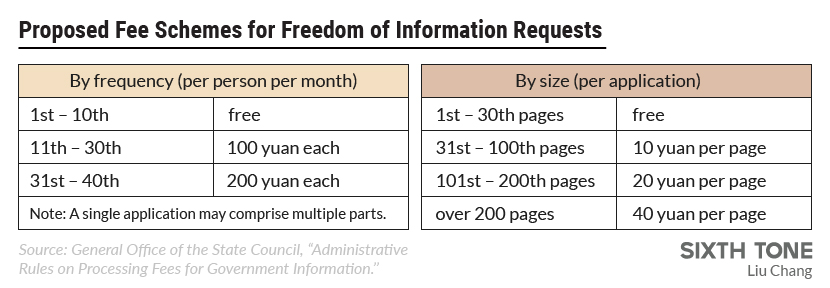
The “size” route is especially problematic. Here’s why:
If you’re an activist or a lawyer seeking a copy of an 800-page environmental impact assessment report, it’s going to cost you around $4,000 under this scheme.
In the past, disclosure requests were essentially free in China because there were no rules for charging fees.
In fact, last December an administrative agency in Shenzhen was ordered to reimburse an applicant after sending him a pay-on-delivery parcel.
According to the State Council’s Dec. 1 notice, the aim of adding the fees isn’t to generate revenue, but to “guide applicants to exercise their rights reasonably.”
Regardless of intention, however, the new costs will likely be a hindrance to those seeking public information.
According to a notice published Dec. 1, government offices will be able to choose from two different rate schemes: one based on frequency, one based on size. https://t.co/KxUSE3dXEu
The “size” route is especially problematic. Here’s why:
If you’re an activist or a lawyer seeking a copy of an 800-page environmental impact assessment report, it’s going to cost you around $4,000 under this scheme.
In the past, disclosure requests were essentially free in China because there were no rules for charging fees.
In fact, last December an administrative agency in Shenzhen was ordered to reimburse an applicant after sending him a pay-on-delivery parcel.
According to the State Council’s Dec. 1 notice, the aim of adding the fees isn’t to generate revenue, but to “guide applicants to exercise their rights reasonably.”
Regardless of intention, however, the new costs will likely be a hindrance to those seeking public information.