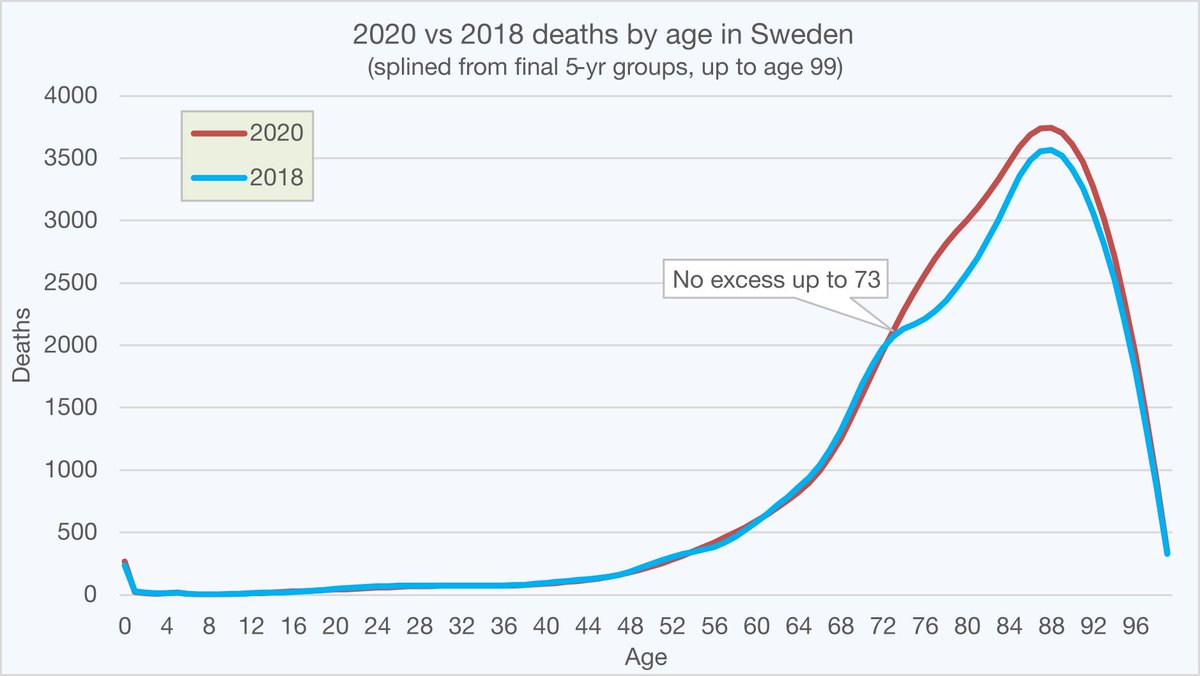
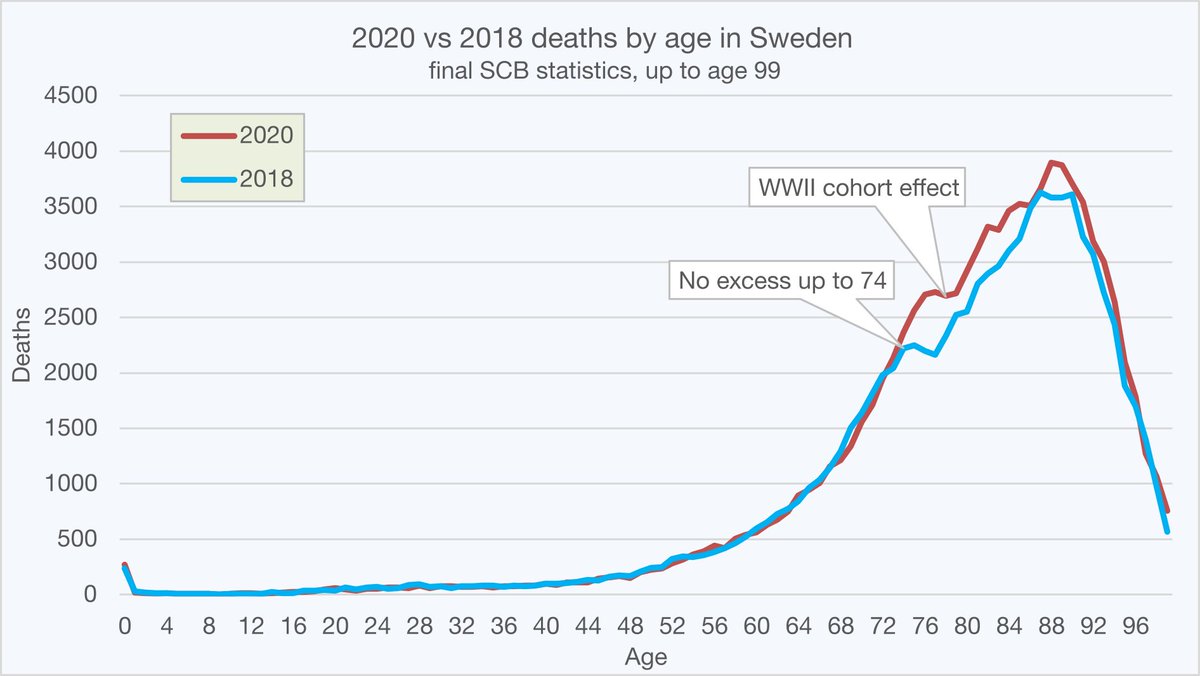
SCB has dropped its final 2020 stats on deaths for Sweden. This chart is a breakdown by age for both sexes compared to 2018.
Most notably, there's no excess among children and people of working age, confirming the preliminary stats for males I had published earlier.
More from Category c19
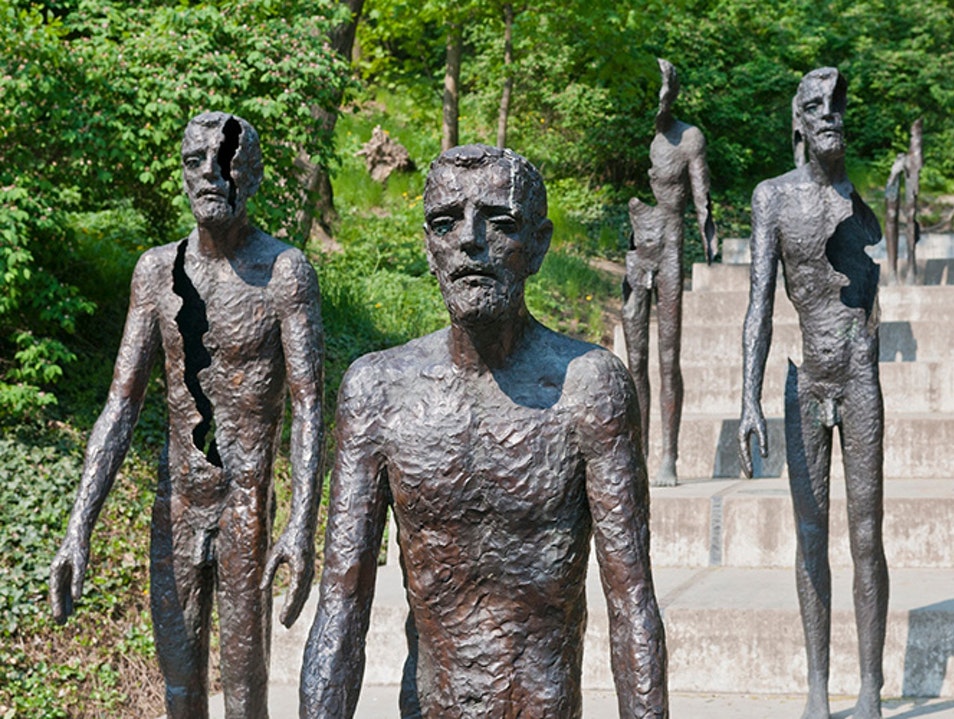
2/: These so-called ‘Doctors’ Trial’ focused on physicians who conducted #inhumane and #unethical human experiments in German concentration camps, in addition to those who were involved in over 3,500,000 sterilizations of German citizens. (the picture shows doctors/criminals)
3/: Ten points of the code were given in the section of the verdict entitled "Permissible Medical Experiments". They can be found in detail on the following website:
4/: Point #1 means that the person involved should have legal capacity to give consent; should be so situated as to be able to exercise free power of choice, without the intervention of any element of force, fraud, or deceit.
5/: Using an insufficiently-tested vaccine on humans is unethical. However, as long as people voluntarily consent to receive the vaccine, being informed about all risks, everything is OK. Doing this with force, however, is against the Nuremberg Code.
Important - share: Camera footage out of care homes (USA, corrected), provided by @RobertKennedyJr's team. You can clearly see: Collateral Damages, Army assisting, force, death.
— Bobby Rajesh Malhotra \u30c4 (@Bobby_Network) February 17, 2021
Worldwide phenomen, also in Germany:https://t.co/GV7gqiPl1u
21st Century Nuremberg Trials-material pic.twitter.com/wPekgPYHIR
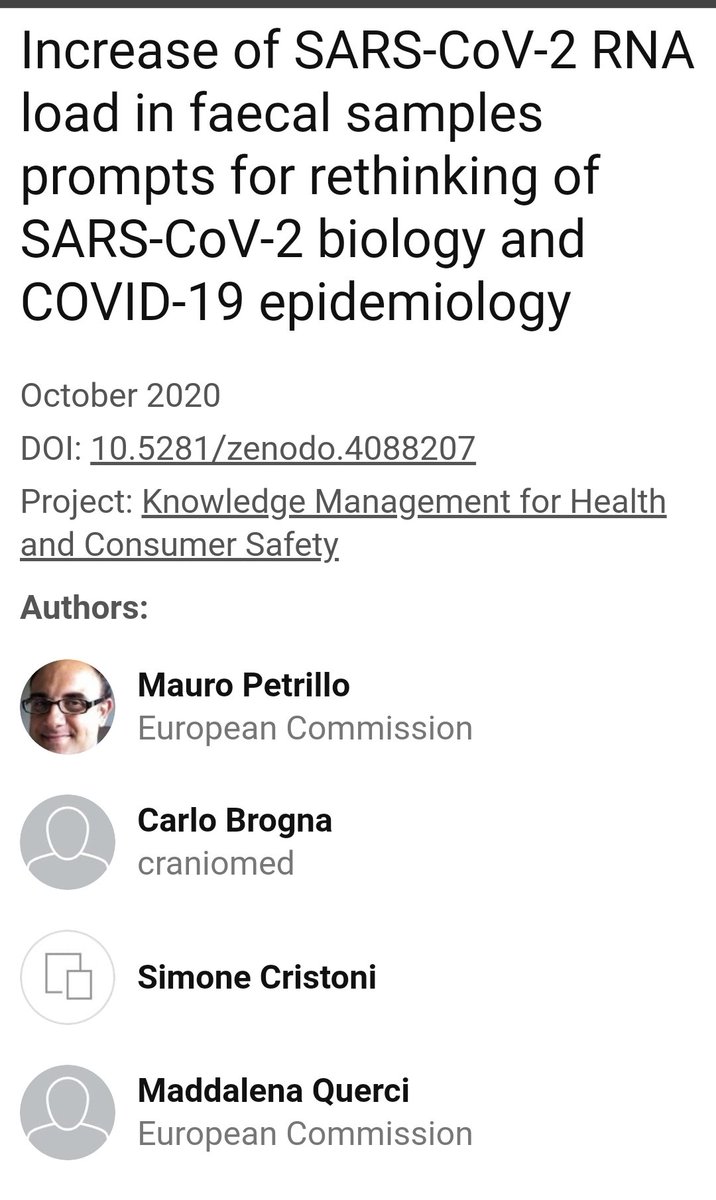
Here is the Italian-EU scientific study indicating SARSCoV2 replicates in bacteria, not only human cells, and that is why antibiotics work and these vaccines will not:
"The preliminary results suggest that SARS-CoV-2 replicates in bacterial
2 of the 4 authors of the study work at the European Commission. Another works at an Italian medical research facility called Craniomed: https://t.co/EETSM3nb3T
You can find all of CRANIOMED's Carlo Brogna's published scientific research articles here, take a look:
2/: The interview is significant because @c_drosten made totally sane statements back then that follow the principle of common sense. Considering his involvement in the "genesis of the current pandemic", his assertions appear in an entirely different
The genesis of a pandemic.
— Pace \U0001f642 (@theotherphilipp) February 25, 2021
The #Corona crisis began with a panopticon of absurd events, improbable coincidences and outright lies.
Time for a review of the impossibilities.
A thread \U0001f9f5 pic.twitter.com/PLbETVv2p8
3/: In 2014, for instance, washing the hands was sufficient against being infected by coronaviruses. Several years he demands measures that destroy national economies and social life worldwide.
4/: Young @c_drosten also severely criticized the fact that Saudi Arabia used the PCR method to detect potential infections. From his point of view, that specific method could lead to many irrelevant cases. Nowadays, his view shifted his opinion towards 'collective punishment'.
5/: Whereas he demands "testing, testing, testing" nowadays and spreads panic and fear via (social) media, he heavily condemned that behaviour of Saudi media in 2014. On top of that, he expressed his concern that medial panic could increase the number of lab tests significantly.
You May Also Like
The Swastik is a geometrical figure and an ancient religious icon. Swastik has been Sanatan Dharma’s symbol of auspiciousness – mangalya since time immemorial.
The name swastika comes from Sanskrit (Devanagari: स्वस्तिक, pronounced: swastik) &denotes “conducive to wellbeing or auspicious”.
The word Swastik has a definite etymological origin in Sanskrit. It is derived from the roots su – meaning “well or auspicious” & as meaning “being”.
"सु अस्ति येन तत स्वस्तिकं"
Swastik is de symbol through which everything auspicios occurs
Scholars believe word’s origin in Vedas,known as Swasti mantra;
"🕉स्वस्ति ना इन्द्रो वृधश्रवाहा
स्वस्ति ना पूषा विश्ववेदाहा
स्वस्तिनास्तरक्ष्यो अरिश्तनेमिही
स्वस्तिनो बृहस्पतिर्दधातु"
It translates to," O famed Indra, redeem us. O Pusha, the beholder of all knowledge, redeem us. Redeem us O Garudji, of limitless speed and O Bruhaspati, redeem us".
SWASTIK’s COSMIC ORIGIN
The Swastika represents the living creation in the whole Cosmos.
Hindu astronomers divide the ecliptic circle of cosmos in 27 divisions called https://t.co/sLeuV1R2eQ this manner a cross forms in 4 directions in the celestial sky. At centre of this cross is Dhruva(Polestar). In a line from Dhruva, the stars known as Saptarishi can be observed.
Like company moats, your personal moat should be a competitive advantage that is not only durable—it should also compound over time.
Characteristics of a personal moat below:
I'm increasingly interested in the idea of "personal moats" in the context of careers.
— Erik Torenberg (@eriktorenberg) November 22, 2018
Moats should be:
- Hard to learn and hard to do (but perhaps easier for you)
- Skills that are rare and valuable
- Legible
- Compounding over time
- Unique to your own talents & interests https://t.co/bB3k1YcH5b
2/ Like a company moat, you want to build career capital while you sleep.
As Andrew Chen noted:
People talk about \u201cpassive income\u201d a lot but not about \u201cpassive social capital\u201d or \u201cpassive networking\u201d or \u201cpassive knowledge gaining\u201d but that\u2019s what you can architect if you have a thing and it grows over time without intensive constant effort to sustain it
— Andrew Chen (@andrewchen) November 22, 2018
3/ You don’t want to build a competitive advantage that is fleeting or that will get commoditized
Things that might get commoditized over time (some longer than
Things that look like moats but likely aren\u2019t or may fade:
— Erik Torenberg (@eriktorenberg) November 22, 2018
- Proprietary networks
- Being something other than one of the best at any tournament style-game
- Many "awards"
- Twitter followers or general reach without "respect"
- Anything that depends on information asymmetry https://t.co/abjxesVIh9
4/ Before the arrival of recorded music, what used to be scarce was the actual music itself — required an in-person artist.
After recorded music, the music itself became abundant and what became scarce was curation, distribution, and self space.
5/ Similarly, in careers, what used to be (more) scarce were things like ideas, money, and exclusive relationships.
In the internet economy, what has become scarce are things like specific knowledge, rare & valuable skills, and great reputations.