Bitcoin: A Peer-to-Peer Electronic Cash System
Satoshi Nakamoto
[email protected]
https://t.co/G8BUvnF9nT
Abstract. A purely peer-to-peer version of electronic cash would allow online payments to be sent directly from one party to another without going through a financial
Commerce on the Internet has come to rely almost exclusively on financial
2. Transactions
We define an electronic coin as a chain of digital signatures.

We need a way for the payee to know that the previous owners did not sign any earlier transactions. For our purposes, the earliest transaction is the one that counts, so we don't care about later attempts to double-spend. The only way to confirm the absence of a
3. Timestamp Server
The solution we propose begins with a timestamp server. A timestamp server

4. Proof-of-Work
To implement a distributed timestamp server on a peer-to-peer basis, we will need to use a proof- of-work system similar to Adam Back's Hashcash [6],
For our timestamp network, we implement the proof-of-work by incrementing a nonce in the block until a value is found that gives the block's hash the required zero bits. Once the CPU effort has been expended to make it satisfy the proof-of-work, the block cannot be
The proof-of-work also solves the problem of determining representation in majority decision making. If the majority were based on

To compensate for increasing hardware speed and varying interest in running nodes over time, the proof-of-work
5. Network
The steps to run the network are as follows:
2) Each node collects new transactions into a block.
3) Each node works on finding a difficult proof-of-work for its block.
4) When a node finds a proof-of-work, it broadcasts the block to all nodes.
6) Nodes express their acceptance of the block by working on creating the next block in the
chain, using the hash of the accepted block as the previous hash.
New transaction broadcasts do not necessarily
By convention, the first transaction in a block is a special transaction that starts a new coin owned by the creator of the block. This adds an incentive for nodes to support the network, and provides a way to initially distribute coins into circulation, since there
The incentive may help encourage nodes to stay honest. If a greedy attacker is able to assemble more CPU power than all the honest nodes, he would have to choose
7. Reclaiming Disk Space
Once the latest transaction in a coin is buried under enough blocks, the spent transactions before it can be discarded to save disk space. To facilitate this without breaking the block's hash, transactions are hashed in a Merkle Tree

8. Simplified Payment Verification
It is possible to verify payments without running a full network node. A user only needs to keep a copy of the block headers of the longest proof-of-work

9. Combining and Splitting Value
Although it would be possible to handle coins individually, it would

The traditional banking model achieves a level of privacy by limiting access to information to the parties involved and the trusted third party. The necessity to announce all transactions publicly precludes this method, but privacy can still be maintained by breaking

We consider the scenario of an attacker trying to generate an alternate chain faster than the honest chain. Even if this is accomplished, it does not throw the system open to arbitrary changes, such as creating value out of thin air or taking money that never
The probability of an attacker catching up from a given deficit is analogous to a Gambler's Ruin problem. Suppose a gambler with unlimited credit starts at a deficit and plays potentially an infinite number of trials to try to reach breakeven.
p = probability an honest node finds the next block
q = probability the attacker finds the next block

The receiver generates a new key pair and gives the public key to the sender shortly before signing. This prevents the sender from preparing a chain of
The recipient waits until the transaction has been added to a block and z blocks have been linked after it. He doesn't know the exact amount of progress the attacker has made, but assuming the honest blocks took the average expected time per block, the

each amount of progress he could have made by the probability he could catch up from that point:


#include
double AttackerSuccessProbability(double q, int z) {
double p = 1.0 - q;
double lambda = z * (q / p); double sum = 1.0;
int i, k;
for (k = 0; k <= z; k++)
{
double poisson = exp(-lambda); for (i = 1; i <= k; i++)
poisson *= lambda / i;
}
return sum; }
Running some results, we can see the probability drop off exponentially with z.
q=0.1
z=0 P=1.0000000
z=1 P=0.2045873
z=2 P=0.0509779
z=3 P=0.0131722
z=4 P=0.0034552
z=5 P=0.0009137
z=6 P=0.0002428
z=7 P=0.0000647
z=9 P=0.0000046
z=10 P=0.0000012
q=0.3
z=0 P=1.0000000
z=5 P=0.1773523
z=10 P=0.0416605
z=15 P=0.0101008
z=20 P=0.0024804
z=25 P=0.0006132
z=30 P=0.0001522
z=35 P=0.0000379
z=40 P=0.0000095
z=45 P=0.0000024
z=50 P=0.0000006
P < 0.001 q=0.10 z=5
q=0.15 z=8
q=0.20 z=11
q=0.25 z=15
q=0.30 z=24
q=0.35 z=41
q=0.40 z=89
q=0.45 z=340
We have proposed a system for electronic transactions without relying on trust. We started with the usual framework of coins made from digital signatures, which provides strong control of ownership, but is incomplete without a way to prevent double-spending.
References
[1] W. Dai, "b-money," https://t.co/kahMDkp7TM, 1998.
[2] H. Massias, X.S. Avila, and J.-J. Quisquater, "Design of a secure timestamping service with minimal
trust requirements," In 20th Symposium on Information Theory in the Benelux, May 1999.
2, pages 99-111, 1991.
[4] D. Bayer, S. Haber, W.S. Stornetta, "Improving the efficiency and reliability of digital time-stamping,"
In Sequences II: Methods in Communication,
[5] S. Haber, W.S. Stornetta, "Secure names for bit-strings," In Proceedings of the 4th ACM Conference
on Computer and Communications Security, pages 28-35, April 1997.
[6] A. Back, "Hashcash - a denial of service
https://t.co/ElYZGUzPRd, 2002.
[7] R.C. Merkle, "Protocols for public key cryptosystems," In Proc. 1980 Symposium on Security and
Privacy, IEEE Computer Society, pages 122-133, April 1980.
[8] W. Feller, "An introduction to probability theory and its
More from Bitcoin



The defi matrix
As each asset class goes on-chain, it can be stored in a digital wallet. And it can be traded against other such assets. Not just cryptocurrencies, but national digital currencies, personal tokens, etc.
We’re about to enter an age of global monetary competition.
The defi matrix is the table of all pair wise trades. It’s the fiat/stablecoin pairs, the fiat/crypto pairs, the crypto/crypto pairs, and much more besides.
Uniswap-style automatic market making for everything. Every possession you have, constantly marked to market by ~2040.
More liquidity, less currency?
This is an interesting point. Cash doesn’t make you money. In fact, it can lose you money in an inflating environment.
Reliable, 24/7 mark-to-market on everything is hard — but if achieved, means less % of assets in cash.
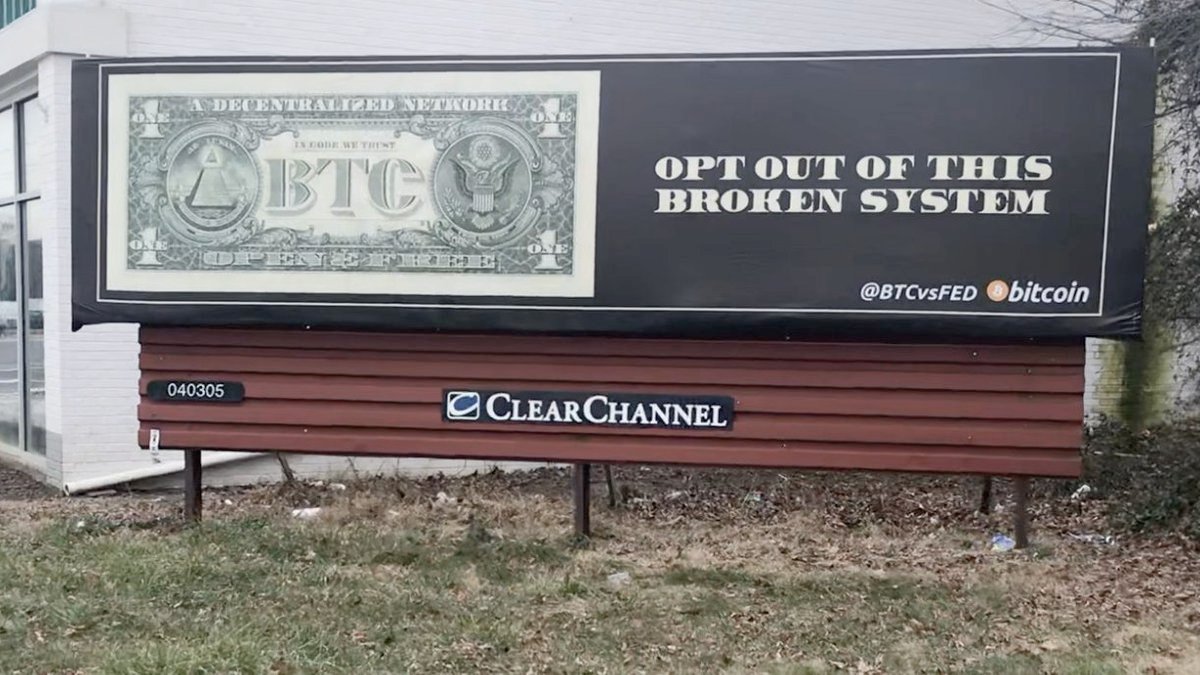
AMMs boost BTC. Here's why.
- All assets trade against all assets in the defi matrix
- Automated market makers give liquidity for rare pairs
- Everything is marked-to-market 24/7
- Value of cash drops, as you can liquidate instantly
- The new no-op is to keep your assets in BTC
Basically, automated market makers like @Uniswap boost BTC in the long term, because they allow *everything* to be priced in BTC terms, and *anyone* to switch out of BTC into their asset of choice.
Though in practice this may mean WBTC/RenBTC [or ETH!] rather than BTC itself.
As each asset class goes on-chain, it can be stored in a digital wallet. And it can be traded against other such assets. Not just cryptocurrencies, but national digital currencies, personal tokens, etc.
We’re about to enter an age of global monetary competition.
The defi matrix is the table of all pair wise trades. It’s the fiat/stablecoin pairs, the fiat/crypto pairs, the crypto/crypto pairs, and much more besides.
Uniswap-style automatic market making for everything. Every possession you have, constantly marked to market by ~2040.
More liquidity, less currency?
This is an interesting point. Cash doesn’t make you money. In fact, it can lose you money in an inflating environment.
Reliable, 24/7 mark-to-market on everything is hard — but if achieved, means less % of assets in cash.
Thus less use for currencies as people can more easily store their wealth into assets and easily trade them.
— Pierre-Yves Gendron (@pierreyvesg7) February 24, 2021
AMMs boost BTC. Here's why.
- All assets trade against all assets in the defi matrix
- Automated market makers give liquidity for rare pairs
- Everything is marked-to-market 24/7
- Value of cash drops, as you can liquidate instantly
- The new no-op is to keep your assets in BTC
Basically, automated market makers like @Uniswap boost BTC in the long term, because they allow *everything* to be priced in BTC terms, and *anyone* to switch out of BTC into their asset of choice.
Though in practice this may mean WBTC/RenBTC [or ETH!] rather than BTC itself.

#Bitcoin update:
- Trapped in consolidation between $30 and $38k
- Lower highs and supply above c$38k
- Buying interest on the books £30-33k
- Meme consolidation triangle
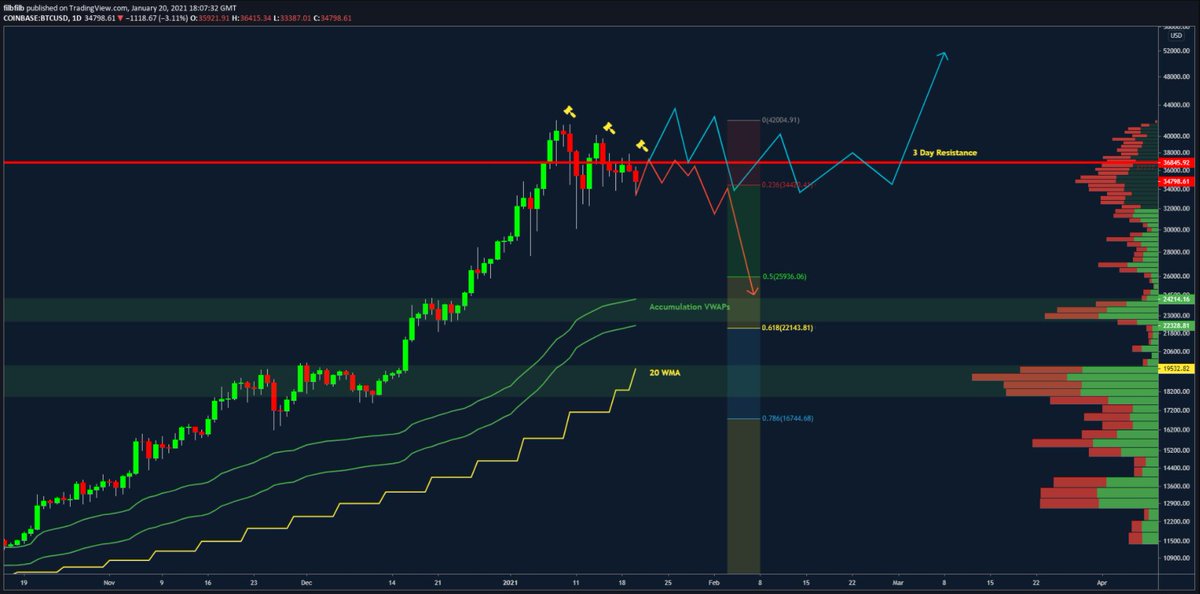
- 20 wma @ $19.5k
- Accumulation VWAPs in the 20s
- underlying tether fud
- 61.8% retracement c. $22k
- 3 Day predator unconfirmed Orange candle
- Demand at low $30s was tested today and has since bounced & Coinbase led price on the drop
- Market structure is complex - Triangle is misleading
- Lots of orders stacked @ 30-33k.
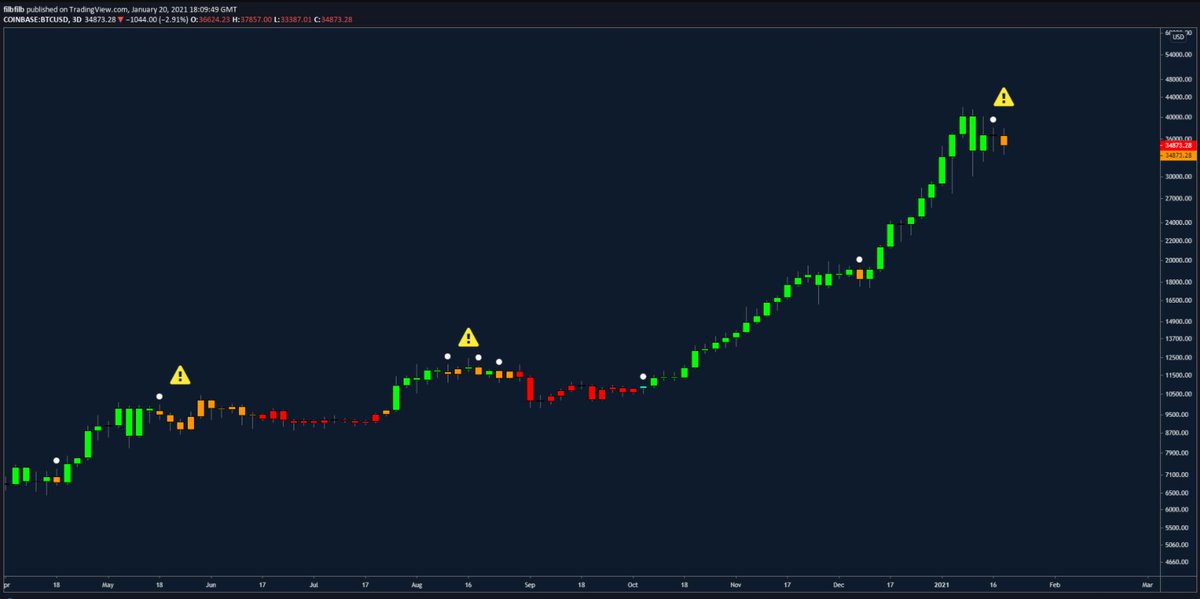
- Market is fearful in the demand zone as shown by funding; i do not think we are ready to drop quite yet; Expecting longer consolidation.
- New Tether output has been on hold but new money came today
- Tether case request for 30 more days; could be indicative of consolidation
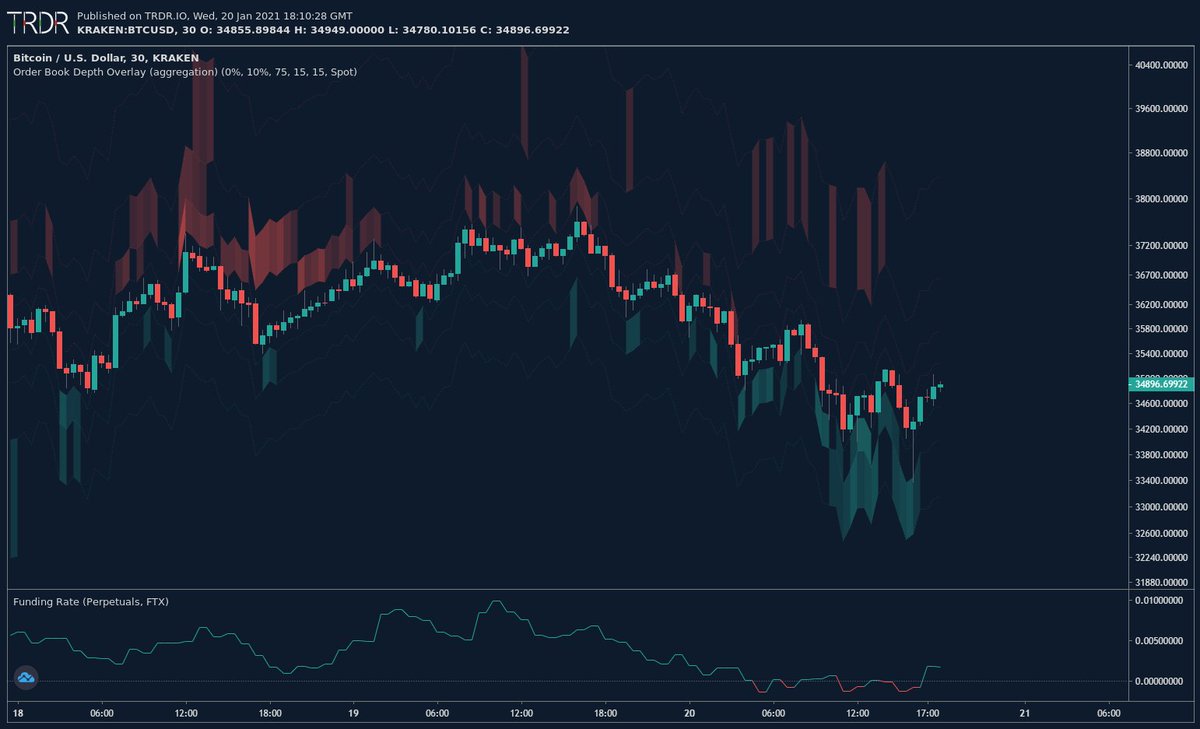
- Breakdown in price deeper than high $20s / lower $30s would IMO most likely require FUD induced event
- If stars align 20 WMA is catching up fast and will probably be resting in with the accumulation VWAPs, 61.8% retracement &d drives into big buy orders.
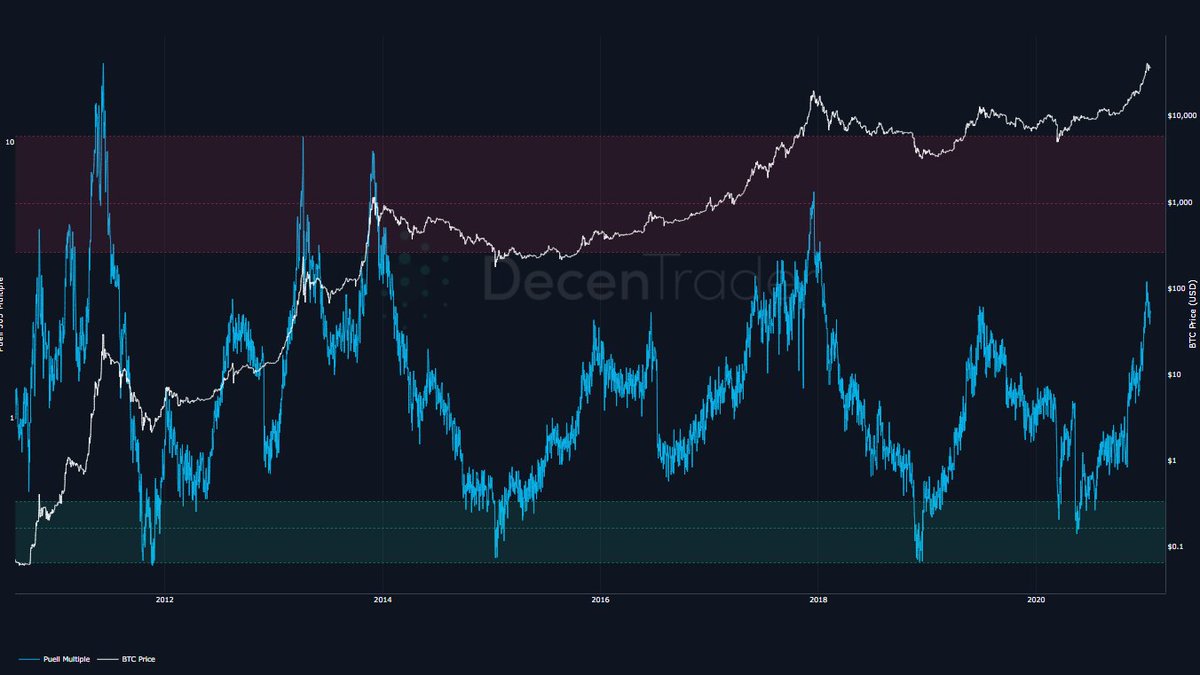
- Why did we stop @ $40k?
- Miners deep in profit vs. 654 average; time to tp
- SImilar response in other cycles
https://t.co/Iurd68NnZZ
- Trapped in consolidation between $30 and $38k
- Lower highs and supply above c$38k
- Buying interest on the books £30-33k
- Meme consolidation triangle
- 20 wma @ $19.5k
- Accumulation VWAPs in the 20s
- underlying tether fud
- 61.8% retracement c. $22k
- 3 Day predator unconfirmed Orange candle
- Demand at low $30s was tested today and has since bounced & Coinbase led price on the drop
- Market structure is complex - Triangle is misleading
- Lots of orders stacked @ 30-33k.
- Market is fearful in the demand zone as shown by funding; i do not think we are ready to drop quite yet; Expecting longer consolidation.
- New Tether output has been on hold but new money came today
- Tether case request for 30 more days; could be indicative of consolidation
- Breakdown in price deeper than high $20s / lower $30s would IMO most likely require FUD induced event
- If stars align 20 WMA is catching up fast and will probably be resting in with the accumulation VWAPs, 61.8% retracement &d drives into big buy orders.
- Why did we stop @ $40k?
- Miners deep in profit vs. 654 average; time to tp
- SImilar response in other cycles
https://t.co/Iurd68NnZZ