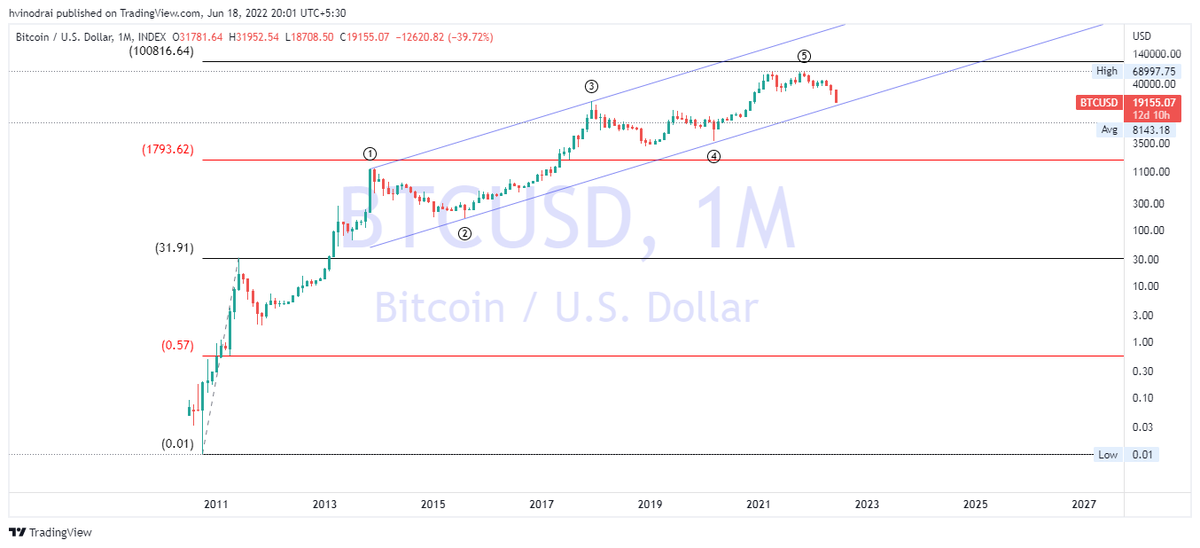
#Bitcoin #BTC - Break of lower channel support at around 16500-17000 shall take it to 1750-1800
Massive price erosion in cryptos a very likely outcome. This shall spill over to equities as well but not to same extent.
More from Harsh / 허쉬
Was looking at #BajajFinance chart once again. I am not able to complete 5 waves yet...hmmm...\U0001f928
— Harsh / \ud5c8\uc26c (@_Harsh_Mehta_) June 17, 2022
As posted earlier, the drop is still 4th (invalidation below 4500).
And target still remains open for 10K+ https://t.co/DozJzNhuuI pic.twitter.com/jPRaEQoPH3
More from Bitcoin
Back with another #FreeLoveFriday. Last time, we covered how Mastercoin/@Omni_Layer pioneered digital asset issuance on blockchains. Today, let\u2019s discuss @Chainlink and the vital role it plays in connecting blockchains to the real world. https://t.co/0poYIBtGrt
— Emin G\xfcn Sirer (@el33th4xor) January 22, 2021
In my thread about Mastercoin, I briefly touched on the vital role fiat-backed stablecoins play in crypto markets, but there’s a catch with them:
The counterparty risk of a third-party holding fiat in reserves.
Enter MakerDAO, which set out to create a decentralized, collateral-backed cryptocurrency, DAI, that would be “soft-pegged” to the U.S. Dollar using the power of algorithms. In crypto tradition, its supporters said trust game theory, not operators.
In 2017, MakerDAO published a whitepaper describing a system where anyone could create DAI by leveraging ETH as collateral to create Collateralized Debt Positions. Essentially, you take out a digital USD loan against your crypto.
The game theory of the system is structured such that DAI issuance is controlled to keep the price pegged to $1.00. In essence, it buffers the fluctuations of the underlying collateral to create a synthetic dollar bill.
claim: bitcoin ownership is heavily concentrated.
@business published an article claiming "2% of accounts control 95% of all Bitcoin" 🤣
truth: the facts, my friends, simple don't line up. let's dive in!
2/ interrogating on-chain addresses is tricky.
address =/ account.
one person can control multiple addresses.
one address can hold bitcoin belonging to multiple ppl.
exchanges and trading firms will have addresses with large balances that represent client funds.
3/ the fine folks @glassnode published an excellent analysis of on-chain address balances in January
the ownership distribution of bitcoin among wallets is actually much more diverse than one might expect.
full piece here:
https://t.co/n5IdIQdNoA
4/ 31% of BTC is held in addresses not identified as exchange wallets.
these are likely institutions, funds, custodians, and OTC desks.
our analysis at @CoinSharesCo indicates >15% of all bitcoin is held in third party custody, including @coinbase and our own @KomainuCustody
5/ in fact, between asset managers @Grayscale ($36B in BTC) and our @xbtprovider ($4B in BTC), 4% of bitcoin is locked up by fund providers and asset managers!
our @CoinSharesCo research team publishes an EXCELLENT weekly report on fund flows and AUMs -
Exceptional listen on #Bitcoin.
— Joseph Skewes (@josephskewes) January 26, 2021
In particular Nic's responses to Mike's aggressive anti-BTC stance.
One dispute with Nic: Even if crypto mail list was best place to announce BTC, if Satoshi wanted fair distribution, surely creating 50% of the supply by Nov 2012 was too fast? https://t.co/e1Hpx4wWOu
#Bitcoin transaction is never really final, given the energy required to keep the network running, and obviously its scale issues will only grow over time. That said, I actually though @nic__carter "won" the debate as it were, and I was unconvinced by the threat to national 2/n
security or undermining Fed policy angles Mike put forward. Two areas that are super interesting to me. One is the issue of #Bitcoin ownership, and how concentrated it is in terms of a small % of addresses that own most of it (2% addresses > 95% of holdings I think). 3/n
made great point a lot of this is omnibus/exchange related - so exchange or fund - ie @Grayscale holds #bitcoin for multiple investors. That may well be true - but it brings up 2 other issues. One - it proves that #bitcoin doesn't really "work" without 4/n
centralisation - as this implies most people need exchanges or funds (or @Paypal) to buy it. If so, that kills off a major "bitcoin is better than gold argument" - as in reality, gold is way more decentralised (from mine supply to ownership distribution). It also brings up a 5/n
Oct. 8, 2020: The purpose of this thread is to document and timestamp when it first became clear that #Bitcoin was likely to become a major reserve asset for public corporations, and eventually states, with Square's purchase of $50M in BTC.
The purpose is to give something to cite when ppl later claim "But there was NO WAY OF KNOWING..."
h/t @ErikSTownsend who used the same format to call out the impact of Covid on Feb 8 and made me personally aware of the looming shutdown of the country https://t.co/opuiNgSeqC !
1/THREAD: WHEN WAS IT CLEAR?
— Erik Townsend \U0001f6e2\ufe0f (@ErikSTownsend) February 8, 2020
Feb. 8, 2020: The purpose of this thread is to document and timestamp when it first became clear that nCov was likely to lead to a global pandemic.
The purpose is to give something to cite when ppl later claim "But there was NO WAY OF KNOWING..."
Bitcoiners smarter than me have been predicting the takeover of the dollar by Bitcoin for many years.
In 2014 with Bitcoin barely at $1B, @pierre_rochard wrote https://t.co/EGHa58KqHq, covering all the incorrect narratives of Bitcoin and stating it will overtake the dollar.
"[skeptics] misunderstand how strong currencies like bitcoin overtake weak currencies like the dollar: it is through speculative attacks and currency crises caused by investors, not through the careful evaluation of tech journalists and 'mainstream consumers'" - @pierre_rochard
I first became bullish on Bitcoin in the summer of 2016, around a $3B market cap, but it was still a toy project at that time in the eyes of most in the financial world, while many technologists thought of it as a v1 technology to be improved on.