https://t.co/0WjuYZ4GTq
Bloomberg Ideas conference now starting! I will be live-tweeting it. You can watch on our Facebook or Twitter pages (links below)!
Today and tomorrow we'll be having a Bloomberg Ideas event!
— Noah Smith (@Noahpinion) October 25, 2018
Today will be a panel on cryptocurrency.
Tomorrow will be panels on the economics of AI, and on regulation of big tech companies.
You can watch livestreams here:https://t.co/1dC0ELGvabhttps://t.co/Juz5Mp2EC1 pic.twitter.com/VfxOscNflo
https://t.co/0WjuYZ4GTq
Russo: Yes. Remittances and cross-border transfers still very small.
(Noah's note: Seems like fees are too high for that)
Feldman: Having been to Iraq, toppling the nation-state sounds bad.
"Cash I think will be better for most kinds of crimes than these anonymous coins for the foreseeable future," says @tylercowen https://t.co/x9lL7uSz8v
— Bloomberg Opinion (@bopinion) October 25, 2018
Levine: A lot of crypto is rediscovering the (institutional) history of finance.
Cowen: Bitcoin is relatively minor as far as energy usage goes, but it's a real problem.
Levine: Lighting network and proof-of-stake.
More from Noah Smith
To be honest, I think this is just the effect of Twitter.
If you're on Twitter all the time - as every political commentator now is - it's easy to think that whiny, big-talking Twitter slacktivists are "the Dems".
But what's happening out there on the ground?
This is another reason I think Twitter is so bad for society.
It convinces intellectuals and commentators that practically everyone who's on their side is an extremist.
Which makes them tolerate extremism out of a (false) feeling of necessity.
If you stay on Twitter too much (which we all do now), you start to think that the typical left-of-center person is some British wanker who quote-tweets "Imagine thinking this" to anyone who doesn't like the idea of "ending capitalism".
But he is not typical.
A majority of Americans are not on Twitter.
But *every* journalist, commentator, and intellectual *has* to be on Twitter.
So every journalist, commentator, and intellectual comes face to face with big-talking slacktivist faux-extremists day in and day out.
It's a problem!!
Online bubbles full of shouty faux-extremists are, in general, fine.
The difference is that every journalist, commentator, and intellectual is essentially forced to exist in THIS bubble, because their jobs require it.
Twitter is a dystopian technology.
(end)
If you're on Twitter all the time - as every political commentator now is - it's easy to think that whiny, big-talking Twitter slacktivists are "the Dems".
But what's happening out there on the ground?
— VeryHiddenGeniusHat (@Popehat) October 18, 2018
This is another reason I think Twitter is so bad for society.
It convinces intellectuals and commentators that practically everyone who's on their side is an extremist.
Which makes them tolerate extremism out of a (false) feeling of necessity.
If you stay on Twitter too much (which we all do now), you start to think that the typical left-of-center person is some British wanker who quote-tweets "Imagine thinking this" to anyone who doesn't like the idea of "ending capitalism".
But he is not typical.
A majority of Americans are not on Twitter.
But *every* journalist, commentator, and intellectual *has* to be on Twitter.
So every journalist, commentator, and intellectual comes face to face with big-talking slacktivist faux-extremists day in and day out.
It's a problem!!
Online bubbles full of shouty faux-extremists are, in general, fine.
The difference is that every journalist, commentator, and intellectual is essentially forced to exist in THIS bubble, because their jobs require it.
Twitter is a dystopian technology.
(end)
1/OK, let's take a little break from Coup Twitter, and think about an economic issue:
How can we build up the wealth of the middle class?
2/The typical American has surprisingly little wealth compared to the typical resident of many other developed countries.
This is a fact that is not widely known or appreciated.
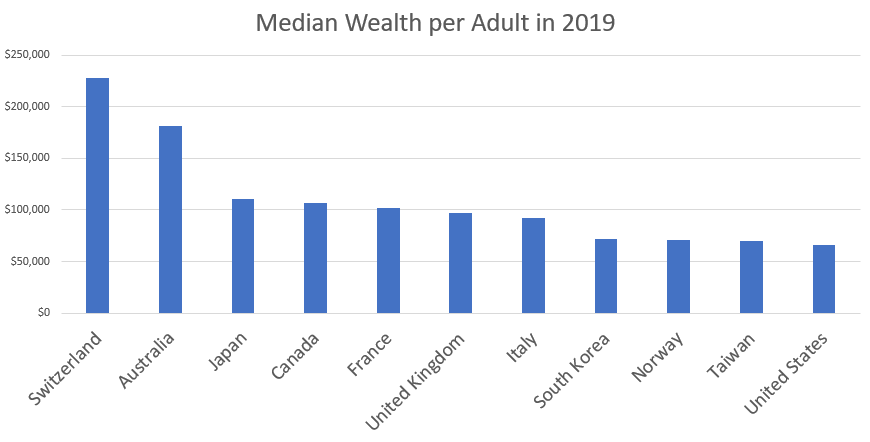
3/Now, some people argue that stuff like Social Security or social insurance programs should be included in wealth. But I chose to focus on private wealth because I think having assets you can sell whenever you want is important to
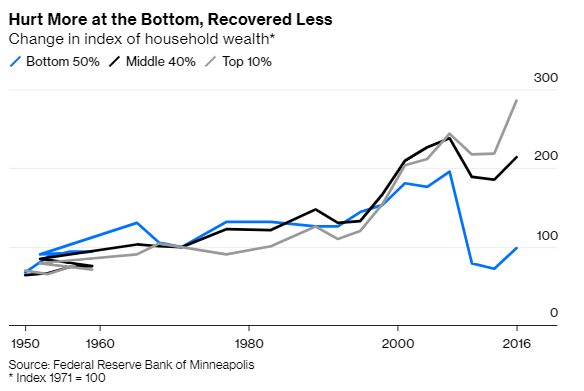
4/For many decades after World War 2, middle-class wealth in America was on a smooth upward trajectory.
Then the housing crash came, and all that changed. Suddenly the rich were still doing well but everyone else was seeing the end of their American Dream.
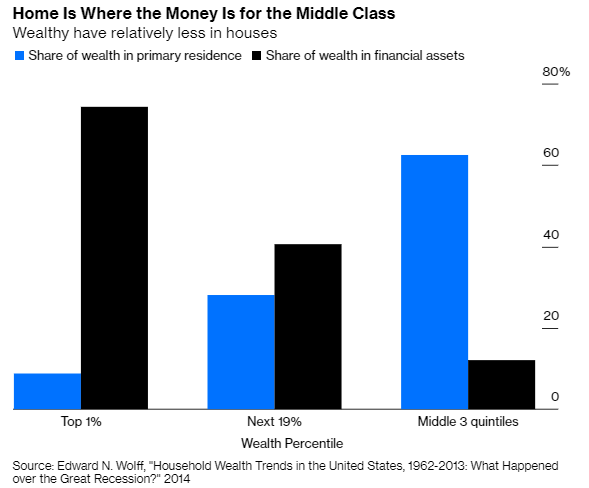
5/Why the divergence?
Because the American middle class has its wealth in houses -- specifically, in the houses they live in.
It's the rich who own stocks.
How can we build up the wealth of the middle class?
2/The typical American has surprisingly little wealth compared to the typical resident of many other developed countries.
This is a fact that is not widely known or appreciated.
3/Now, some people argue that stuff like Social Security or social insurance programs should be included in wealth. But I chose to focus on private wealth because I think having assets you can sell whenever you want is important to
Yes, these numbers don't include things like Social Security, just privately held wealth. They're not an attempt to capitalize every possible future income stream.
— Noahtogolpe \U0001f407 (@Noahpinion) January 10, 2021
4/For many decades after World War 2, middle-class wealth in America was on a smooth upward trajectory.
Then the housing crash came, and all that changed. Suddenly the rich were still doing well but everyone else was seeing the end of their American Dream.
5/Why the divergence?
Because the American middle class has its wealth in houses -- specifically, in the houses they live in.
It's the rich who own stocks.
1/Politics thread time.
To me, the most important aspect of the 2018 midterms wasn't even about partisan control, but about democracy and voting rights. That's the real battle.
2/The good news: It's now an issue that everyone's talking about, and that everyone cares about.
3/More good news: Florida's proposition to give felons voting rights won. But it didn't just win - it won with substantial support from Republican voters.
That suggests there is still SOME grassroots support for democracy that transcends
4/Yet more good news: Michigan made it easier to vote. Again, by plebiscite, showing broad support for voting rights as an
5/OK, now the bad news.
We seem to have accepted electoral dysfunction in Florida as a permanent thing. The 2000 election has never really
Bad ballot design led to a lot of undervotes for Bill Nelson in Broward Co., possibly even enough to cost him his Senate seat. They do appear to be real undervotes, though, instead of tabulation errors. He doesn't really seem to have a path to victory. https://t.co/utUhY2KTaR
— Nate Silver (@NateSilver538) November 16, 2018
Today's @bopinion post is about how poor countries started catching up to rich ones.
It looks like decolonization just took a few decades to start
Basic econ theory says poor countries should grow faster than rich ones.
But for much of the Industrial Revolution, the opposite happened.
https://t.co/JjjVtWzz5c
Why? Probably because the first countries to discover industrial technologies used them to conquer the others!
But then colonial empires went away. And yet still, for the next 30 years or so, poor countries fell further behind rich ones.
https://t.co/hilDvv0IQV
Why??
Possible reasons:
1. Bad institutions (dictators, communism, autarkic trade regimes)
2. Civil wars
3. Lack of education
But then, starting in the 80s (for China) and the 90s (for India and Indonesia), some of the biggest poor countries got their acts together and started to catch up!
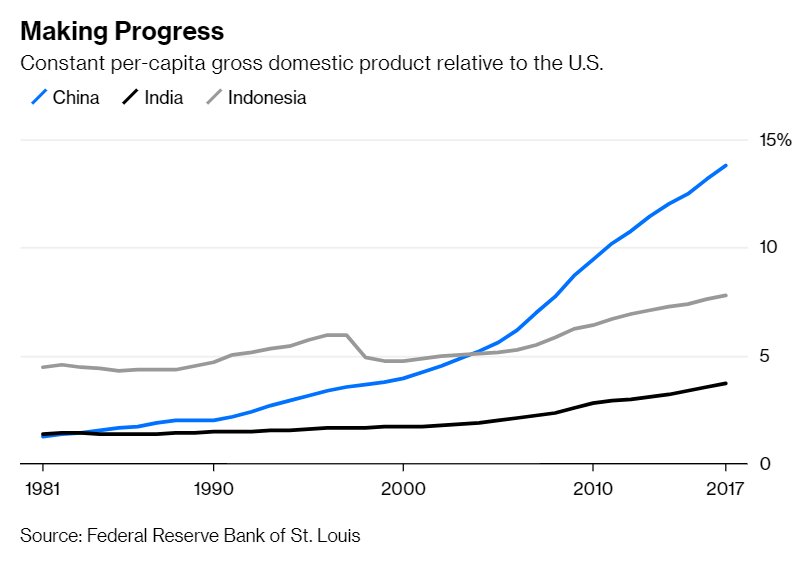
Global inequality began to fall.
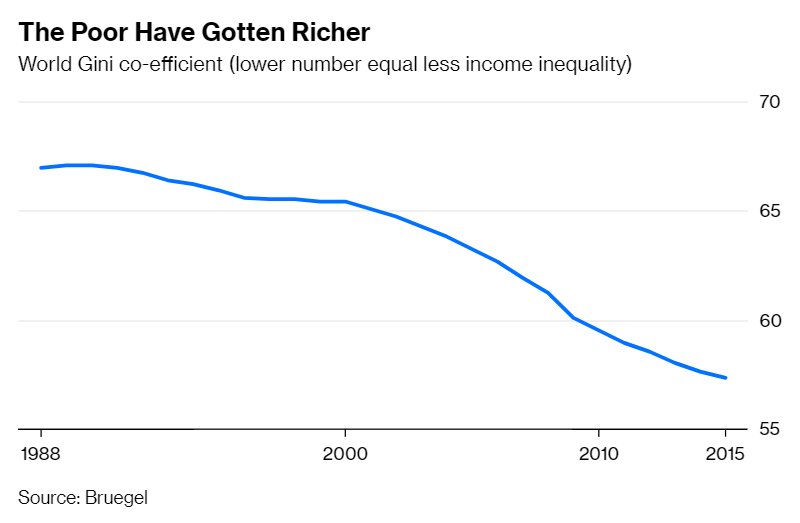
It looks like decolonization just took a few decades to start
Basic econ theory says poor countries should grow faster than rich ones.
But for much of the Industrial Revolution, the opposite happened.
https://t.co/JjjVtWzz5c
Why? Probably because the first countries to discover industrial technologies used them to conquer the others!
But then colonial empires went away. And yet still, for the next 30 years or so, poor countries fell further behind rich ones.
https://t.co/hilDvv0IQV
Why??
Possible reasons:
1. Bad institutions (dictators, communism, autarkic trade regimes)
2. Civil wars
3. Lack of education
But then, starting in the 80s (for China) and the 90s (for India and Indonesia), some of the biggest poor countries got their acts together and started to catch up!
Global inequality began to fall.
1/OK, so. Let's talk about Left-NIMBYism.
We all know about Right-NIMBYs, rabidly protecting their white-flight suburbs from Those People. And there are plenty of liberal NIMBYs too.
But NIMBYs of the Left are also a force to be reckoned
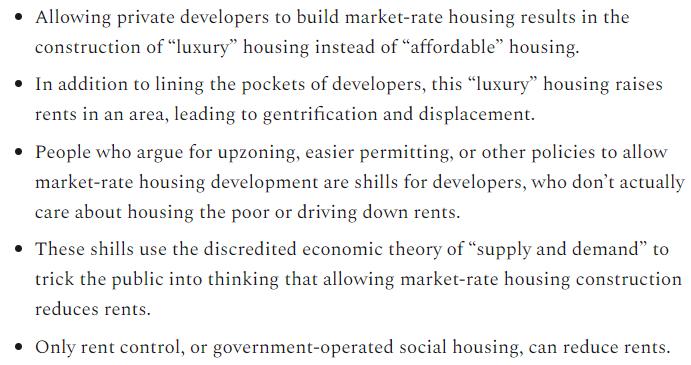
2/Left-NIMBYs have developed a canon of interlocking, mutually reinforcing beliefs about housing and urbanism.
These beliefs are mostly false, but they form a powerful "canon" that quickly ossifies into a hardened worldview.
It looks something like this:
3/Fortunately, Nathan J. Robinson of Current Affairs has written an article that perfectly encapsulates the Left-NIMBY worldview (and quotes me in it!).
So this is a teachable
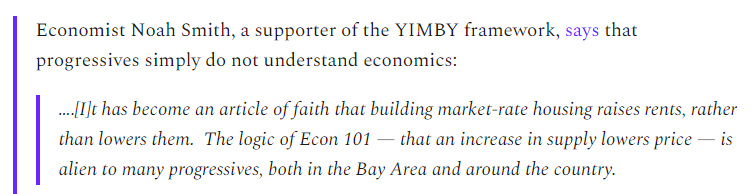
4/Robinson selectively quotes a Bloomberg article of mine (https://t.co/iamRrW6oei).
Look at the part he quoted, vs. what I actually wrote!
Pretty different, eh? 😉
5/In fact, as I wrote in the article that Robinson failed to read more than one line of, it's theoretically possible that Left-NIMBYs COULD be right that allowing market-rate housing drives up local rents.
I take that possibility very seriously, as do YIMBYs.
We all know about Right-NIMBYs, rabidly protecting their white-flight suburbs from Those People. And there are plenty of liberal NIMBYs too.
But NIMBYs of the Left are also a force to be reckoned
2/Left-NIMBYs have developed a canon of interlocking, mutually reinforcing beliefs about housing and urbanism.
These beliefs are mostly false, but they form a powerful "canon" that quickly ossifies into a hardened worldview.
It looks something like this:
3/Fortunately, Nathan J. Robinson of Current Affairs has written an article that perfectly encapsulates the Left-NIMBY worldview (and quotes me in it!).
So this is a teachable
4/Robinson selectively quotes a Bloomberg article of mine (https://t.co/iamRrW6oei).
Look at the part he quoted, vs. what I actually wrote!
Pretty different, eh? 😉
5/In fact, as I wrote in the article that Robinson failed to read more than one line of, it's theoretically possible that Left-NIMBYs COULD be right that allowing market-rate housing drives up local rents.
I take that possibility very seriously, as do YIMBYs.