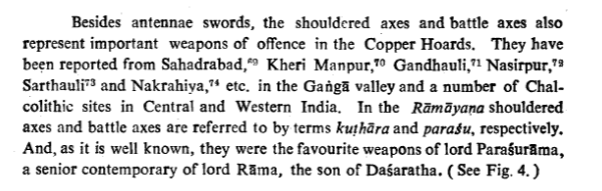
Flat, bar & shouldered celts, double edged axe, hatchet, rings, antennae swords, hooked swords and spearheads, barbed harpoons...(2/n)
There has been considerable speculation by serious researchers into the Bronze/Iron Age cultures who could have produced the itihaasas. While not being a pursuit into the exact provenance.
Krishna Kumar published a detailed analysis in BORI 1992.....(1/n)
What are the evidences that support historicity of Ramayana?
— \u1c74\u1c77\u1c63 \u1c74\u1c68\u1c69\u1c6e \u1c65\u1c64\u1c5c\u1c62\u1c5a (@SunKnight___) October 1, 2022
Flat, bar & shouldered celts, double edged axe, hatchet, rings, antennae swords, hooked swords and spearheads, barbed harpoons...(2/n)
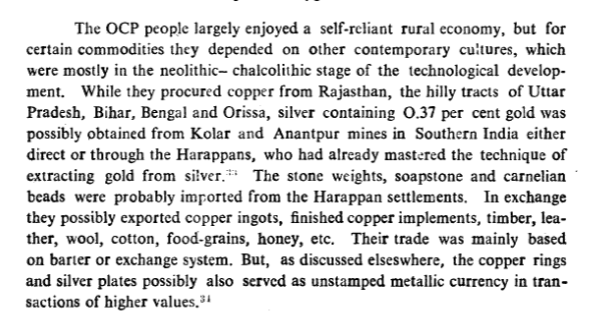
(4/n)....
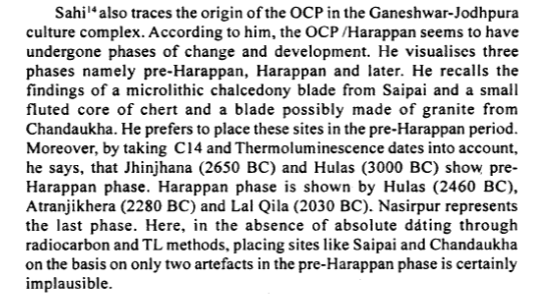
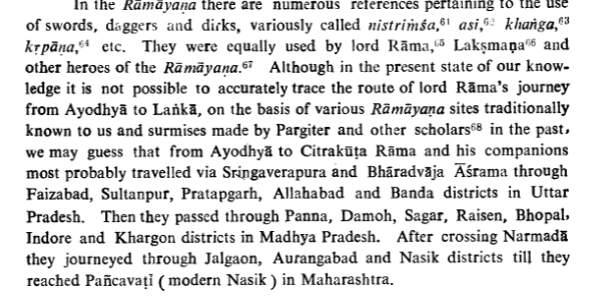
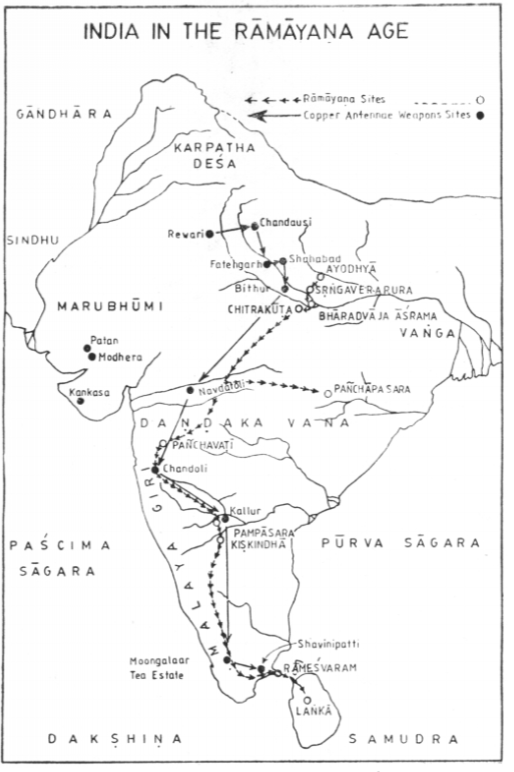
Krishna Kumar therefore assesses a fit between the culture that might have produced the Ramayana and the archaeo-record. (6/n)
The finding of a grave buried chariot at Sinauli (OCP culture) has led to renewed discussions in the Indian archaeological community. (7/n)
The contrast with Harappans, who seemed to have exclusively concentrated on trade/urbanism, could not be greater. (8/n)
More from All

https://t.co/6cRR2B3jBE
Viruses and other pathogens are often studied as stand-alone entities, despite that, in nature, they mostly live in multispecies associations called biofilms—both externally and within the host.
https://t.co/FBfXhUrH5d

Microorganisms in biofilms are enclosed by an extracellular matrix that confers protection and improves survival. Previous studies have shown that viruses can secondarily colonize preexisting biofilms, and viral biofilms have also been described.

...we raise the perspective that CoVs can persistently infect bats due to their association with biofilm structures. This phenomenon potentially provides an optimal environment for nonpathogenic & well-adapted viruses to interact with the host, as well as for viral recombination.

Biofilms can also enhance virion viability in extracellular environments, such as on fomites and in aquatic sediments, allowing viral persistence and dissemination.

Viruses and other pathogens are often studied as stand-alone entities, despite that, in nature, they mostly live in multispecies associations called biofilms—both externally and within the host.
https://t.co/FBfXhUrH5d
Microorganisms in biofilms are enclosed by an extracellular matrix that confers protection and improves survival. Previous studies have shown that viruses can secondarily colonize preexisting biofilms, and viral biofilms have also been described.
...we raise the perspective that CoVs can persistently infect bats due to their association with biofilm structures. This phenomenon potentially provides an optimal environment for nonpathogenic & well-adapted viruses to interact with the host, as well as for viral recombination.
Biofilms can also enhance virion viability in extracellular environments, such as on fomites and in aquatic sediments, allowing viral persistence and dissemination.