2. Reliance (11%) Infy (7.5%) TCS (5%)& HDFC (5.80 %) are other major contributors, have all info about them to get an idea about Nifty's next move.
Top 51 Tips to do Option Buying in Nifty.
🧵
2. Reliance (11%) Infy (7.5%) TCS (5%)& HDFC (5.80 %) are other major contributors, have all info about them to get an idea about Nifty's next move.
4. While preparing for the next day in Nifty, look at the OI & PA data of these contributors & Nifty itself.
6. Always set daily maximum loss limit beforehand, depending on your account size.
8. The quantity you take in each trade will be decided After you decide the SL, not before.
10. If you can't find a small SL trade & you have to go with a large SL - decrease your quantity accordingly.
12. Never exceed your loss limit , both per trade & daily ones.
14. When the market is dull, esp. during mid-day hours, avoid option buying in Nifty.
16. Draw Support & Resistance lines on Major (1D & 60 Min) as well as trading (5-15 Min) TF.
17. The S/R levels which align with S/R from OI are more important.
19. Before initiating any trade, do check the charts & OI data of major constituents of Nifty as well as BNF.
21. Using TSL (trailing SL) will ensure you ride maximum of trend.
23. For trading Nifty in intraday 5 & 3 min TF works best.
25. Avoid getting caught in Breakout failures. The concept of "Testing" helps a lot with this.
27. Do not initiate any trade based on just News. Always wait for Data to confirm direction.
29. On Expiry Day, you'll get lots of good scalping opportunities, if you show enough patience.
31. Keep looking at unwinding & addition of OI at different levels to get an idea about direction.
33. While going for BTST, always study the data of nifty as well as it's constituents carefully.
35. Finnifty is affecting Nifty heavily on Tuesdays, so keep an eye on that too.
15 more super tips are remaining which I'll DM to you once you Retweet the First Tweet of this thread below..
https://t.co/cY7kcRk6yA
Plz note that....
Top 51 Tips to do Option Buying in Nifty.
— The Cnceptual Trader \U0001f1ee\U0001f1f3 (@CnceptualTrader) September 6, 2022
\U0001f9f5
@CnceptualTrader
to get the DM containing 15 more Super Tips & other interesting stuffs.
Thank you.
More from The Cnceptual Trader 🇮🇳


More from All


















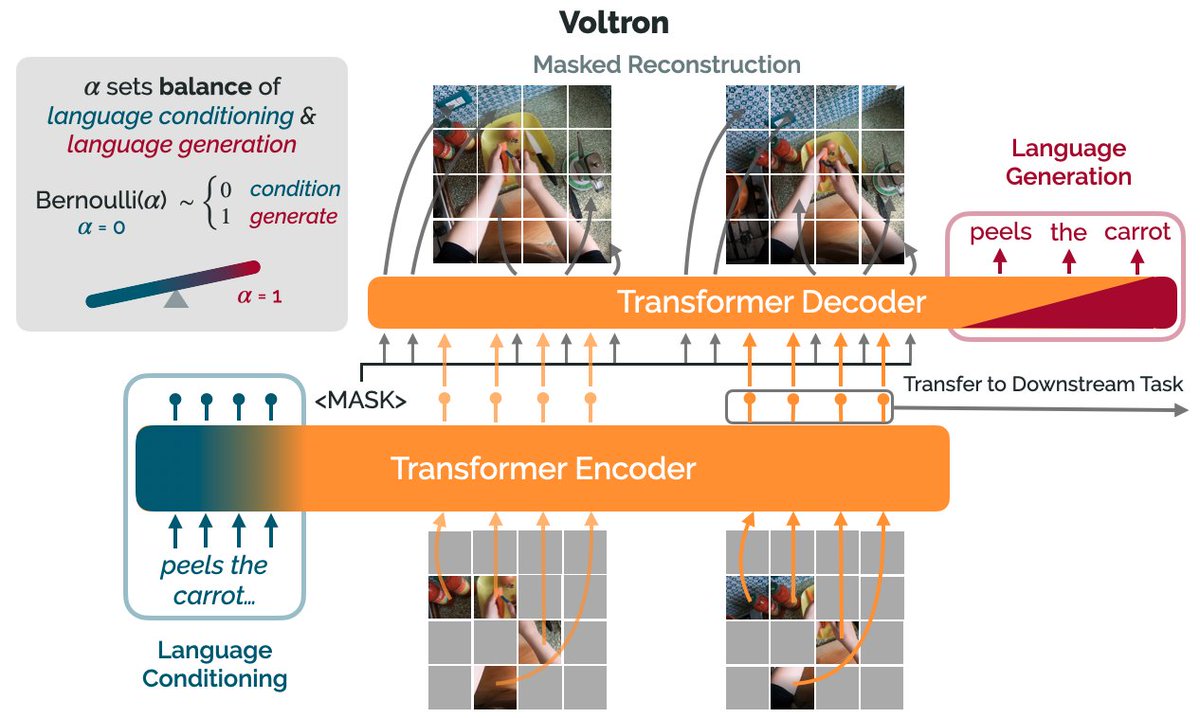
How can we use language supervision to learn better visual representations for robotics?
Introducing Voltron: Language-Driven Representation Learning for Robotics!
Paper: https://t.co/gIsRPtSjKz
Models: https://t.co/NOB3cpATYG
Evaluation: https://t.co/aOzQu95J8z
🧵👇(1 / 12)
Videos of humans performing everyday tasks (Something-Something-v2, Ego4D) offer a rich and diverse resource for learning representations for robotic manipulation.
Yet, an underused part of these datasets are the rich, natural language annotations accompanying each video. (2/12)
The Voltron framework offers a simple way to use language supervision to shape representation learning, building off of prior work in representations for robotics like MVP (https://t.co/Pb0mk9hb4i) and R3M (https://t.co/o2Fkc3fP0e).
The secret is *balance* (3/12)
Starting with a masked autoencoder over frames from these video clips, make a choice:
1) Condition on language and improve our ability to reconstruct the scene.
2) Generate language given the visual representation and improve our ability to describe what's happening. (4/12)
By trading off *conditioning* and *generation* we show that we can learn 1) better representations than prior methods, and 2) explicitly shape the balance of low and high-level features captured.
Why is the ability to shape this balance important? (5/12)
Introducing Voltron: Language-Driven Representation Learning for Robotics!
Paper: https://t.co/gIsRPtSjKz
Models: https://t.co/NOB3cpATYG
Evaluation: https://t.co/aOzQu95J8z
🧵👇(1 / 12)
Videos of humans performing everyday tasks (Something-Something-v2, Ego4D) offer a rich and diverse resource for learning representations for robotic manipulation.
Yet, an underused part of these datasets are the rich, natural language annotations accompanying each video. (2/12)
The Voltron framework offers a simple way to use language supervision to shape representation learning, building off of prior work in representations for robotics like MVP (https://t.co/Pb0mk9hb4i) and R3M (https://t.co/o2Fkc3fP0e).
The secret is *balance* (3/12)
Starting with a masked autoencoder over frames from these video clips, make a choice:
1) Condition on language and improve our ability to reconstruct the scene.
2) Generate language given the visual representation and improve our ability to describe what's happening. (4/12)
By trading off *conditioning* and *generation* we show that we can learn 1) better representations than prior methods, and 2) explicitly shape the balance of low and high-level features captured.
Why is the ability to shape this balance important? (5/12)

You May Also Like

1/ Here’s a list of conversational frameworks I’ve picked up that have been helpful.
Please add your own.
2/ The Magic Question: "What would need to be true for you
3/ On evaluating where someone’s head is at regarding a topic they are being wishy-washy about or delaying.
“Gun to the head—what would you decide now?”
“Fast forward 6 months after your sabbatical--how would you decide: what criteria is most important to you?”
4/ Other Q’s re: decisions:
“Putting aside a list of pros/cons, what’s the *one* reason you’re doing this?” “Why is that the most important reason?”
“What’s end-game here?”
“What does success look like in a world where you pick that path?”
5/ When listening, after empathizing, and wanting to help them make their own decisions without imposing your world view:
“What would the best version of yourself do”?
Please add your own.
2/ The Magic Question: "What would need to be true for you
1/\u201cWhat would need to be true for you to\u2026.X\u201d
— Erik Torenberg (@eriktorenberg) December 4, 2018
Why is this the most powerful question you can ask when attempting to reach an agreement with another human being or organization?
A thread, co-written by @deanmbrody: https://t.co/Yo6jHbSit9
3/ On evaluating where someone’s head is at regarding a topic they are being wishy-washy about or delaying.
“Gun to the head—what would you decide now?”
“Fast forward 6 months after your sabbatical--how would you decide: what criteria is most important to you?”
4/ Other Q’s re: decisions:
“Putting aside a list of pros/cons, what’s the *one* reason you’re doing this?” “Why is that the most important reason?”
“What’s end-game here?”
“What does success look like in a world where you pick that path?”
5/ When listening, after empathizing, and wanting to help them make their own decisions without imposing your world view:
“What would the best version of yourself do”?