I've raised $20M for my startups by just emailing

Fundraising is hard but with the right system, anyone can raise

Here's my step by step process

1. Find Interested Investors

Let's say you're building an automation tool

Go to Crunchbase and look up every NON-DIRECT competitor startup in a related sector (No-Code SaaS in this case)

List down ALL companies and ALL their investors
Go to the Investor Funds' website to find their email

OR

b) Use VoilaNorbert. com or apollo .io

Put the first + last name + Company URL, and it will try a bunch of email permutations and predict the correct one with a 98% success rate.
Create a list of 200-300 investors

Research

1) Which stage they like to invest in,
2) How much money do they typically deploy, and
3) Which person from their investment team led the investment in another startup in the related space
Unpopular advice -

Rank investors by how willing you are to lose them

Start with those first, get their feedback, keep improving your pitch and then work upwards.

(I'm an Angel, so shouldn't be saying this, but heh it works, lol)
2. Now draft an email sequence

A good email will do the following -

1) Establish Competence
2) Explain what the company does
3) Share your growth and progress
4) End with a clear CTA
1) Establish Competence by sharing your past success - (Time to 💪)
After they know you are a capable founder, give them a no bs explanation of what you're building
Now that they know you and your company, blow them away by your growth and progress
Make it easy for them to respond by ending with a Yes/No Call-To-Action
- Follow up at least two times with each person
- Keep an interval of 2 days between each follow-up
- Use a shorter version of the above email to follow-up

Use Snov .io to check who has opened your email and who hasn't
As you talk to more investors you will get feedback on how to make a better deck and pitch, iterate!

- Record🔴 all video calls (w/permission)
- What makes Investors' faces light up and what causes them to lose interest
- Note all feedback and rapidly improve your pitch
The purpose of your deck is to show why your startup WILL be a massive business one day and make your investors a killer IRR

Therefore, only two questions matter to an investor
1) How strong is your business today?
2) How big will it be tomorrow?
For Inspiration - Head to slidebean .com and study examples of successful pitch decks such as Uber and AirBnB

Here's my framework for nailing the two questions that matter most:

How strong is your startup today?
Answer with - at least 3 of these:

1) Solid Revenue
2) Great Growth
3) Strong Unit Economics
4) Fast Execution Speed
5) Dedicated Customer Love

If you can be great at 3 of these, you can be average at the rest.
How big can your startup be tomorrow?

Answer with -

7) Market size is large (mandatory)
8) Category tailwinds favor your growth
9) Your unique business strategy
10) Relevant competition and why you'll beat them
11) How you will Profitably Scale

Again, you just need 3 of these
Also, include:

12) Why you founded this startup
13) Why you're the right founder at the right time
14) Why your team is the best team in the space

Being great at all 3 of these will give you room to screw up in other areas
TLDR;

- Speak to investors you're willing to lose and work upwards
- Record their feedback
- Rapidly improve your pitch
- Focus on answering the 2 questions
My fundraising process summed up

1) Find Investors
2) Create an Email Database
3) Follow Up
4) Focus your pitch on 2 questions only
4) Get on calls and get feedback
5) Keep improving your pitch
6) Repeat
I AM SHARING MY DATABASE OF VCs THAT I USED TO RAISE $20 MILLION

There's $10 Billion+ of active, available capital on this list

Retweet + comment and I'll send it to you for free
Retweet the first tweet if you found this helpful

Follow @jspeiser for more. https://t.co/0y6hU21aDg

More from All

MASTER THREAD on Short Strangles.

Curated the best tweets from the best traders who are exceptional at managing strangles.

• Positional Strangles
• Intraday Strangles
• Position Sizing
• How to do Adjustments
• Plenty of Examples
• When to avoid
• Exit Criteria

How to sell Strangles in weekly expiry as explained by boss himself. @Mitesh_Engr

• When to sell
• How to do Adjustments
• Exit


Beautiful explanation on positional option selling by @Mitesh_Engr
Sir on how to sell low premium strangles yourself without paying anyone. This is a free mini course in


1st Live example of managing a strangle by Mitesh Sir. @Mitesh_Engr

• Sold Strangles 20% cap used
• Added 20% cap more when in profit
• Booked profitable leg and rolled up
• Kept rolling up profitable leg
• Booked loss in calls
• Sold only


2nd example by @Mitesh_Engr Sir on converting a directional trade into strangles. Option Sellers can use this for consistent profit.

• Identified a reversal and sold puts

• Puts decayed a lot

• When achieved 2% profit through puts then sold
1. Mini Thread on Conflicts of Interest involving the authors of the Nature Toilet Paper:
https://t.co/VUYbsKGncx
Kristian G. Andersen
Andrew Rambaut
Ian Lipkin
Edward C. Holmes
Robert F. Garry

2. Thanks to @newboxer007 for forwarding the link to the research by an Australian in Taiwan (not on

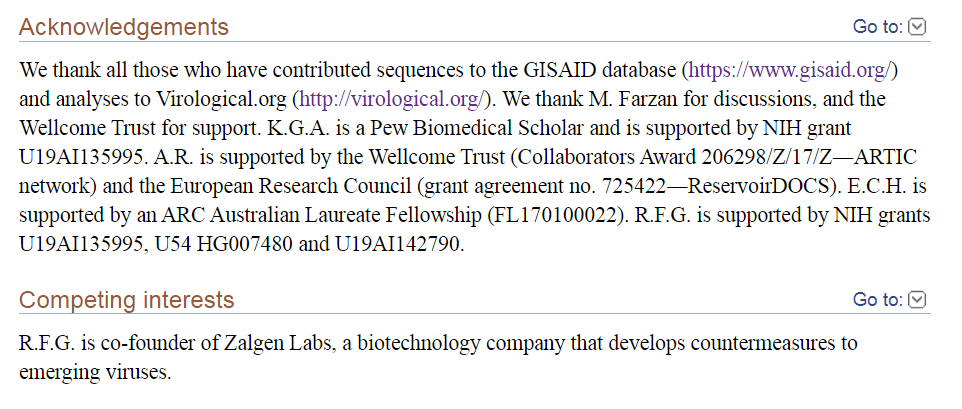
3. K.Andersen didn't mention "competing interests"
Only Garry listed Zalgen Labs, which we will look at later.
In acknowledgements, Michael Farzan, Wellcome Trust, NIH, ERC & ARC are mentioned.
Author affiliations listed as usual.
Note the 328 Citations!
https://t.co/nmOeohM89Q


4. Kristian Andersen (1)
Andersen worked with USAMRIID & Fort Detrick scientists on research, with Robert Garry, Jens Kuhn & Sina Bavari among


5. Kristian Andersen (2)
Works at Scripps Research Institute, which WAS in serious financial trouble, haemorrhaging 20 million $ a year.
But just when the first virus cases were emerging, they received great news.
They issued a press release dated November 27, 2019:

You May Also Like