____________________
What is Kundalini?
____________________

Kundalini is the name of a sleeping dormant potential force in the human organism.
(1/13)
#threadseries

@DeepaShreeAB @V_Shuddhi @LostTemple7 @rightwingchora
@hathyogi31

and it is situated at the root of the spinal column. In the masculine body it is in the perineum, between the urinary and excretory organs.
In the female body its location is at the root of the uterus, in the cervix.
(2/13)
This centre is known as mooladhara chakra and it is actually a physical structure. It is a small gland which you can even take out and press.
(3/13)
However, kundalini is a dormant energy, and even if you press it, it will not explode like a bomb.
(4/13)
To awaken kundalini you must prepare yourself through yogic techniques. You must practise asanas, pranayama, kriya yoga and meditation.
(5/13)
Then, when you are able to direct your prana into the seat of kundalini, the energy wakes up and makes its way through sushumna nadi, in the central nervous canal, to the brain.
(6/13)
As kundalini ascends, it passes through each of the chakras which are interconnected with the different silent areas of the brain.
(7/13)
With the awakening of kundalini there is an explosion in the brain as the dormant or sleeping areas start blossoming like flowers.
(8/13)
Therefore, kundalini can be equated with the awakening of the silent areas of the brain.
(9/13)
Although kundalini is said to reside in mooladhara chakra, we are all at different stages of evolution, and in some of us kundalini may have already reached swadhisthana, manipura or anahata chakra.
(10/13)
If this is so, whatever sadhana you do now might start an awakening in anahata or some other chakra.
However, awakening of kundalini in mooladhara chakra is one thing, and awakening in sahasrara, the highest centre of the brain is another.
(11/13)
Once the multi-petalled lotus of sahasrara blossoms, a new consciousness dawns. Our present consciousness is not independent, as the mind depends on the information supplied by the senses.
(12/13)
If you have no eyes, you can never see; if you are deaf, you will never hear. However, when the superconsciousness emerges, experience becomes completely independent and knowledge also becomes completely independent.
(13/13)
Note :-
🙏Mute tagged while replying

More from All

1. Mini Thread on Conflicts of Interest involving the authors of the Nature Toilet Paper:
https://t.co/VUYbsKGncx
Kristian G. Andersen
Andrew Rambaut
Ian Lipkin
Edward C. Holmes
Robert F. Garry

2. Thanks to @newboxer007 for forwarding the link to the research by an Australian in Taiwan (not on

3. K.Andersen didn't mention "competing interests"
Only Garry listed Zalgen Labs, which we will look at later.
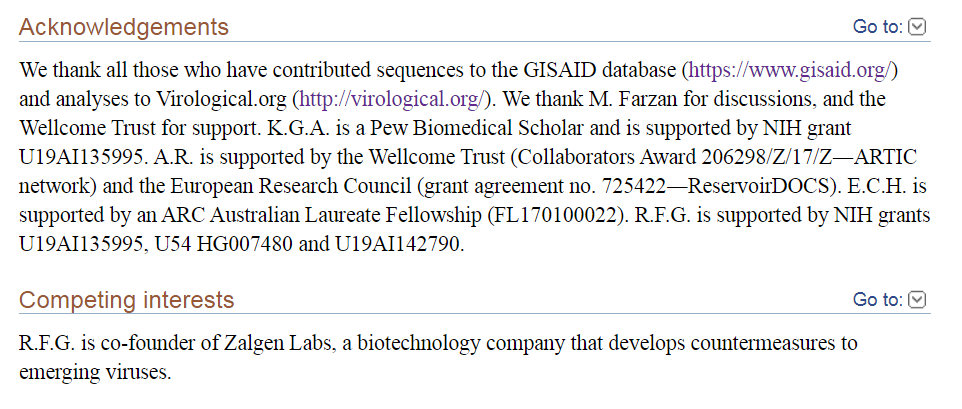
In acknowledgements, Michael Farzan, Wellcome Trust, NIH, ERC & ARC are mentioned.
Author affiliations listed as usual.
Note the 328 Citations!
https://t.co/nmOeohM89Q


4. Kristian Andersen (1)
Andersen worked with USAMRIID & Fort Detrick scientists on research, with Robert Garry, Jens Kuhn & Sina Bavari among


5. Kristian Andersen (2)
Works at Scripps Research Institute, which WAS in serious financial trouble, haemorrhaging 20 million $ a year.
But just when the first virus cases were emerging, they received great news.
They issued a press release dated November 27, 2019:
How can we use language supervision to learn better visual representations for robotics?

Introducing Voltron: Language-Driven Representation Learning for Robotics!

Paper: https://t.co/gIsRPtSjKz
Models: https://t.co/NOB3cpATYG
Evaluation: https://t.co/aOzQu95J8z

🧵👇(1 / 12)


Videos of humans performing everyday tasks (Something-Something-v2, Ego4D) offer a rich and diverse resource for learning representations for robotic manipulation.

Yet, an underused part of these datasets are the rich, natural language annotations accompanying each video. (2/12)

The Voltron framework offers a simple way to use language supervision to shape representation learning, building off of prior work in representations for robotics like MVP (
https://t.co/Pb0mk9hb4i) and R3M (https://t.co/o2Fkc3fP0e).

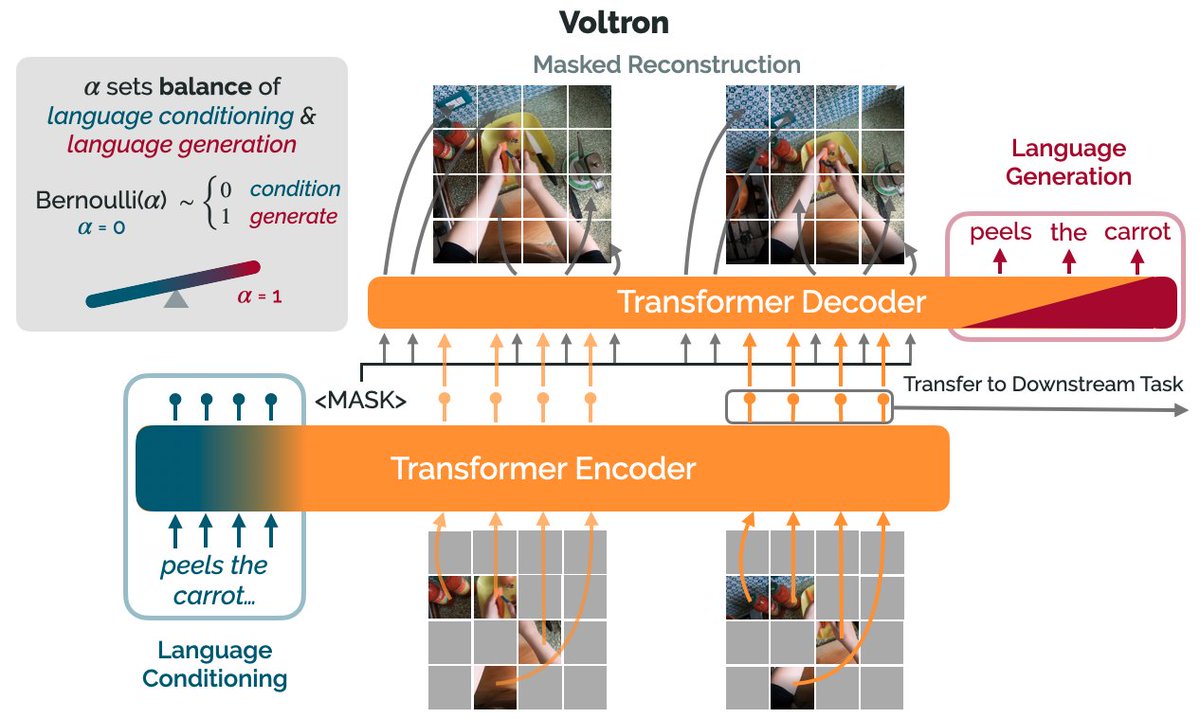
The secret is *balance* (3/12)

Starting with a masked autoencoder over frames from these video clips, make a choice:

1) Condition on language and improve our ability to reconstruct the scene.

2) Generate language given the visual representation and improve our ability to describe what's happening. (4/12)

By trading off *conditioning* and *generation* we show that we can learn 1) better representations than prior methods, and 2) explicitly shape the balance of low and high-level features captured.

Why is the ability to shape this balance important? (5/12)

You May Also Like

Great article from @AsheSchow. I lived thru the 'Satanic Panic' of the 1980's/early 1990's asking myself "Has eveyrbody lost their GODDAMN MINDS?!"


The 3 big things that made the 1980's/early 1990's surreal for me.

1) Satanic Panic - satanism in the day cares ahhhh!

2) "Repressed memory" syndrome

3) Facilitated Communication [FC]

All 3 led to massive abuse.

"Therapists" -and I use the term to describe these quacks loosely - would hypnotize people & convince they they were 'reliving' past memories of Mom & Dad killing babies in Satanic rituals in the basement while they were growing up.

Other 'therapists' would badger kids until they invented stories about watching alligators eat babies dropped into a lake from a hot air balloon. Kids would deny anything happened for hours until the therapist 'broke through' and 'found' the 'truth'.

FC was a movement that started with the claim severely handicapped individuals were able to 'type' legible sentences & communicate if a 'helper' guided their hands over a keyboard.