
1. “Who Are Ireland’s Members Of The World Economic Forum Implementing The Great Reset In 2021 ? 🧵1/28
🕵️🔎 Politicians, Musicians, Clergy, Bankers, Journalists, Human Rights, Artificial Intelligence, Sustainability, Corporations & Agriculture

Leo Varadkar
Former Taoiseach, Tánaiste and Minister for Enterprise and also a member of the Young Global leaders site
https://t.co/5Cq2bu04mn
Former Minister of Finance, Department of Finance of Ireland
https://t.co/y8KD9sJEhr
David McWilliams
Broadcaster, Writer and Commentator, Iconic Media Ltd and also a member of the Young Global Leaders site
https://t.co/YLRkLZ6PE6
Francesca McDonagh
Chief Executive Officer, Bank of Ireland Group
https://t.co/QLd7FonC9J
Chief Executive Officer, sub-Saharan Africa, JPMorgan Chase & Co
https://t.co/agbzP6yQU2
Eimear Farrell
Human Rights Officer
Heads Up Ireland's national Artificial Intelligence Strategy
https://t.co/QqqlooyKXx
William (Liam) Casey
Founder and Chief Executive Officer, PCH International
Interestingly, on their site https://t.co/9ek6ABLeoR there is a link to providing PPE to hospitals which is now broken
https://t.co/F8lmZIlMZE
Director-General, Development Cooperation and Africa Division, Irish Aid
https://t.co/ZVadn585Wo
Co-Founder and COO, Kinzen. Also married to Aodhán Ó Ríordáin who is an Irish Labour Party politician.
Not sure why but the link to her profile is broken 🤔
https://t.co/GCWqi2ssfk
Senior Partner and Managing Director, Boston Consulting Group.
https://t.co/YYHZ3coWWM
https://t.co/7YMwLVzDfp
Time for a bit of housekeeping. I\u2019ve collated all my\U0001f9f5and put them in one place to make them easier to find. Lots of\U0001f407\U0001f573\ufe0f to go down. Download links\U0001f447for each\U0001f9f5in a word document as well if you want to circulate. Enjoy
— Stephen Fasenfeld \U0001f600 (@fasenfeld) December 19, 2020
More from Economy


1. HUGE DISCOVERY!
What would have been exposed if @GenFlynn hadn't been impeded by corrupt FBI, DOJ and the Obama White house?
He'd have exposed CHINA and their laundering of IRANIAN OIL MONEY!
Read the thread below for the back story on how they went after Flynn.
What would have been exposed if @GenFlynn hadn't been impeded by corrupt FBI, DOJ and the Obama White house?
He'd have exposed CHINA and their laundering of IRANIAN OIL MONEY!
Read the thread below for the back story on how they went after Flynn.
1. As promised.
— \U0001f1fa\U0001f1f8 \U0001d7dc\U0001d7d8\u210d\U0001d556\U0001d552\U0001d555 \U0001f1fa\U0001f1f8 \u2b50\u2b50\u2b50 \U0001f1fa\U0001f1f8 (@40_head) December 2, 2020
A deep dig covering years of research. This is going to take you committing some real time to get through. What's THIS all about?
A coup. Murder. Treason. Laundering gold for Iran...I think it will blow your mind.


You May Also Like






A list of cool websites you might now know about
A thread 🧵
1) Learn Anything - Search tools for knowledge discovery that helps you understand any topic through the most efficient
2) Grad Speeches - Discover the best commencement speeches.
This website is made by me
3) What does the Internet Think - Find out what the internet thinks about anything
4) https://t.co/vuhT6jVItx - Send notes that will self-destruct after being read.
A thread 🧵
1) Learn Anything - Search tools for knowledge discovery that helps you understand any topic through the most efficient
2) Grad Speeches - Discover the best commencement speeches.
This website is made by me
3) What does the Internet Think - Find out what the internet thinks about anything
4) https://t.co/vuhT6jVItx - Send notes that will self-destruct after being read.

@EricTopol @NBA @StephenKissler @yhgrad B.1.1.7 reveals clearly that SARS-CoV-2 is reverting to its original pre-outbreak condition, i.e. adapted to transgenic hACE2 mice (either Baric's BALB/c ones or others used at WIV labs during chimeric bat coronavirus experiments aimed at developing a pan betacoronavirus vaccine)
@NBA @StephenKissler @yhgrad 1. From Day 1, SARS-COV-2 was very well adapted to humans .....and transgenic hACE2 Mice
@NBA @StephenKissler @yhgrad 2. High Probability of serial passaging in Transgenic Mice expressing hACE2 in genesis of SARS-COV-2
@NBA @StephenKissler @yhgrad B.1.1.7 has an unusually large number of genetic changes, ... found to date in mouse-adapted SARS-CoV2 and is also seen in ferret infections.
https://t.co/9Z4oJmkcKj

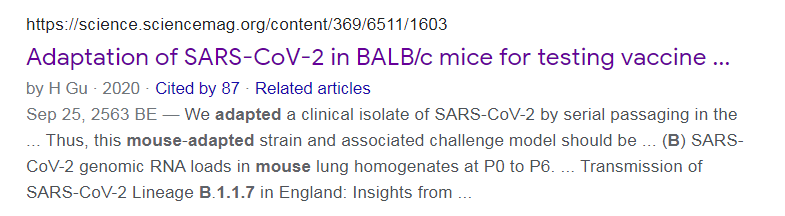
@NBA @StephenKissler @yhgrad We adapted a clinical isolate of SARS-CoV-2 by serial passaging in the ... Thus, this mouse-adapted strain and associated challenge model should be ... (B) SARS-CoV-2 genomic RNA loads in mouse lung homogenates at P0 to P6.
https://t.co/I90OOCJg7o
@NBA @StephenKissler @yhgrad 1. From Day 1, SARS-COV-2 was very well adapted to humans .....and transgenic hACE2 Mice
1. From Day 1, SARS-COV-2 was very well adapted to humans .....and transgenic hACE2 Mice
— Billy Bostickson \U0001f3f4\U0001f441&\U0001f441 \U0001f193 (@BillyBostickson) January 30, 2021
"we generated a mouse model expressing hACE2 by using CRISPR/Cas9 knockin technology. In comparison with wild-type C57BL/6 mice, both young & aged hACE2 mice sustained high viral loads... pic.twitter.com/j94XtSkscj
@NBA @StephenKissler @yhgrad 2. High Probability of serial passaging in Transgenic Mice expressing hACE2 in genesis of SARS-COV-2
1. High Probability of serial passaging in Transgenic Mice expressing hACE2 in genesis of SARS-COV-2!
— Billy Bostickson \U0001f3f4\U0001f441&\U0001f441 \U0001f193 (@BillyBostickson) January 2, 2021
2 papers:
Human\u2013viral molecular mimicryhttps://t.co/irfH0Zgrve
Molecular Mimicryhttps://t.co/yLQoUtfS6s https://t.co/lsCv2iMEQz
@NBA @StephenKissler @yhgrad B.1.1.7 has an unusually large number of genetic changes, ... found to date in mouse-adapted SARS-CoV2 and is also seen in ferret infections.
https://t.co/9Z4oJmkcKj
@NBA @StephenKissler @yhgrad We adapted a clinical isolate of SARS-CoV-2 by serial passaging in the ... Thus, this mouse-adapted strain and associated challenge model should be ... (B) SARS-CoV-2 genomic RNA loads in mouse lung homogenates at P0 to P6.
https://t.co/I90OOCJg7o


