Mollyycolllinss Categories For later read
7 days
30 days
All time
Recent
Popular

So this is a subject that fascinates me for one reason.
Authoritarians (both followers and leaders) tend to see their leaders as god-like figures, and if you cut off the head, the body follows.
This is why they try to find "leftist leaders".
Most of this is drawn from one of my favorite books on the subject, The Authoritarians, by Bob Altemeyer.
You can find it
The thing about authoritarian followers, is that they don't ask why. They don't question. They don't get suspicious. They don't suspect ulterior motives. When someone tells them what they wanna hear, they buy it, hook, line, and sinker... and they assume everyone else does too.
Therefor, they assume others do this too, and they try to poke holes in their opponents arguments. They think that if they catch, say, Hillary Clinton lying, then her "followers" will leave her.
Under the assumption that they aren't already aware she probably is lying at times.
They don't understand how a decentralized movement works, they don't understand how to be properly critical of politicians you vote for, and they see this as one giant political game of King of the Mountain.
Just shove people off and you win.
Authoritarians (both followers and leaders) tend to see their leaders as god-like figures, and if you cut off the head, the body follows.
This is why they try to find "leftist leaders".
This is an important post to read if you're concerned about QAnon. pic.twitter.com/WIpOk1BXRe
— Social Consequences (@hachx0) January 20, 2021
Most of this is drawn from one of my favorite books on the subject, The Authoritarians, by Bob Altemeyer.
You can find it
The thing about authoritarian followers, is that they don't ask why. They don't question. They don't get suspicious. They don't suspect ulterior motives. When someone tells them what they wanna hear, they buy it, hook, line, and sinker... and they assume everyone else does too.
Therefor, they assume others do this too, and they try to poke holes in their opponents arguments. They think that if they catch, say, Hillary Clinton lying, then her "followers" will leave her.
Under the assumption that they aren't already aware she probably is lying at times.
They don't understand how a decentralized movement works, they don't understand how to be properly critical of politicians you vote for, and they see this as one giant political game of King of the Mountain.
Just shove people off and you win.

Interesting how the shift in the 'pubs message is now "hey, lets get unified". And do that by trying, yet again, to elude consequences...and investigation, into what happened.
We have tried that path multiple times already.
It does not work.
Rep. Jordan does not see!..
(thread)
Of course not. It is imperative that he not see.
Here is how it works...The way you and your team always put up a concrete wall when it comes to the relatively petty crimes some people do. They need to learn the lesson by suffering the consequences of their choices.
Consequences you absolve those who actually do deep and structural damage to the country from. At least until it cannot be ignored any longer, and you need a "sacrificial lamb".
Looking forward to seeing which 'lambs' will be offered up for this monumental moment.
Eventually
Eventually when the lesser 'lambs' are insufficient to the crime, sometimes, the responsibility finally lands on the leader, the head perp, the mob boss goes to prison after all. Or like Spiro Agnew, allowed to resign quietly... (one of the lucky ones).
Trump has the option to
Trump has the option to resign. The quick (and cowardly) way out. It won't heal the nation as well as a deep investigation would.
However, regardless of how these next few days play out, that investigation that has been called for before Jan6 still needs to happen.
So there
We have tried that path multiple times already.
It does not work.
Rep. Jordan does not see!..
(thread)
Rep. Jordan on potential Trump impeachment: \u2018I do not see how that unifies the country\u2019 https://t.co/GiiQtKTqvv @SundayFutures @FoxNews @Jim_Jordan
— Maria Bartiromo (@MariaBartiromo) January 10, 2021
Of course not. It is imperative that he not see.
Here is how it works...The way you and your team always put up a concrete wall when it comes to the relatively petty crimes some people do. They need to learn the lesson by suffering the consequences of their choices.
Consequences you absolve those who actually do deep and structural damage to the country from. At least until it cannot be ignored any longer, and you need a "sacrificial lamb".
Looking forward to seeing which 'lambs' will be offered up for this monumental moment.
Eventually
Eventually when the lesser 'lambs' are insufficient to the crime, sometimes, the responsibility finally lands on the leader, the head perp, the mob boss goes to prison after all. Or like Spiro Agnew, allowed to resign quietly... (one of the lucky ones).
Trump has the option to
Trump has the option to resign. The quick (and cowardly) way out. It won't heal the nation as well as a deep investigation would.
However, regardless of how these next few days play out, that investigation that has been called for before Jan6 still needs to happen.
So there






I’m guessing these responses really reflect people’s weighted averages (age*current average effort fraction) though I kept it simple and asked for just averages.
I suspect a healthy weighted average should be ~ (age-20)/2. So a 30 year old should be at 5, a 40 year old at 10, a 50 year old at 15 etc.
Standard deviation should be ~average/3 maybe, so distribution spreads as you age and accumulate projects and get better at them.
Other things being equal, people get good at starting in their 20s, at follow through in 30s, at finishing in 40s.
No point learning food follow through until you’ve found a few good starts to bet on. No point getting good at finishing until a few projects have aged gracefully.
I’m in the 7+ range myself. Probably 8-9. Slightly less than healthy for my age.
I suspect most self-judgments on being good starters/follow-through-ers/finishers are really flawed because of the non-ergodicity of project management skill learning. You can’t learn good practices for the 3 phases in an arbitrary order. On,y one order actually works.
Poll: where is the temporal center of gravity of all your live projects based on average age of start-dates?
— Venkatesh Rao (@vgr) January 17, 2021
I suspect a healthy weighted average should be ~ (age-20)/2. So a 30 year old should be at 5, a 40 year old at 10, a 50 year old at 15 etc.
Standard deviation should be ~average/3 maybe, so distribution spreads as you age and accumulate projects and get better at them.
Other things being equal, people get good at starting in their 20s, at follow through in 30s, at finishing in 40s.
No point learning food follow through until you’ve found a few good starts to bet on. No point getting good at finishing until a few projects have aged gracefully.
I’m in the 7+ range myself. Probably 8-9. Slightly less than healthy for my age.
I suspect most self-judgments on being good starters/follow-through-ers/finishers are really flawed because of the non-ergodicity of project management skill learning. You can’t learn good practices for the 3 phases in an arbitrary order. On,y one order actually works.


This is a good @mattyglesias post about techno-politics but I want to quibble with the part of it that’s about my essay on the policy feedback loops you can build by Just Helping People Fast. Matt writes: https://t.co/MuBlgQV6LW
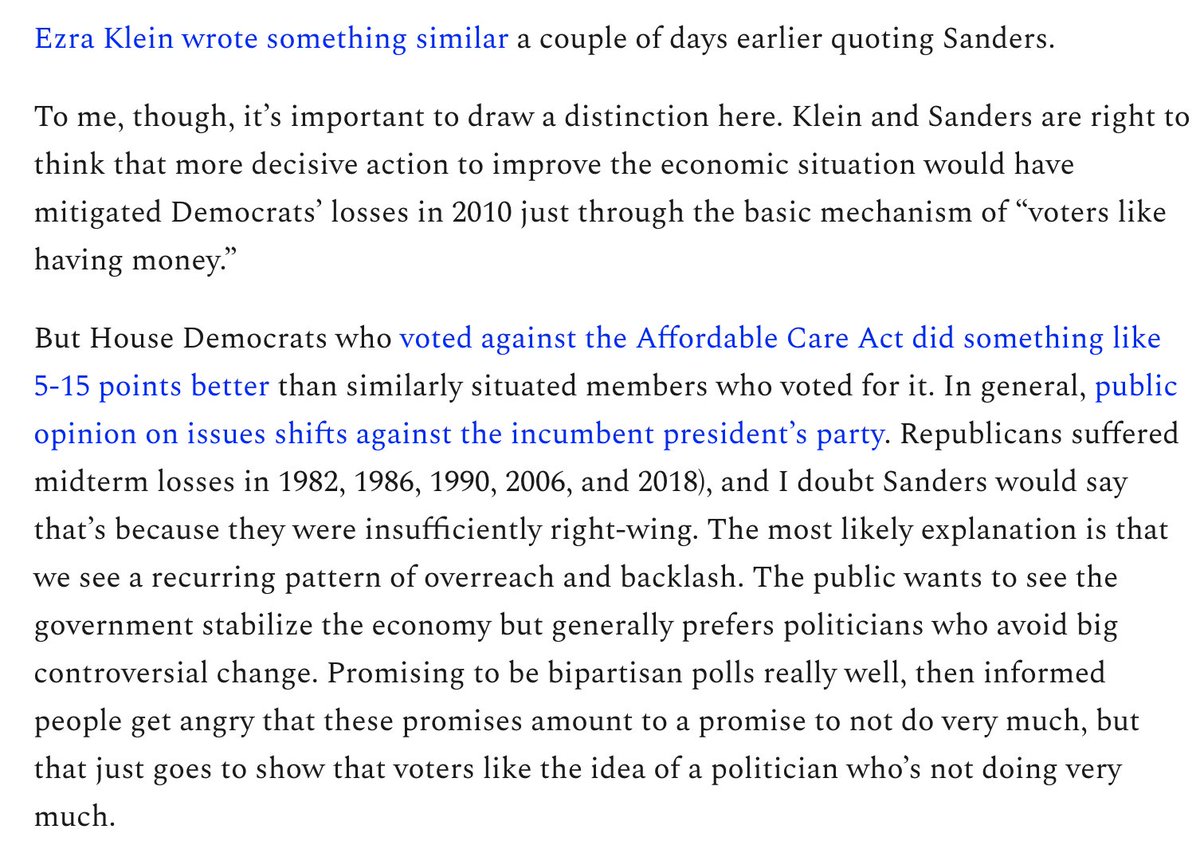
Over at Mischiefs of Faction, @Smotus makes a similar point: https://t.co/al6fS5tZXP
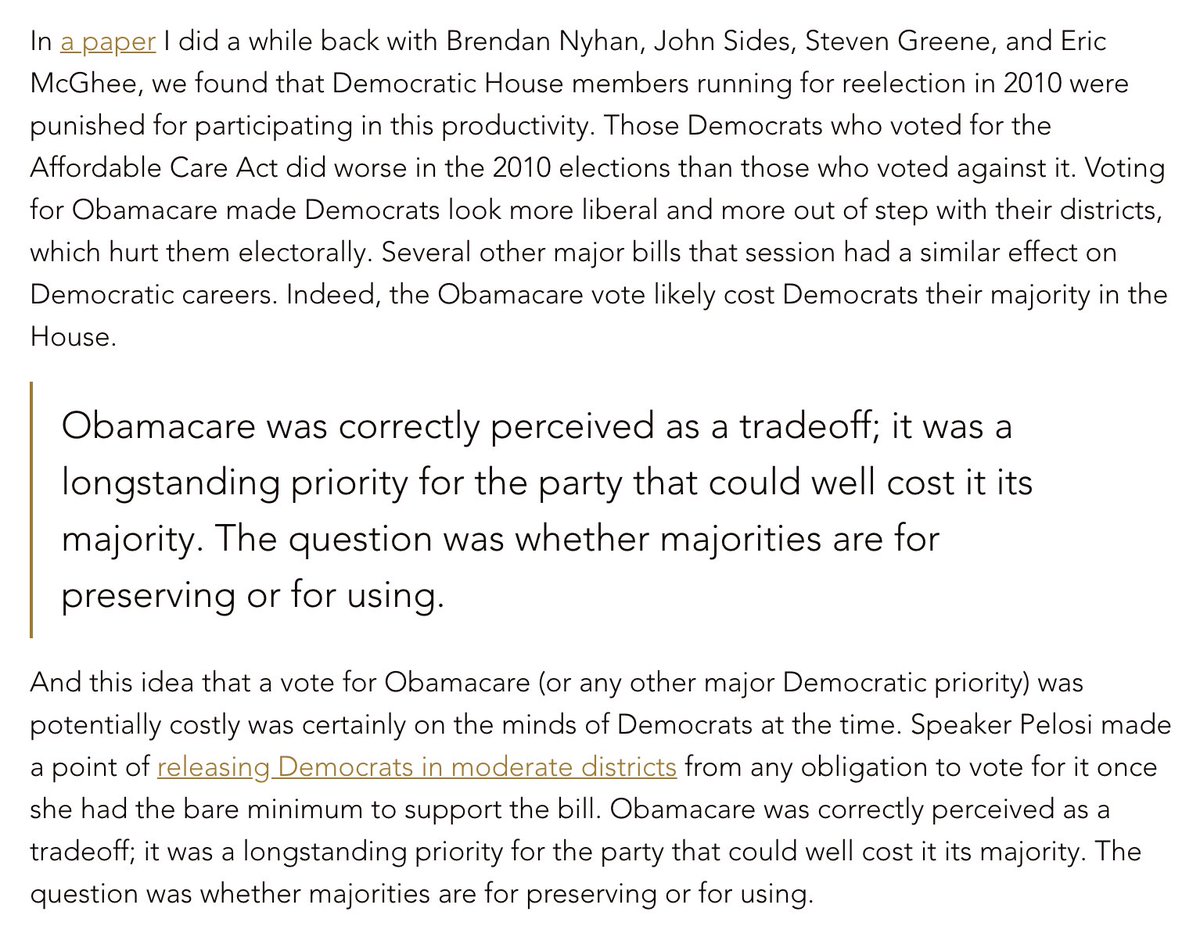
I want to be clear here: I’m saying that the Affordable Care act was, from a political perspective, badly designed, and that *a different health care plan* might’ve led to a better Dem performance in 2010. But these arguments don't grapple with that.
To @Smotus’s point, Pelosi released those House Democrats at the end, not the beginning. Having covered the beginning of this, I can tell you a lot of those Democrats thought a bipartisan health care bill would be great politics for them!
But they didn’t get that.
This is key. The ACA was built on the political theory that:
1. Bipartisan policy is easier to pass — and more popular once passed.
2. Working off of the Heritage Foundation/Romney template could get you a bipartisan health bill.
1 was probably right. 2 was utterly wrong.
Over at Mischiefs of Faction, @Smotus makes a similar point: https://t.co/al6fS5tZXP
I want to be clear here: I’m saying that the Affordable Care act was, from a political perspective, badly designed, and that *a different health care plan* might’ve led to a better Dem performance in 2010. But these arguments don't grapple with that.
To @Smotus’s point, Pelosi released those House Democrats at the end, not the beginning. Having covered the beginning of this, I can tell you a lot of those Democrats thought a bipartisan health care bill would be great politics for them!
But they didn’t get that.
This is key. The ACA was built on the political theory that:
1. Bipartisan policy is easier to pass — and more popular once passed.
2. Working off of the Heritage Foundation/Romney template could get you a bipartisan health bill.
1 was probably right. 2 was utterly wrong.


