
Reading a Reddit AMA with a former Q believer and he had a really insightful thing to say: “Conspiracy theory thinking hooks the brain because it feels like critical thinking.”
More from For later read

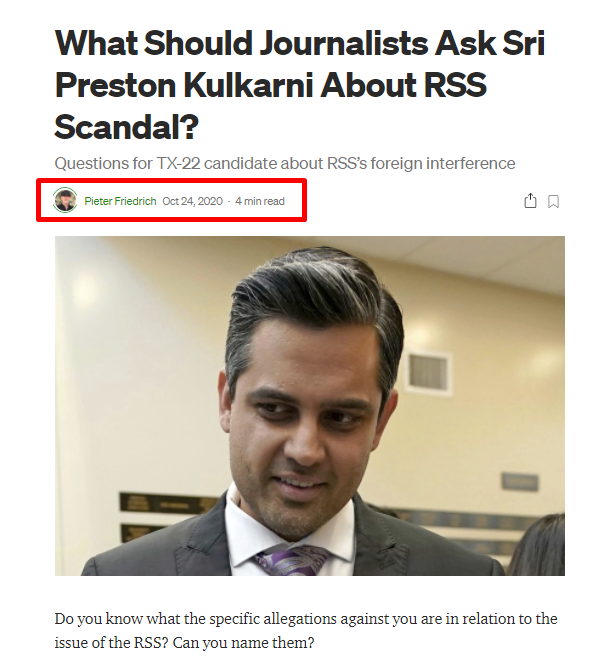
A name has caught the radar of agencies investigating #GretaToolkit- FRIEDRICH PIETER. Delhi Police expressed shock over the appearance of Pieter's name as "Who to Follow" in g-doc as he is under cops' scanner since 2006 for his Anti-India activities. Some shocking details..
1/9
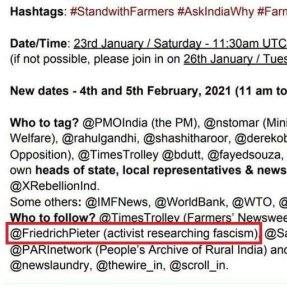
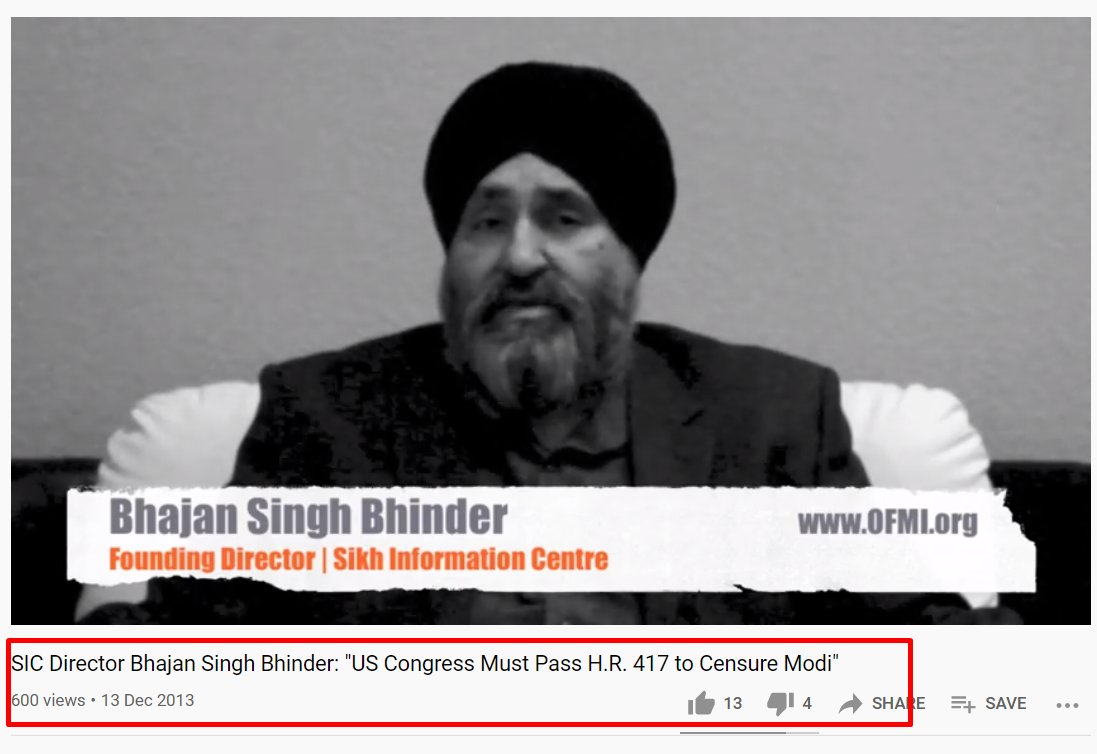
Pieter is close associate (read hired by) Bhajan Singh Bhindar, founder of OFMI (Org for Minorities of India) that considers itself an anti-Gandhi 'crusader' & is Pro-Khalistan. They also campaigned to free Bhullar (convicted Khalistani terr0r!st) & lobby against Modi in US.
2/9
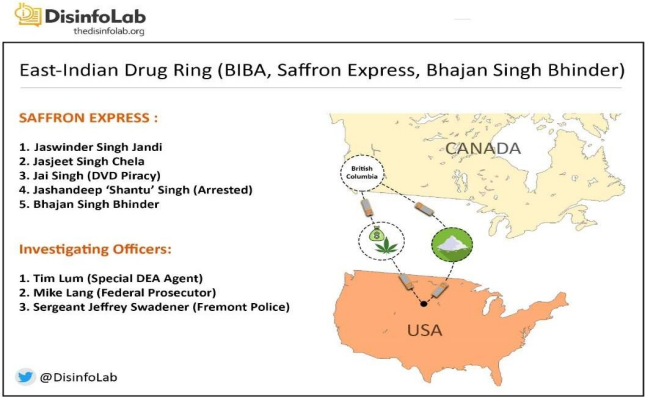
Bhinder has alleged connection with ISI & had records of owning inter-state drugs cartel & DVD piracy for terr0r funding. They also took control Fremont Gurudwara, US back in 2003 for millions of donation. Details of this 'Info-War' by @DisinfoLab
https://t.co/oIDFSoaDX2
3/9
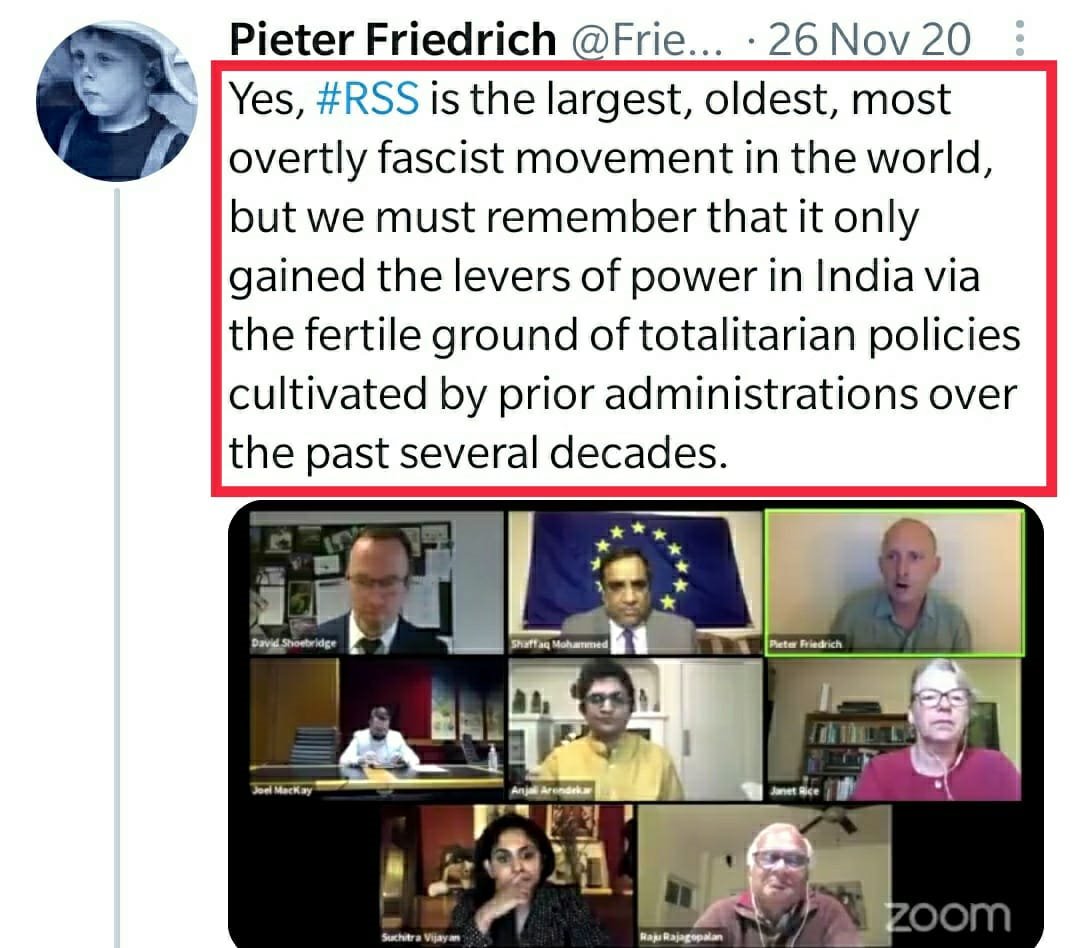
Back to Pieter. Take a glance at his work. His TL is filled with anti-BJP/RSS/Modi propaganda. From his speeches to articles, everything have few keywords in common- RSS/Fascism/gen0c!de/k!ll!ing/Kashmir/Hindutva, as if running a non-stop unrest in India is his bread & butter
4/9
He picks every topic with an extreme narrative that potentially hurts integrity of nation, be it Kashmir,CAA,1984 & with his recent projects- Farmer protest & campaigning heavily against Sri Kulkarni. Despite all, Kulkarni appointed as Chief of Ext Affairs at Biden admin.
5/9
1/9
Pieter is close associate (read hired by) Bhajan Singh Bhindar, founder of OFMI (Org for Minorities of India) that considers itself an anti-Gandhi 'crusader' & is Pro-Khalistan. They also campaigned to free Bhullar (convicted Khalistani terr0r!st) & lobby against Modi in US.
2/9
Bhinder has alleged connection with ISI & had records of owning inter-state drugs cartel & DVD piracy for terr0r funding. They also took control Fremont Gurudwara, US back in 2003 for millions of donation. Details of this 'Info-War' by @DisinfoLab
https://t.co/oIDFSoaDX2
3/9
Back to Pieter. Take a glance at his work. His TL is filled with anti-BJP/RSS/Modi propaganda. From his speeches to articles, everything have few keywords in common- RSS/Fascism/gen0c!de/k!ll!ing/Kashmir/Hindutva, as if running a non-stop unrest in India is his bread & butter
4/9
He picks every topic with an extreme narrative that potentially hurts integrity of nation, be it Kashmir,CAA,1984 & with his recent projects- Farmer protest & campaigning heavily against Sri Kulkarni. Despite all, Kulkarni appointed as Chief of Ext Affairs at Biden admin.
5/9


1. A little DRASTIC Project you may be able to help with?
We want to collate all references to DRASTIC in academic papers & media articles
Here are a few:
medium article by @emmecola
thorough report by @netpoette
@ColinDavdButler 's Paper
Please add any links to this thread. Tks!

2. More References
Papers by @MonaRahalkar and @BahulikarRahul
Papers by @Rossana38510044 and @ydeigin
Medium articles & papers by
@gdemaneuf & @Rdemaistre
Papers by @flavinkins (Daoyu Zhang)
Papers by "Anon" & "interneperson"
French News - le Monde
Can anyone remember any more?
3. More References
Papers & Blog Posts by @Harvard2H (Sirotkin & Sirotkin)
260 Questions for WHO collated by @billybostickson
If you find mentions of our individual names or "DRASTIC" in Papers or News, please forward here to this thread as links or screenshots.
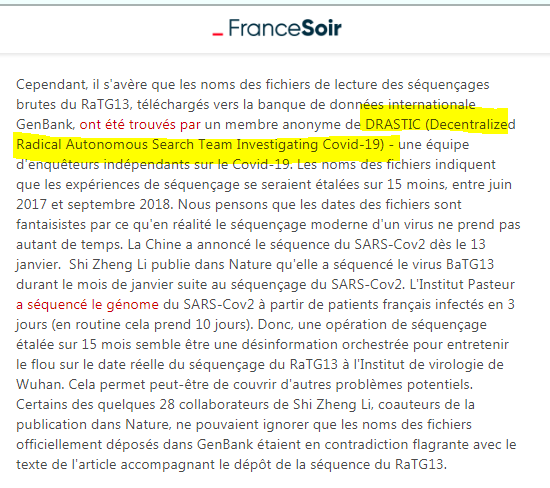
Histoire du COVID-19 – chapitre 6 - Partie 2 : Pourquoi le séquençage complet du virus RaTG13 n'a pas été communiqué par Shi Zheng Li avant février 2020 ? https://t.co/MYEZZSAzaE
SARS-CoV-2: lab-origin hypothesis gains traction
BY ANNETTE GARTLAND ON OCTOBER 12, 2020
https://t.co/sPs1y8Herg
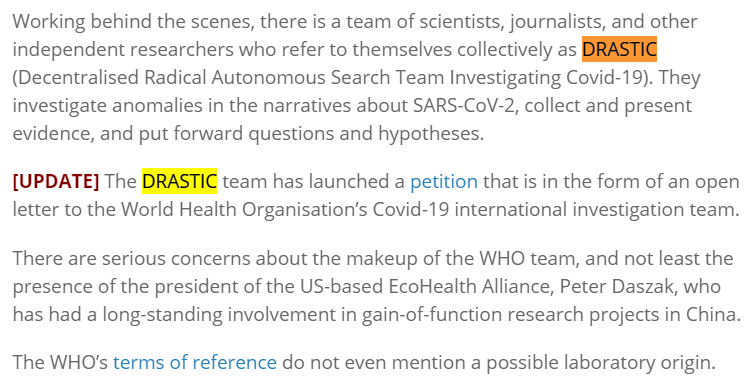
We want to collate all references to DRASTIC in academic papers & media articles
Here are a few:
medium article by @emmecola
thorough report by @netpoette
@ColinDavdButler 's Paper
Please add any links to this thread. Tks!
2. More References
Papers by @MonaRahalkar and @BahulikarRahul
Papers by @Rossana38510044 and @ydeigin
Medium articles & papers by
@gdemaneuf & @Rdemaistre
Papers by @flavinkins (Daoyu Zhang)
Papers by "Anon" & "interneperson"
French News - le Monde
Can anyone remember any more?
3. More References
Papers & Blog Posts by @Harvard2H (Sirotkin & Sirotkin)
260 Questions for WHO collated by @billybostickson
If you find mentions of our individual names or "DRASTIC" in Papers or News, please forward here to this thread as links or screenshots.
Histoire du COVID-19 – chapitre 6 - Partie 2 : Pourquoi le séquençage complet du virus RaTG13 n'a pas été communiqué par Shi Zheng Li avant février 2020 ? https://t.co/MYEZZSAzaE
SARS-CoV-2: lab-origin hypothesis gains traction
BY ANNETTE GARTLAND ON OCTOBER 12, 2020
https://t.co/sPs1y8Herg


The #worldwildlifeday2021 theme is Forests and Livelihoods: Sustaining People and Planet aligning with UN Sustainable Development Goals 1, 12, 13 and 15. So, what are the UN Sustainable Development Goals (SDGs) & how can children begin to learn about them & get involved ?
https://t.co/8ICvHxE9QL is easy & fun to follow for our smallest of people #EYFS. Early childhood is the perfect stage to introduce the core concepts of what it means to be a global citizen. For our reception & KS1 children please take a look at this fabulous free resource
https://t.co/tZx8UIS58Q Storytelling is a powerful communications tool and helps children remember lessons and virtues that they will use in everyday life. The idea is to simplify the lessons of the (SDGs) so young children can relate to – and better understand – the SDGs.
For older children here’s a board game that aims to help teach children around the world about the Sustainable Development Goals in a simple and child-friendly way
This is a lovely free book for children to enjoy flicking through themselves https://t.co/ScMbQCfpjl Elyx, the United Nations’ digital ambassador, uses various expressions and actions to help demonstrate the meaning of each Sustainable Development Goal.
https://t.co/8ICvHxE9QL is easy & fun to follow for our smallest of people #EYFS. Early childhood is the perfect stage to introduce the core concepts of what it means to be a global citizen. For our reception & KS1 children please take a look at this fabulous free resource
https://t.co/tZx8UIS58Q Storytelling is a powerful communications tool and helps children remember lessons and virtues that they will use in everyday life. The idea is to simplify the lessons of the (SDGs) so young children can relate to – and better understand – the SDGs.
For older children here’s a board game that aims to help teach children around the world about the Sustainable Development Goals in a simple and child-friendly way
This is a lovely free book for children to enjoy flicking through themselves https://t.co/ScMbQCfpjl Elyx, the United Nations’ digital ambassador, uses various expressions and actions to help demonstrate the meaning of each Sustainable Development Goal.
You May Also Like


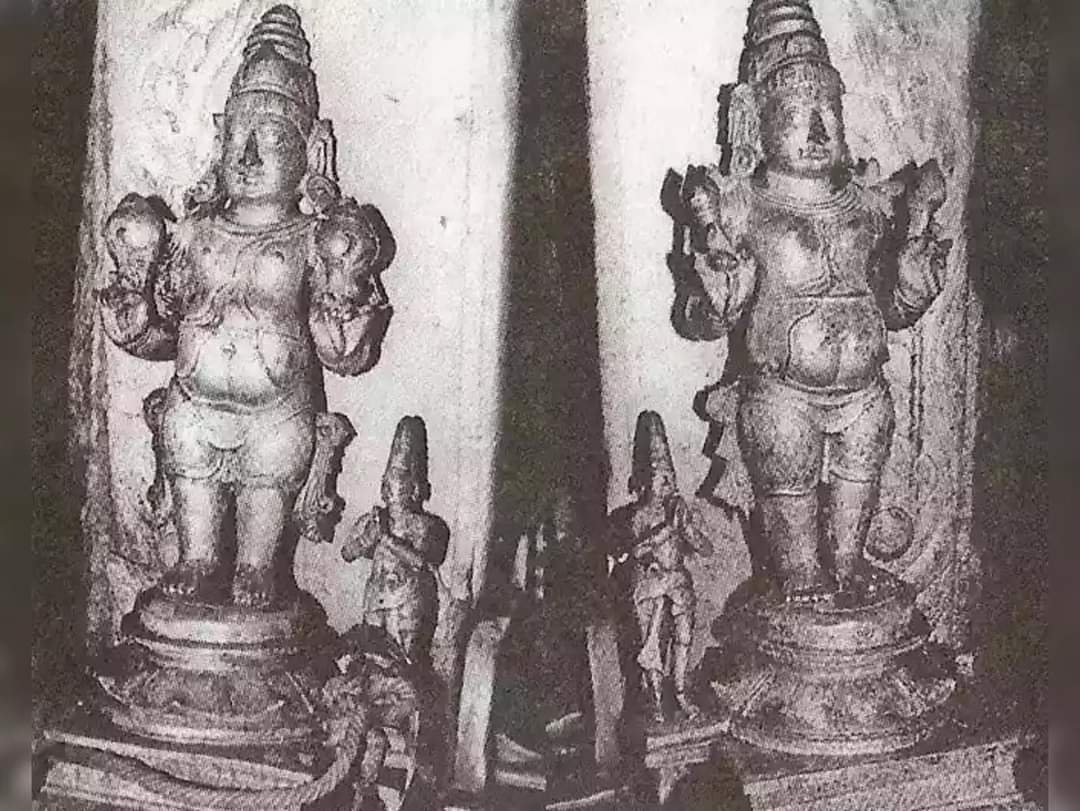






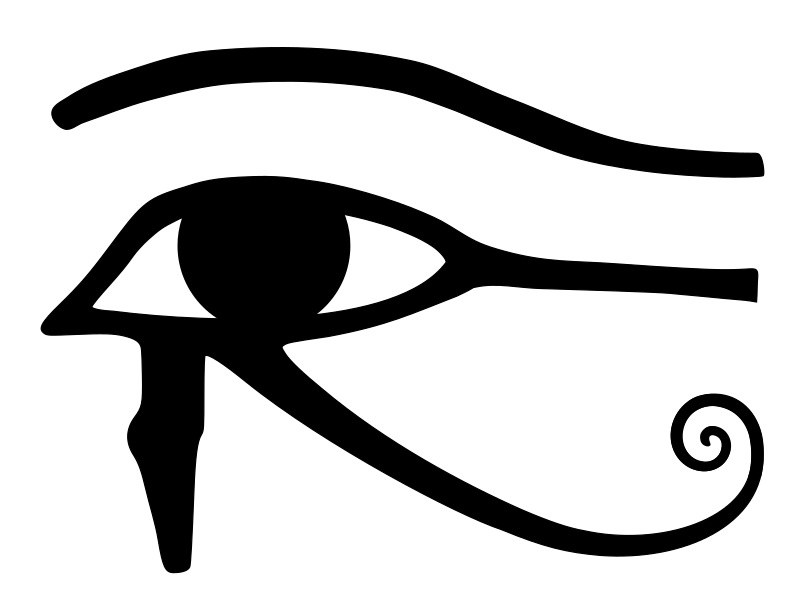
The Eye of Horus. 1/*
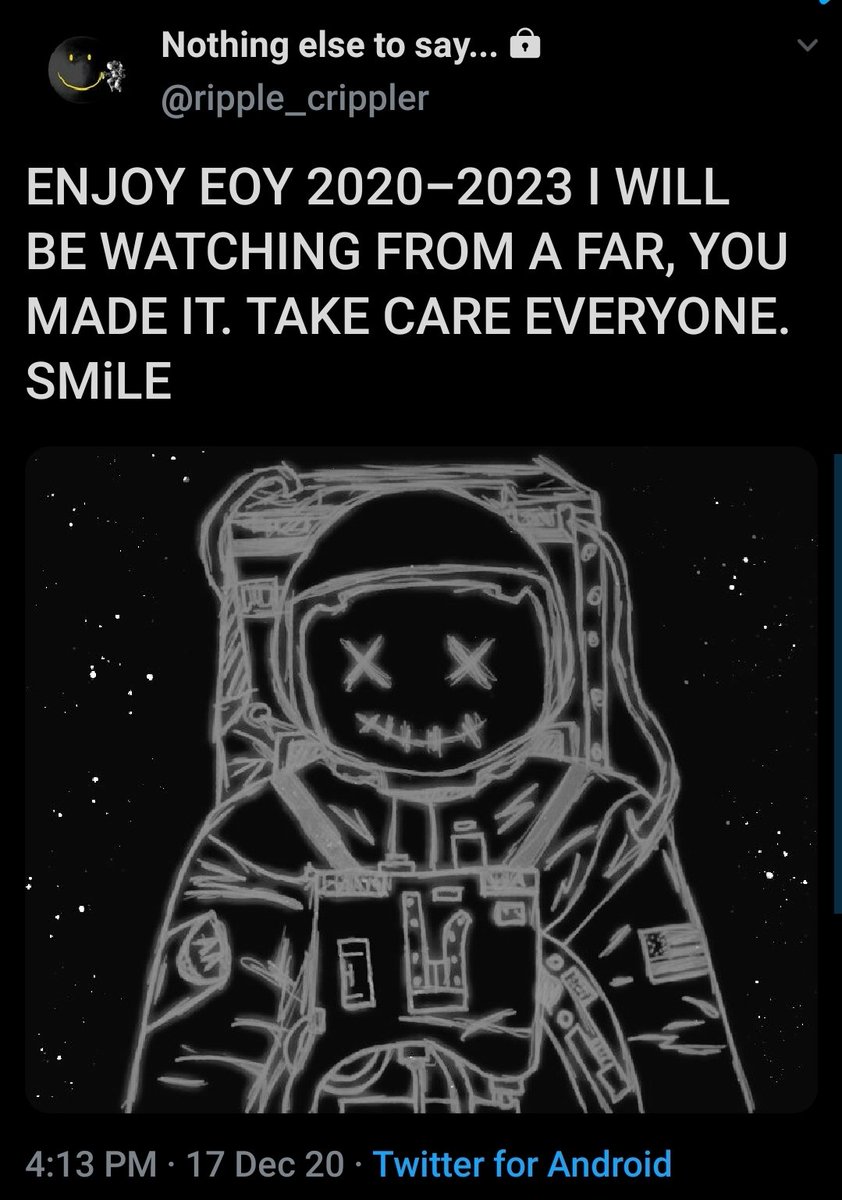
I believe that @ripple_crippler and @looP_rM311_7211 are the same person. I know, nobody believes that. 2/*
Today I want to prove that Mr Pool smile faces mean XRP and price increase. In Ripple_Crippler, previous to Mr Pool existence, smile faces were frequent. They were very similar to the ones Mr Pool posts. The eyes also were usually a couple of "x", in fact, XRP logo. 3/*

The smile XRP-eyed face also appears related to the Moon. XRP going to the Moon. 4/*
And smile XRP-eyed faces also appear related to Egypt. In particular, to the Eye of Horus. https://t.co/i4rRzuQ0gZ 5/*

I believe that @ripple_crippler and @looP_rM311_7211 are the same person. I know, nobody believes that. 2/*
Today I want to prove that Mr Pool smile faces mean XRP and price increase. In Ripple_Crippler, previous to Mr Pool existence, smile faces were frequent. They were very similar to the ones Mr Pool posts. The eyes also were usually a couple of "x", in fact, XRP logo. 3/*
The smile XRP-eyed face also appears related to the Moon. XRP going to the Moon. 4/*
And smile XRP-eyed faces also appear related to Egypt. In particular, to the Eye of Horus. https://t.co/i4rRzuQ0gZ 5/*