William J. O’Neil’s 10 Trading Principles that Made Him a Legend.

A Thread🧵👇
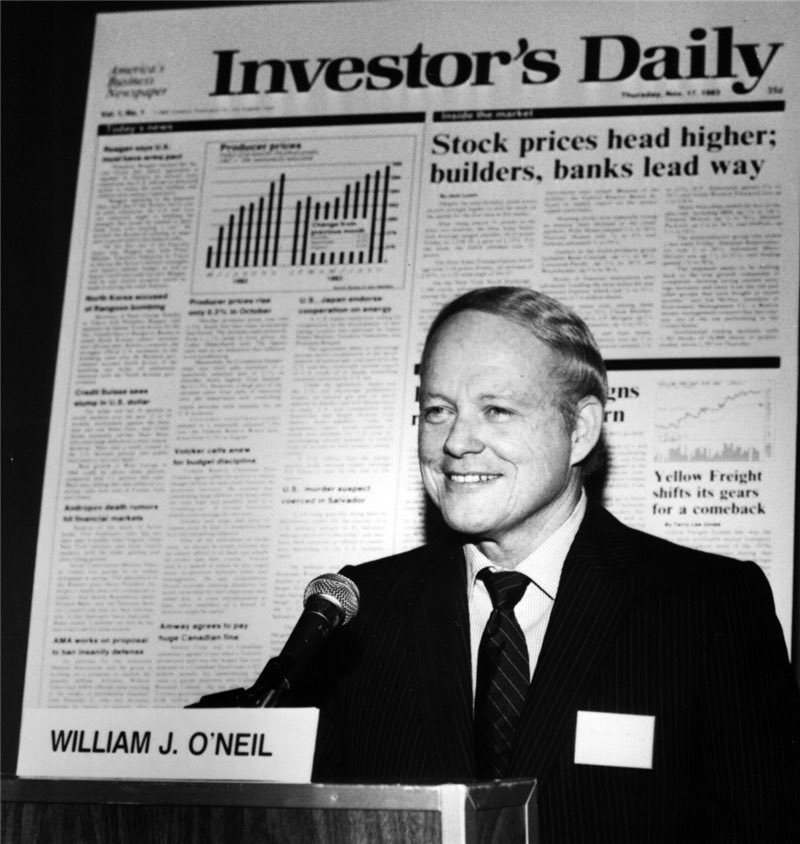
“I make it a rule to never lose more than 7 percent on any stock I buy. If a stock drops 7 percent below my purchase price, I will automatically sell it at the market – no second-guessing, no hesitation”
“The whole secret to winning in the stock market is to lose the least amount possible when you’re not right.”
William O’Neil studied historical chart patterns relentlessly and read thousands of trading books.

“90% of the people in the stock market, professionals and amateurs alike, simply haven’t done enough homework.”
He invested in an industries leading stocks not its laggards and dogs.

“It seldom pays to invest in laggard stocks, even if they look tantalizingly cheap. Look for, and confine your purchases to, market leaders.”
“Investors cash in small, easy-to-take profits and hold their losers. This tactic is exactly the opposite of correct investment procedure. Investors will sell a stock with profit before they will sell one with a loss.”
He did not waste his time and money playing the short side in bull markets.

“Cardinal Rule #1 is to sell short only during what you believe is a developing bear market, not a bull market.”
“The number one market leader is not the largest company or the one with the most recognized brand name; it’s the one with the best quarterly and annual earnings growth, return on equity, profit margins, sales growth, and price action.”
Some investors have trouble making decisions to buy or sell. They vacillate & can’t make up their minds. They are unsure because they really don’t know what they’re doing. They don’t have a plan, set principles, or rules to guide them & are uncertain of what they should be doing
O’Neil knew exactly what he was doing in the markets. He had a trading plan, trading principles, and rules.
“Since the market tends to go in the opposite direction of what the majority of people think, I would say 95% of all these people you hear on TV shows are giving you their personal opinion. And personal opinions are almost always worthless facts & markets are far more reliable.”
The best way to measure a stock’s supply & demand is by watching its daily volume. When a stock pulls back in price, you want to see volume dry up, indicating no significant selling pressure. When it rallies up in price, you want to see volume rise, which represents accumulation

More from Steve Burns

You May Also Like

Department List of UCAS-China PROFESSORs for ANSO, CSC and UCAS (fully or partial) Scholarship Acceptance
1) UCAS School of physical sciences Professor
https://t.co/9X8OheIvRw
2) UCAS School of mathematical sciences Professor

3) UCAS School of nuclear sciences and technology
https://t.co/nQH8JnewcJ
4) UCAS School of astronomy and space sciences
https://t.co/7Ikc6CuKHZ
5) UCAS School of engineering

6) Geotechnical Engineering Teaching and Research Office
https://t.co/jBCJW7UKlQ
7) Multi-scale Mechanics Teaching and Research Section
https://t.co/eqfQnX1LEQ
😎 Microgravity Science Teaching and Research

9) High temperature gas dynamics teaching and research section
https://t.co/tVIdKgTPl3
10) Department of Biomechanics and Medical Engineering
https://t.co/ubW4xhZY2R
11) Ocean Engineering Teaching and Research

12) Department of Dynamics and Advanced Manufacturing
https://t.co/42BKXEugGv
13) Refrigeration and Cryogenic Engineering Teaching and Research Office
https://t.co/pZdUXFTvw3
14) Power Machinery and Engineering Teaching and Research