Donald Trump’s presidency was defined by multiple financial conflicts of interest and unprecedented abuses of power. Here are some of the most important things we’ve uncovered about Trump’s actions in office — and what we’re still
https://t.co/gR0u7dS8fj
https://t.co/tlzhWOkPHz
-What did Trump’s DOJ tell federal prosecutors about pursuing and publicizing “voter fraud” allegations in the leadup to the election?
-Did the administration stifle the release of information about foreign actors attempting to interfere in our elections?
-What role did the president and the White House play in the delay of the ascertainment of presidential transition?
https://t.co/CitKHxVm17
https://t.co/Fj4dYDGD5u
-How have agencies responded to Trump’s pardons, and who was involved?
-How did DOJ, DHS, and Defense respond to Trump’s insistence on a militarized response to nationwide protests?
https://t.co/rGMt1QmZ0Y
https://t.co/80z409sWNl

-a cozy relationship between the White House & private-sector actors working on pandemic response
-details about the WH’s efforts to control messaging this spring— including its heavy-handed approach to HHS communications.
https://t.co/SzdN3C37NC
We still want to know:
— American Oversight (@weareoversight) December 28, 2020
-What did Trump\u2019s DOJ tell federal prosecutors about pursuing and publicizing \u201cvoter fraud\u201d allegations in the leadup to the election?
-Did the administration stifle the release of information about foreign actors attempting to interfere in our elections?
https://t.co/vTyAw8OjSj
-How has the White House’s pandemic response left more Americans at risk?
-What were the full details and timeline of Trump’s Covid-19 illness?
-To what extent were officials warned about the dire risks of hosting large events?
https://t.co/5Gfo0jIOTZ
https://t.co/3sLFDV28ng
https://t.co/oWsBNr5T8n
https://t.co/CJ4ym34Z2c
-Did Trump and the White House direct key agencies to obstruct the impeachment inquiry?
-To what extent did Trump’s key allies enable his corrupt dealings with Ukraine?
https://t.co/633bMd2wPS
We obtained a receipt of US Ambassador to Britain Woody Johnson\u2019s taxpayer-funded stay at Trump Turnberry, the president\u2019s resort in Scotland, reports @MartynMcL of the @TheScotsman. https://t.co/l3gK0dJtnD
— American Oversight (@weareoversight) October 7, 2020
https://t.co/luOGGsNGSF
-How much money have the federal government and other countries spent at Trump’s properties during his presidency?
-What was Trump’s personal involvement in scrapping a plan to relocate the FBI headquarters?
https://t.co/qMMnsQXY96
More from Trump

Trump: Day 1,407 (THREAD)
-13,454,254 Cases of COVID-19 in US
-US CV-19 Death Toll Rises to 271,026
-Day 20 Since Biden Declared Winner
-Day 424 at a Trump-owned Property
-Touts Assassination of Iran Scientist
-Appointed Judge Rejects PA Lawsuit
-$3M Recount Increases Biden Lead
https://t.co/hOfTV6hRNx
https://t.co/KYBIm6Qohw
https://t.co/Bj5tluZ5dh
https://t.co/Q9YG4btKvH
-13,454,254 Cases of COVID-19 in US
-US CV-19 Death Toll Rises to 271,026
-Day 20 Since Biden Declared Winner
-Day 424 at a Trump-owned Property
-Touts Assassination of Iran Scientist
-Appointed Judge Rejects PA Lawsuit
-$3M Recount Increases Biden Lead
https://t.co/hOfTV6hRNx
According to the press pool, Trump arrived at his Trump-branded golf club this morning in Sterling, VA.
— Alamo_On_The_Rise \u2197\ufe0f\U0001f198 \U0001f1fa\U0001f1f2 (@AlamoOnTheRise) November 27, 2020
This is Trump's 315th day at a golf club and 424th day at a Trump property since taking office at our expense as the outbreak continues to ravage our country. https://t.co/zaNo0gWEpY
https://t.co/KYBIm6Qohw
along the "presidential" motorcade route today. pic.twitter.com/eIkQi5ZhtC
— ActivistKathy (@activistkathy) November 27, 2020
https://t.co/Bj5tluZ5dh
The sign I was holding as Trump pulled into his golf course. Visible in above picture! pic.twitter.com/kYC5aQJB8A
— William D Johnson (@GMUBillJohnson) November 27, 2020
https://t.co/Q9YG4btKvH
Reminder: Trump said, if elected, he would never see his golf courses ... would be working all the time #TrumpLies pic.twitter.com/Kj6aFVoeaw
— Alamo_On_The_Rise \u2197\ufe0f\U0001f198 \U0001f1fa\U0001f1f2 (@AlamoOnTheRise) September 20, 2020


1. @NYGovCuomo became a pandemic star by contrasting himself with Trump
Cuomo crafted an IMAGE of being determined, honest and grounded in science
But 11 months later this image is falling apart
Follow along for a FACTUAL assessment of Cuomo's
2. Cuomo WROTE A BOOK, published in October, celebrating his own leadership during the pandemic.
Cuomo writes that NY had "confronted and defeated" the virus, and had "achieved what all the experts told us was impossible."
Today, things look
3. Today, New York has 338 people hospitalized with COVID per million residents.
This is the HIGHEST NUMBER IN ANY STATE by a considerable margin.
https://t.co/Hl4fsFxB6l
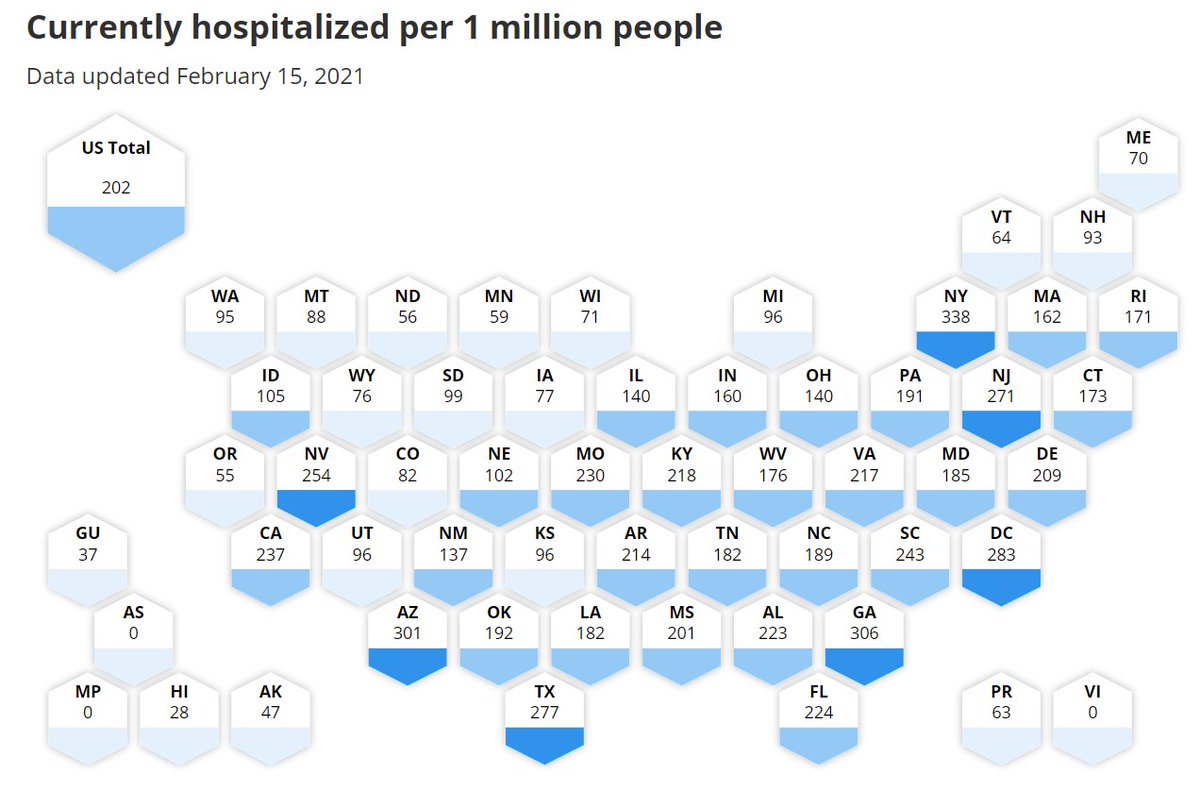
4. Overall, 46K New Yorkers have died of COVID, which trails only California (47K), a state with 2x as many people.
On a per capita basis, New York has had more deaths than every state but New Jersey.
Cuomo made decisions that made things
5. A new report by NY AG Letitia James (D) found Cuomo's order requiring nursing homes to accept residents w/COVID "may have put residents at increased risk of harm"
Cuomo dismissed criticisms of his nursing home policies in his book as
Cuomo crafted an IMAGE of being determined, honest and grounded in science
But 11 months later this image is falling apart
Follow along for a FACTUAL assessment of Cuomo's
2. Cuomo WROTE A BOOK, published in October, celebrating his own leadership during the pandemic.
Cuomo writes that NY had "confronted and defeated" the virus, and had "achieved what all the experts told us was impossible."
Today, things look
3. Today, New York has 338 people hospitalized with COVID per million residents.
This is the HIGHEST NUMBER IN ANY STATE by a considerable margin.
https://t.co/Hl4fsFxB6l
4. Overall, 46K New Yorkers have died of COVID, which trails only California (47K), a state with 2x as many people.
On a per capita basis, New York has had more deaths than every state but New Jersey.
Cuomo made decisions that made things
5. A new report by NY AG Letitia James (D) found Cuomo's order requiring nursing homes to accept residents w/COVID "may have put residents at increased risk of harm"
Cuomo dismissed criticisms of his nursing home policies in his book as
You May Also Like















The Eye of Horus. 1/*

I believe that @ripple_crippler and @looP_rM311_7211 are the same person. I know, nobody believes that. 2/*
Today I want to prove that Mr Pool smile faces mean XRP and price increase. In Ripple_Crippler, previous to Mr Pool existence, smile faces were frequent. They were very similar to the ones Mr Pool posts. The eyes also were usually a couple of "x", in fact, XRP logo. 3/*

The smile XRP-eyed face also appears related to the Moon. XRP going to the Moon. 4/*

And smile XRP-eyed faces also appear related to Egypt. In particular, to the Eye of Horus. https://t.co/i4rRzuQ0gZ 5/*

I believe that @ripple_crippler and @looP_rM311_7211 are the same person. I know, nobody believes that. 2/*
Today I want to prove that Mr Pool smile faces mean XRP and price increase. In Ripple_Crippler, previous to Mr Pool existence, smile faces were frequent. They were very similar to the ones Mr Pool posts. The eyes also were usually a couple of "x", in fact, XRP logo. 3/*
The smile XRP-eyed face also appears related to the Moon. XRP going to the Moon. 4/*
And smile XRP-eyed faces also appear related to Egypt. In particular, to the Eye of Horus. https://t.co/i4rRzuQ0gZ 5/*