🚨 BUY ALERT $CDON +23% 🚨

$CDON was founded in 1999 and was part of the Qliro group until September 2020

⭐️ It was then spun out at started operating as a fully independent retailer

🌐 It is now a leading e-commerce player, but is still valued as a brick & mortar retailer

The company generated most of its revenue from its own sales (first party sales)

🛍 It is now moving towards an “e-commerce platform” / marketplace positioning where merchants retail products and send these to clients
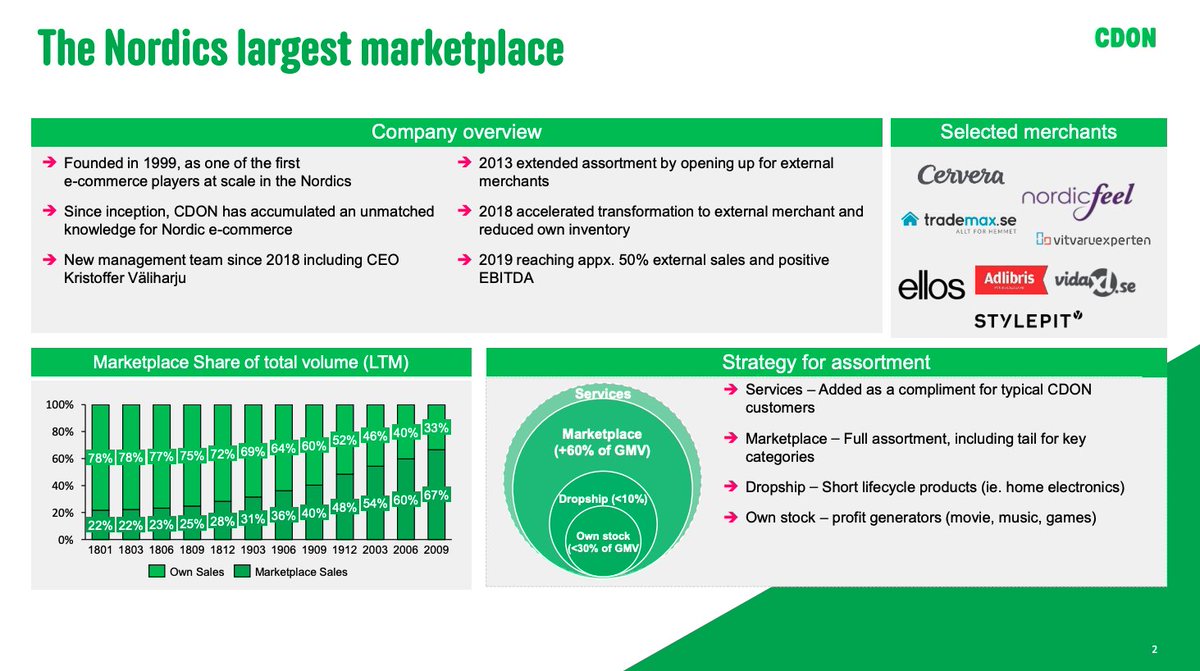
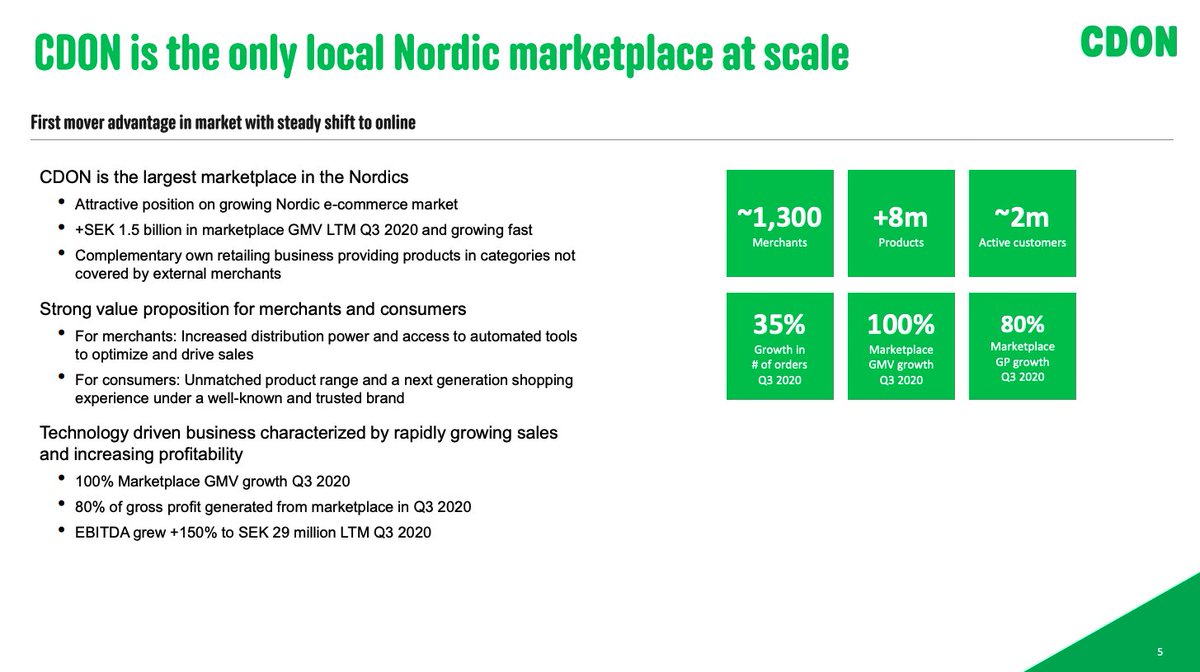
$CDON is the leading e-commerce player in the Nordics, it counts 2m active customers and over 1,300 merchants

💸 It retails over 8m products and scored a Gross Merchandise Value of SEK 2.4B ($ 288m) in the 12 months leading to Q3 ’20
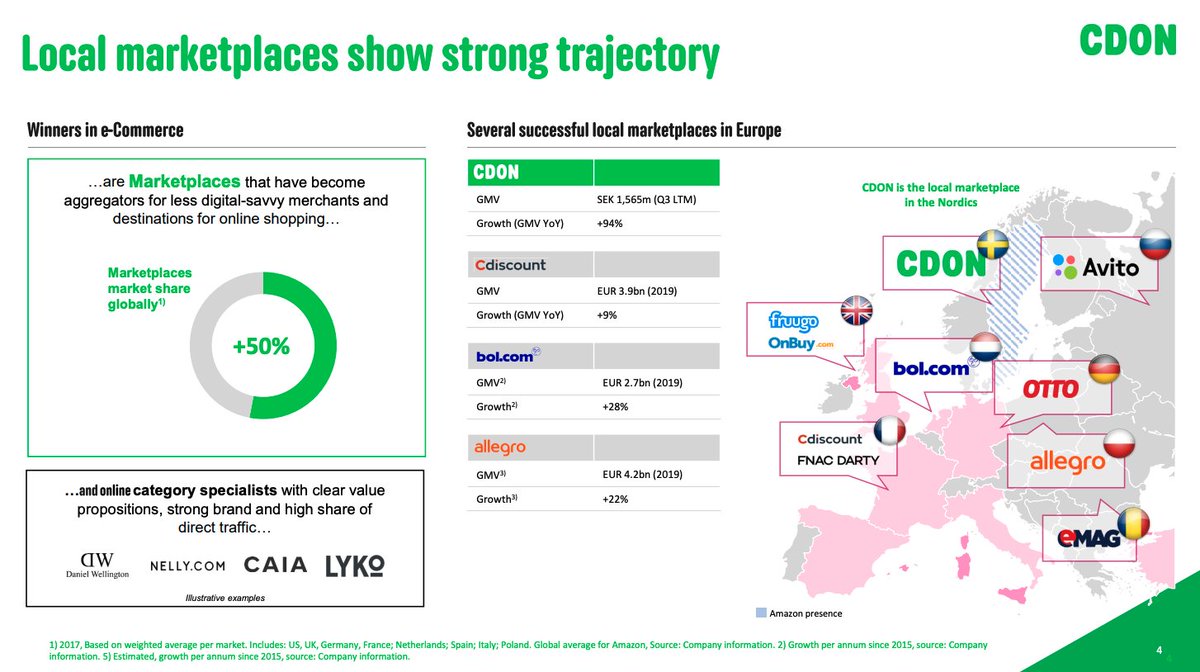
$CDON belongs to a cohort of local e-commerce player which have successfully managed to fight $AMZN’s dominance

🇳🇱 https://t.co/jUdtPRTkdU in the Netherlands is the leading e-commerce player with 111m website visits (+30% in H2 ’20) vs 33m for $AMZN (+67% in H2 ’20)
🇫🇷 https://t.co/r9rdGvrx9d in France is the N°2 e-commerce player with 84m visits (+21% in H2 ’20) vs 270m for $AMZN (+42% in H2 ’20)

🇸🇪 https://t.co/m8OyFnNYNJ in Sweden scored 7m visits (+27% in H2 ’20) vs 10.3m for $AMZN (entered market in 2020)
Following $AMZN’s example, $CDON is turning itself into a marketplace

🛍 It doesn’t sell products directly to consumers but takes a commission on sales

📦 It doesn’t need to manage inventory or insure product quality

💸 It generates additional sales through advertising
In order to attract and retain merchants, the company is developing a range of tools

📊 Provides data-insights on products sold

🛍 Integrations to $SHOP and Magento

📦 Delivery, warehousing management
On the market side, e-commerce penetration is high in the Nordics

🇳🇴 Norway: 26%

🇩🇰 Denmark: 25%

🇸🇪 Sweden: 25%

🇫🇮 Finland: 23%

Compared to other European countries:

🇫🇷 France: 22%

🇬🇧 UK: 21%

🇪🇺 EU Average: 18%

https://t.co/5wGqyJQqmd
Nothing too extraordinary for now - What is the pitch?

1️⃣ $CDON was previously valued as a brick & mortar retailer as its activity-mix consisted mainly in conventional retail operations

2️⃣ Marketplace sales now account for 67% of total in Q3 ’20, up from 40% a year earlier
3️⃣ Despite the change in activities, the company still trades at a PS of 1.5

For comparison:

✅ $OZON trades at a PS of 8

✅ $SE trades at a PS of 30

✅ $MELI trades at a PS of 28
4️⃣ Growth is overshadowed by the decline in its conventional retail activities

5️⃣ When looking only at the “marketplace” sales, these are up 94% YoY to SEK 1.5B ($ 180m)
Thank you @T_I_M_P_P_A for surfacing this gem!

Happy to hear your thoughts!

@miljonjakten
@cmuggla
@KodarnMotMelon
@mhvestergaard
@Matematikern3
@JGSventures
@SJ_Invest
@tjylha
@Andan_swe

⁉️ Other gem worth surfacing ⁉️

🔥 $GFG.DE is on the watchlist as well
🔥 We have a stake in $CDON.ST 🔥

Disclaimer - This is not investment advice in any form and investors are responsible for conducting their own research before investing.

Don’t MISS anything 📩 Subscribe NOW ⚡️

https://t.co/lQ6ay1zmm2

More from Trading

You May Also Like

First thread of the year because I have time during MCO. As requested, a thread on the gods and spirits of Malay folk religion. Some are indigenous, some are of Indian origin, some have Islamic


Before I begin, it might be worth explaining the Malay conception of the spirit world. At its deepest level, Malay religious belief is animist. All living beings and even certain objects are said to have a soul. Natural phenomena are either controlled by or personified as spirits

Although these beings had to be respected, not all of them were powerful enough to be considered gods. Offerings would be made to the spirits that had greater influence on human life. Spells and incantations would invoke their


Two known examples of such elemental spirits that had god-like status are Raja Angin (king of the wind) and Mambang Tali Arus (spirit of river currents). There were undoubtedly many more which have been lost to time

Contact with ancient India brought the influence of Hinduism and Buddhism to SEA. What we now call Hinduism similarly developed in India out of native animism and the more formal Vedic tradition. This can be seen in the multitude of sacred animals and location-specific Hindu gods