
Special Purpose Acquisition Company (SPAC) has become very popular globally, especially in USA. SPACs are known as blank cheque companies, because its a shell company with cash. What is it? How does it work? This is a thread.
More from Trading

1/ Feels like a good time to tell the story of how I went from broke to a millionaire to broke again in 2017/18 again...
Yesterday was brutal for some people...
Losing life-changing money sucks, losing any money sucks...you can chase the market or you can change your strategy.
2/ The original thread is gone but you can read it here.
https://t.co/cLLNs75rB0
tl;dr
- Traded $32k to $1.2m
- Thought I was a genius
- Made poor investments
- Didn't conserve capital
- Peaked at 150 BTC
- Lost nearly all of it
2 weeks from losing my house + no income. Oops.
3/ I am going to assume you are in it for the money rather than the tech. Yeah, you might Tweet about the amazing blockchaining of cross-border payments and oracles yadda yadda...really, you are in it to make money.
If you are really in it for the tech, go and build something.
4/ Okay, so if you want to make money, trading is super hard, you are trading against:
- Better traders than you
- People who can move markets
- Unknown information
And if you are trading with leverage you might blow up your account with the volatility.
5/ If you are not trading, you are investing. Okay, so what are you investing in?
I made the decision that the crypto with the best opportunity of existing in 10 years is #Bitcoin:
- Solves a genuine problem
- The right tech
- A proven track record
Yesterday was brutal for some people...
Losing life-changing money sucks, losing any money sucks...you can chase the market or you can change your strategy.
2/ The original thread is gone but you can read it here.
https://t.co/cLLNs75rB0
tl;dr
- Traded $32k to $1.2m
- Thought I was a genius
- Made poor investments
- Didn't conserve capital
- Peaked at 150 BTC
- Lost nearly all of it
2 weeks from losing my house + no income. Oops.
3/ I am going to assume you are in it for the money rather than the tech. Yeah, you might Tweet about the amazing blockchaining of cross-border payments and oracles yadda yadda...really, you are in it to make money.
If you are really in it for the tech, go and build something.
4/ Okay, so if you want to make money, trading is super hard, you are trading against:
- Better traders than you
- People who can move markets
- Unknown information
And if you are trading with leverage you might blow up your account with the volatility.
5/ If you are not trading, you are investing. Okay, so what are you investing in?
I made the decision that the crypto with the best opportunity of existing in 10 years is #Bitcoin:
- Solves a genuine problem
- The right tech
- A proven track record





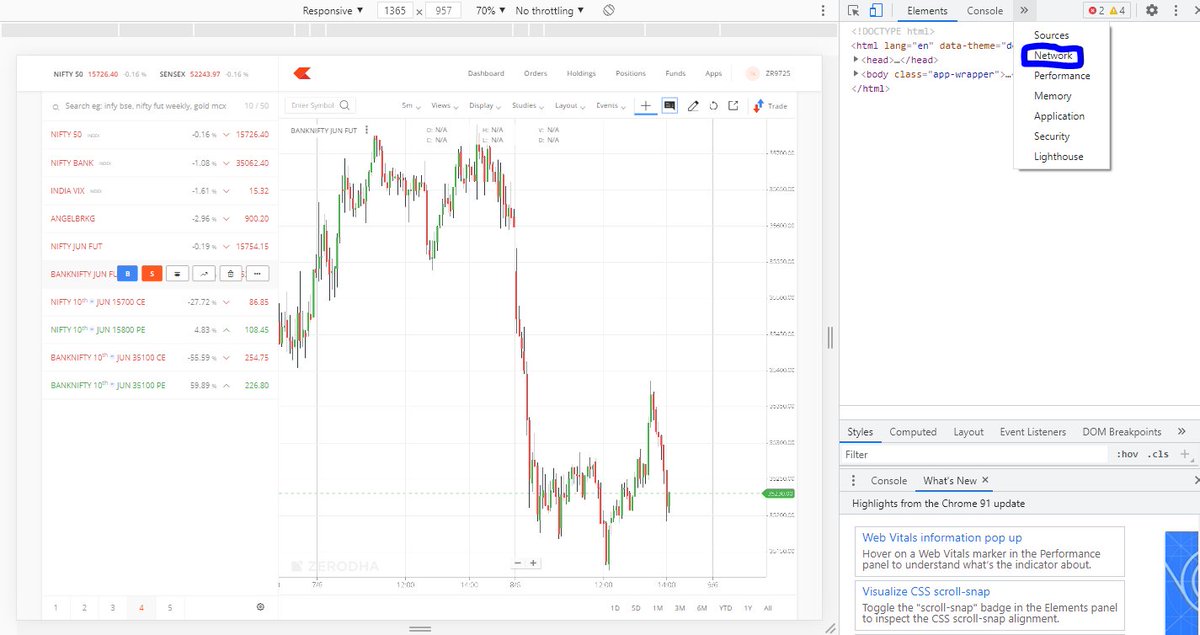
A thread on getting intraday (any timeframe) data to excel without any coding. Limited to only last 60 days. Fetches from zerodha chart.
👇
1. Open the chart on zerodha web in chrome. Right click and select 'Inspect'. Click 'Network' as shown in this pic.
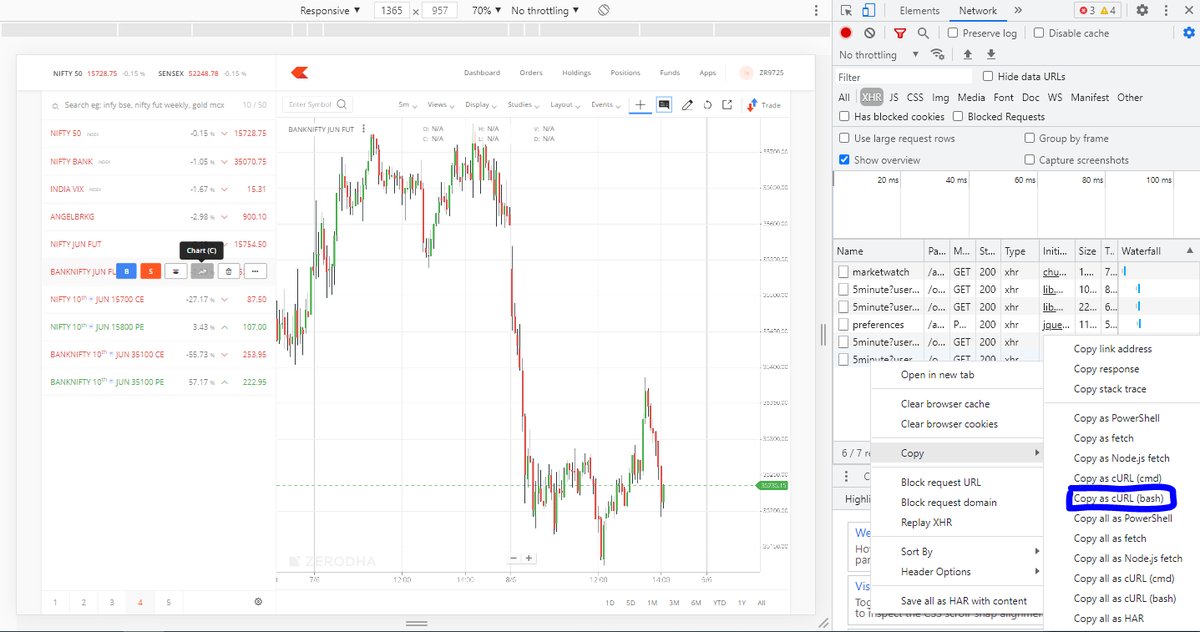
2. Right click on the last entry on the table you see and click 'copy as cURL (bash)'
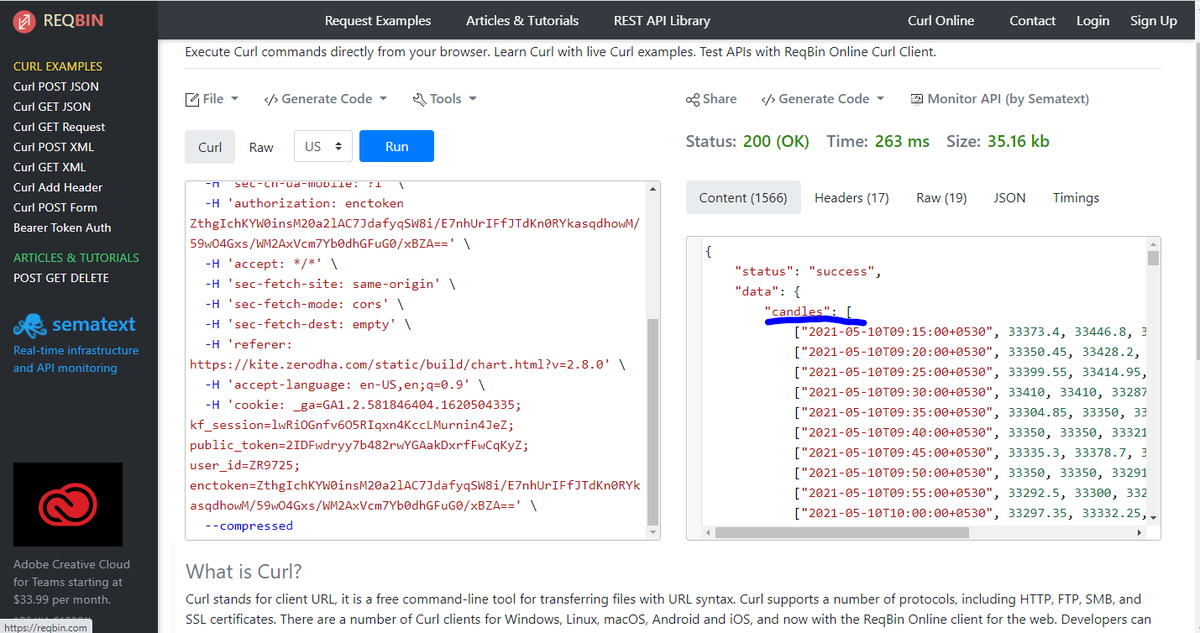
3. Go to website https://t.co/f8rhwoGLUc and paste on the left box and click 'Run'
4. The output below candles written on right of box is the ohlc, volume and oi data. Copy and paste to excel.
👇
1. Open the chart on zerodha web in chrome. Right click and select 'Inspect'. Click 'Network' as shown in this pic.
2. Right click on the last entry on the table you see and click 'copy as cURL (bash)'
3. Go to website https://t.co/f8rhwoGLUc and paste on the left box and click 'Run'
4. The output below candles written on right of box is the ohlc, volume and oi data. Copy and paste to excel.

Option Trading is very difficult to master as there are so many things to understand.
Here is a master thread related that will help a beginner to understand about Options Trading.
A complete course worth Rs 50K for free.
1/ A detailed thread on basics of Option Greeks and how it impacts Options
2/ Basic Option Trading Strategies:
There are many option strategies to trade. But keeping your strategy simple is the key.
In this thread, all the basic option trading strategies are being
3/ What are the things that you should look at before taking any Option
4/ Is Option Selling Possible with Rs 1 Lakh Capital?
Even a beginner can start trading in option selling with capital as low as Rs 1 Lakh.
What are the techniques one can use and how to mitigate the infinite loss risk is shared in this
Here is a master thread related that will help a beginner to understand about Options Trading.
A complete course worth Rs 50K for free.
1/ A detailed thread on basics of Option Greeks and how it impacts Options
There are various Options Greeks like: Delta, Gamma, Vega, Rho, Theta.
— Yash Mehta (@YMehta_) September 4, 2022
A complete guide on how these #Option Greeks impact option price.
2/ Basic Option Trading Strategies:
There are many option strategies to trade. But keeping your strategy simple is the key.
In this thread, all the basic option trading strategies are being
Option trading is tough but here\u2019s what can make it easier for you
— The Chartians (@chartians) September 17, 2022
8 option strategies that you can use in any market (sold as a \u20b9 50,000 course !)
3/ What are the things that you should look at before taking any Option
They say options trading can make YOU BANKRUPT - is it true ?
— The Chartians (@chartians) September 23, 2022
If yes then why ?
A thread on Risk management and Position sizing in options trading (worth 50k\u20b9 course)\U0001f9f5
4/ Is Option Selling Possible with Rs 1 Lakh Capital?
Even a beginner can start trading in option selling with capital as low as Rs 1 Lakh.
What are the techniques one can use and how to mitigate the infinite loss risk is shared in this
101 guide on how you can start option selling to generate active returns with less capital (Rs 1 Lakh) \U0001f9f5:
— Yash Mehta (@YMehta_) August 19, 2022
A course on option selling available for free.
You May Also Like

Krugman is, of course, right about this. BUT, note that universities can do a lot to revitalize declining and rural regions.
See this thing that @lymanstoneky wrote:
And see this thing that I wrote:
And see this book that @JamesFallows wrote:
And see this other thing that I wrote:
One thing I've been noticing about responses to today's column is that many people still don't get how strong the forces behind regional divergence are, and how hard to reverse 1/ https://t.co/Ft2aH1NcQt
— Paul Krugman (@paulkrugman) November 20, 2018
See this thing that @lymanstoneky wrote:
And see this thing that I wrote:
And see this book that @JamesFallows wrote:
And see this other thing that I wrote:



The entire discussion around Facebook’s disclosures of what happened in 2016 is very frustrating. No exec stopped any investigations, but there were a lot of heated discussions about what to publish and when.
In the spring and summer of 2016, as reported by the Times, activity we traced to GRU was reported to the FBI. This was the standard model of interaction companies used for nation-state attacks against likely US targeted.
In the Spring of 2017, after a deep dive into the Fake News phenomena, the security team wanted to publish an update that covered what we had learned. At this point, we didn’t have any advertising content or the big IRA cluster, but we did know about the GRU model.
This report when through dozens of edits as different equities were represented. I did not have any meetings with Sheryl on the paper, but I can’t speak to whether she was in the loop with my higher-ups.
In the end, the difficult question of attribution was settled by us pointing to the DNI report instead of saying Russia or GRU directly. In my pre-briefs with members of Congress, I made it clear that we believed this action was GRU.
The story doesn\u2019t say you were told not to... it says you did so without approval and they tried to obfuscate what you found. Is that true?
— Sarah Frier (@sarahfrier) November 15, 2018
In the spring and summer of 2016, as reported by the Times, activity we traced to GRU was reported to the FBI. This was the standard model of interaction companies used for nation-state attacks against likely US targeted.
In the Spring of 2017, after a deep dive into the Fake News phenomena, the security team wanted to publish an update that covered what we had learned. At this point, we didn’t have any advertising content or the big IRA cluster, but we did know about the GRU model.
This report when through dozens of edits as different equities were represented. I did not have any meetings with Sheryl on the paper, but I can’t speak to whether she was in the loop with my higher-ups.
In the end, the difficult question of attribution was settled by us pointing to the DNI report instead of saying Russia or GRU directly. In my pre-briefs with members of Congress, I made it clear that we believed this action was GRU.
