From an @extendicare Assist supervisor:
After dedicating his life to nursing, he has lost trust in his employer. “There is no friggin’ way I would ever put [my mother] in a place like that. Never.”
⤵️
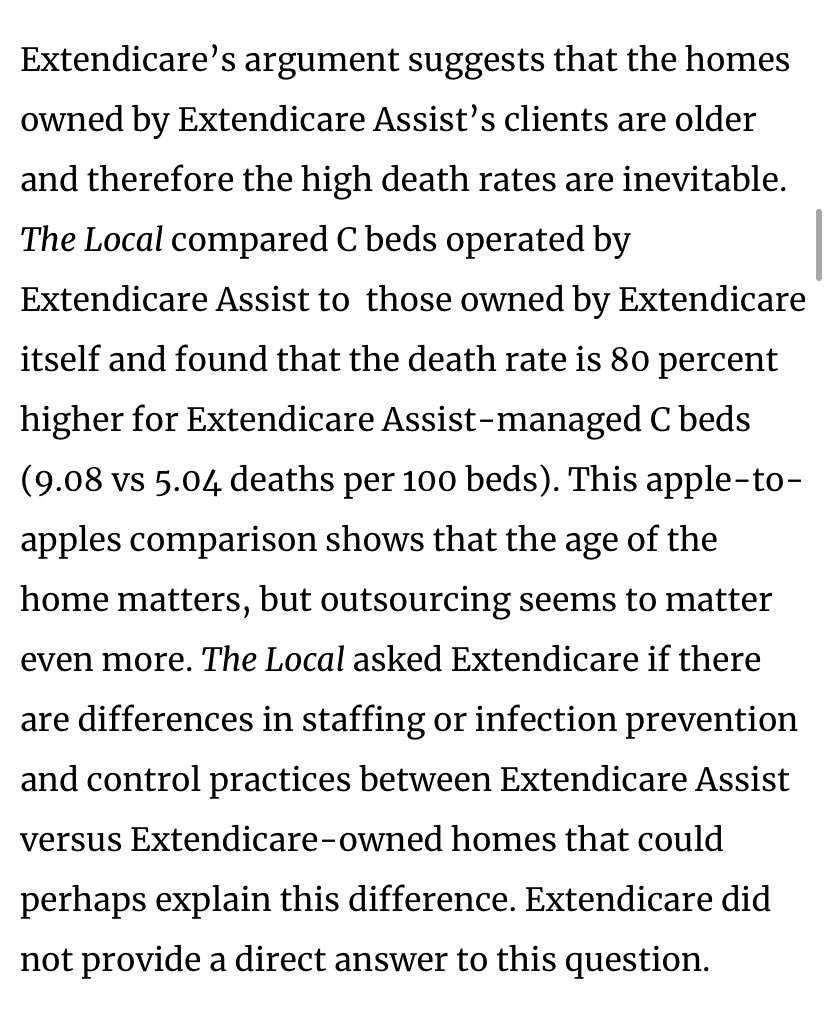
It’s not enough to ask who owns the home; it’s also a question of who operates it.
⤵️
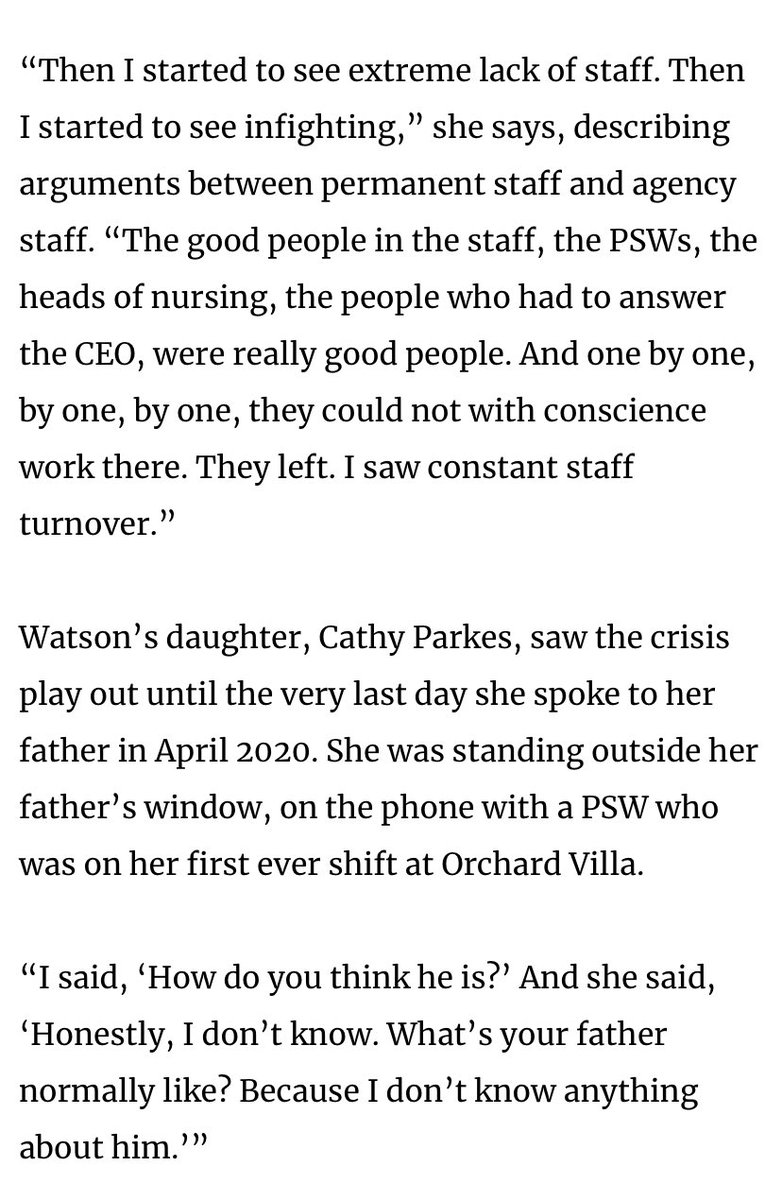
THE #1 FEAR OF LTC FAMILIES.
I hear this ALL the time.
As with the other homes, it began with the food (which gets contracted out often)
More from Tech
A common misunderstanding about Agile and “Big Design Up Front”:
There’s nothing in the Agile Manifesto or Principles that states you should never have any idea what you’re trying to build.
You’re allowed to think about a desired outcome from the beginning.
It’s not Big Design Up Front if you do in-depth research to understand the user’s problem.
It’s not BDUF if you spend detailed time learning who needs this thing and why they need it.
It’s not BDUF if you help every team member know what success looks like.
Agile is about reducing risk.
It’s not Agile if you increase risk by starting your sprints with complete ignorance.
It’s not Agile if you don’t research.
Don’t make the mistake of shutting down critical understanding by labeling it Bg Design Up Front.
It would be a mistake to assume this research should only be done by designers and researchers.
Product management and developers also need to be out with the team, conducting the research.
Shared Understanding is the key objective
Big Design Up Front is a thing to avoid.
Defining all the functionality before coding is BDUF.
Drawing every screen and every pixel is BDUF.
Promising functionality (or delivery dates) to customers before development starts is BDUF.
These things shouldn’t happen in Agile.
There’s nothing in the Agile Manifesto or Principles that states you should never have any idea what you’re trying to build.
You’re allowed to think about a desired outcome from the beginning.
It’s not Big Design Up Front if you do in-depth research to understand the user’s problem.
It’s not BDUF if you spend detailed time learning who needs this thing and why they need it.
It’s not BDUF if you help every team member know what success looks like.
Agile is about reducing risk.
It’s not Agile if you increase risk by starting your sprints with complete ignorance.
It’s not Agile if you don’t research.
Don’t make the mistake of shutting down critical understanding by labeling it Bg Design Up Front.
It would be a mistake to assume this research should only be done by designers and researchers.
Product management and developers also need to be out with the team, conducting the research.
Shared Understanding is the key objective
I\u2019d recommend that the devs participate directly in the research.
— Jared Spool (@jmspool) November 18, 2018
If the devs go into the first sprint with a thorough understanding of the user\u2019s problems, they are far more likely to solve it well.
Big Design Up Front is a thing to avoid.
Defining all the functionality before coding is BDUF.
Drawing every screen and every pixel is BDUF.
Promising functionality (or delivery dates) to customers before development starts is BDUF.
These things shouldn’t happen in Agile.
You May Also Like
MDZS is laden with buddhist references. As a South Asian person, and history buff, it is so interesting to see how Buddhism, which originated from India, migrated, flourished & changed in the context of China. Here's some research (🙏🏼 @starkjeon for CN insight + citations)
1. LWJ’s sword Bichen ‘is likely an abbreviation for the term 躲避红尘 (duǒ bì hóng chén), which can be translated as such: 躲避: shunning or hiding away from 红尘 (worldly affairs; which is a buddhist teaching.) (https://t.co/zF65W3roJe) (abbrev. TWX)
2. Sandu (三 毒), Jiang Cheng’s sword, refers to the three poisons (triviṣa) in Buddhism; desire (kāma-taṇhā), delusion (bhava-taṇhā) and hatred (vibhava-taṇhā).
These 3 poisons represent the roots of craving (tanha) and are the cause of Dukkha (suffering, pain) and thus result in rebirth.
Interesting that MXTX used this name for one of the characters who suffers, arguably, the worst of these three emotions.
3. The Qian kun purse “乾坤袋 (qián kūn dài) – can be called “Heaven and Earth” Pouch. In Buddhism, Maitreya (मैत्रेय) owns this to store items. It was believed that there was a mythical space inside the bag that could absorb the world.” (TWX)
1. LWJ’s sword Bichen ‘is likely an abbreviation for the term 躲避红尘 (duǒ bì hóng chén), which can be translated as such: 躲避: shunning or hiding away from 红尘 (worldly affairs; which is a buddhist teaching.) (https://t.co/zF65W3roJe) (abbrev. TWX)
2. Sandu (三 毒), Jiang Cheng’s sword, refers to the three poisons (triviṣa) in Buddhism; desire (kāma-taṇhā), delusion (bhava-taṇhā) and hatred (vibhava-taṇhā).
These 3 poisons represent the roots of craving (tanha) and are the cause of Dukkha (suffering, pain) and thus result in rebirth.
Interesting that MXTX used this name for one of the characters who suffers, arguably, the worst of these three emotions.
3. The Qian kun purse “乾坤袋 (qián kūn dài) – can be called “Heaven and Earth” Pouch. In Buddhism, Maitreya (मैत्रेय) owns this to store items. It was believed that there was a mythical space inside the bag that could absorb the world.” (TWX)