Well,
Here is the text version:
1/ Here is a description of what went down according to someone with far greater technical knowledge than me:
"so a group of developers latched onto the Press Release that Twilio put out at midnight last night. In that Press Release, Twilio
Well,
deliver content -- ALL CONTENT (parleys, video, images, user profiles, user information, etc) -. But what it also did was revealed which USERS had "Administration" rights,
Well, then what happened, those user accounts that had Administration rights to the entire platform... The hackers, internet warriors, call it what you will, was able to use the forgot password link to change the password. Why? Because Twilio was no
This group of Internet Warriors then used that account, to create a handful of other ADMINISTRATION accounts, and then created a script that ended up
Now that they had a way of creating admin accounts without interruption, they created a Docker Image (basically a virtual machine) called a Warrior, that anyone could download, and when fired up, would immediately start
Consider it like SETI (Search for Extra-Terrestrial Intelligence) that people used to load up as screen savers when their computers were not being used. Same concept, crowdsourcing.
All of this data, the videos,
And the kicker. is this: all of this information was thought to be secure and private by individuals who were making the posts. A significant number of those
It means they uploaded a picture of the front and back of their REAL State Driver's License....... Let that sink in for a second.
I am positive the FBI has been actively
And it's how the FBI, DHS, and FAA have been able to immediately and exhaustively create no-fly lists. Every verified attendee of the Capitol riot where
More from Tech

On press call, Zuckerberg says FB users "naturally engage more with sensational content" that comes close to violating its rules. Compares it to cable TV and tabloids, and says, "This seems to be true regardless of where we set our policy lines."
Zuckerberg says FB is in the process of setting up a "new independent body" that users will be able to appeal content takedowns to. Sort of like the "Facebook Supreme Court" idea he previewed earlier this year.
Zuckerberg: "One of my biggest lessons from this year is that when you connect more than 2 billion people, you’re going to see the good and bad of humanity."
This is how Facebook says it's trying to change the engagement pattern on its services. https://t.co/3p0PGc912o

.@RebeccaJarvis asks Zuckerberg if anyone is going to lose their job over the revelations in the NYT story. He dodges, says that personnel issues aren't a public matter, and that employee performance is evaluated all the time.
Zuckerberg says FB is in the process of setting up a "new independent body" that users will be able to appeal content takedowns to. Sort of like the "Facebook Supreme Court" idea he previewed earlier this year.
Zuckerberg: "One of my biggest lessons from this year is that when you connect more than 2 billion people, you’re going to see the good and bad of humanity."
This is how Facebook says it's trying to change the engagement pattern on its services. https://t.co/3p0PGc912o
.@RebeccaJarvis asks Zuckerberg if anyone is going to lose their job over the revelations in the NYT story. He dodges, says that personnel issues aren't a public matter, and that employee performance is evaluated all the time.

On Wednesday, The New York Times published a blockbuster report on the failures of Facebook’s management team during the past three years. It's.... not flattering, to say the least. Here are six follow-up questions that merit more investigation. 1/
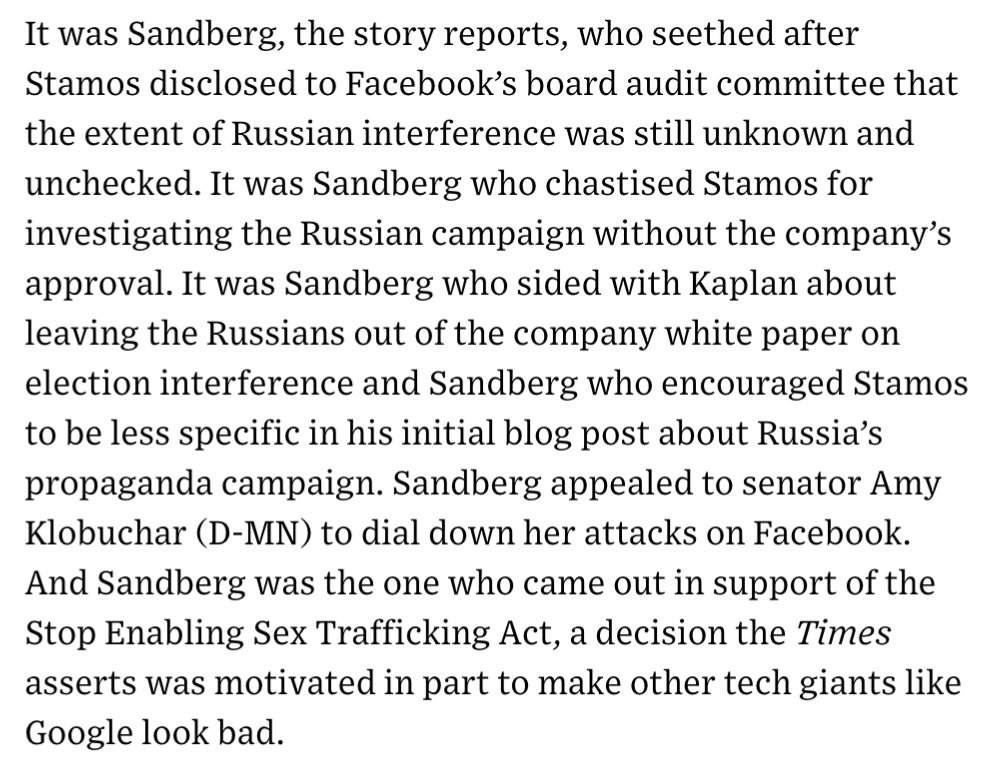
1) During the past year, most of the anger at Facebook has been directed at Mark Zuckerberg. The question now is whether Sheryl Sandberg, the executive charged with solving Facebook’s hardest problems, has caused a few too many of her own. 2/ https://t.co/DTsc3g0hQf
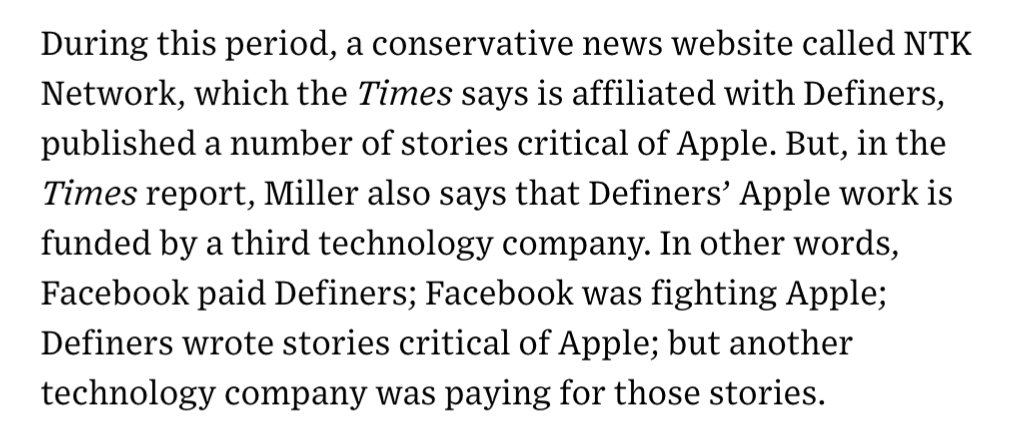
2) One of the juiciest sentences in @nytimes’ piece involves a research group called Definers Public Affairs, which Facebook hired to look into the funding of the company’s opposition. What other tech company was paying Definers to smear Apple? 3/ https://t.co/DTsc3g0hQf
3) The leadership of the Democratic Party has, generally, supported Facebook over the years. But as public opinion turns against the company, prominent Democrats have started to turn, too. What will that relationship look like now? 4/
4) According to the @nytimes, Facebook worked to paint its critics as anti-Semitic, while simultaneously working to spread the idea that George Soros was supporting its critics—a classic tactic of anti-Semitic conspiracy theorists. What exactly were they trying to do there? 5/
1) During the past year, most of the anger at Facebook has been directed at Mark Zuckerberg. The question now is whether Sheryl Sandberg, the executive charged with solving Facebook’s hardest problems, has caused a few too many of her own. 2/ https://t.co/DTsc3g0hQf
2) One of the juiciest sentences in @nytimes’ piece involves a research group called Definers Public Affairs, which Facebook hired to look into the funding of the company’s opposition. What other tech company was paying Definers to smear Apple? 3/ https://t.co/DTsc3g0hQf
3) The leadership of the Democratic Party has, generally, supported Facebook over the years. But as public opinion turns against the company, prominent Democrats have started to turn, too. What will that relationship look like now? 4/
4) According to the @nytimes, Facebook worked to paint its critics as anti-Semitic, while simultaneously working to spread the idea that George Soros was supporting its critics—a classic tactic of anti-Semitic conspiracy theorists. What exactly were they trying to do there? 5/

I think about this a lot, both in IT and civil infrastructure. It looks so trivial to “fix” from the outside. In fact, it is incredibly draining to do the entirely crushing work of real policy changes internally. It’s harder than drafting a blank page of how the world should be.
I’m at a sort of career crisis point. In my job before, three people could contain the entire complexity of a nation-wide company’s IT infrastructure in their head.
Once you move above that mark, it becomes exponentially, far and away beyond anything I dreamed, more difficult.
And I look at candidates and know-everything’s who think it’s all so easy. Or, people who think we could burn it down with no losses and start over.
God I wish I lived in that world of triviality. In moments, I find myself regretting leaving that place of self-directed autonomy.
For ten years I knew I could build something and see results that same day. Now I’m adjusting to building something in my mind in one day, and it taking a year to do the due-diligence and edge cases and documentation and familiarization and roll-out.
That’s the hard work. It’s not technical. It’s not becoming a rockstar to peers.
These people look at me and just see another self-important idiot in Security who thinks they understand the system others live. Who thinks “bad” designs were made for no reason.
Who wasn’t there.
The tragedy of revolutionaries is they design a utopia by a river but discover the impure city they razed was on stilts for a reason.
— SwiftOnSecurity (@SwiftOnSecurity) June 19, 2016
I’m at a sort of career crisis point. In my job before, three people could contain the entire complexity of a nation-wide company’s IT infrastructure in their head.
Once you move above that mark, it becomes exponentially, far and away beyond anything I dreamed, more difficult.
And I look at candidates and know-everything’s who think it’s all so easy. Or, people who think we could burn it down with no losses and start over.
God I wish I lived in that world of triviality. In moments, I find myself regretting leaving that place of self-directed autonomy.
For ten years I knew I could build something and see results that same day. Now I’m adjusting to building something in my mind in one day, and it taking a year to do the due-diligence and edge cases and documentation and familiarization and roll-out.
That’s the hard work. It’s not technical. It’s not becoming a rockstar to peers.
These people look at me and just see another self-important idiot in Security who thinks they understand the system others live. Who thinks “bad” designs were made for no reason.
Who wasn’t there.



You May Also Like








1/Politics thread time.
To me, the most important aspect of the 2018 midterms wasn't even about partisan control, but about democracy and voting rights. That's the real battle.
2/The good news: It's now an issue that everyone's talking about, and that everyone cares about.
3/More good news: Florida's proposition to give felons voting rights won. But it didn't just win - it won with substantial support from Republican voters.
That suggests there is still SOME grassroots support for democracy that transcends
4/Yet more good news: Michigan made it easier to vote. Again, by plebiscite, showing broad support for voting rights as an
5/OK, now the bad news.
We seem to have accepted electoral dysfunction in Florida as a permanent thing. The 2000 election has never really
Bad ballot design led to a lot of undervotes for Bill Nelson in Broward Co., possibly even enough to cost him his Senate seat. They do appear to be real undervotes, though, instead of tabulation errors. He doesn't really seem to have a path to victory. https://t.co/utUhY2KTaR
— Nate Silver (@NateSilver538) November 16, 2018