We aren't doing this near enough.
Some of the things I've learned in more than 20 years in the tech industry.
You need to hear these.
🧵👇
We aren't doing this near enough.
No small improvement is too small.
Just aim for something new every day, and you'll be surprised at the end.
Be the person that pulls everyone out of the rabbit holes.
Great results will get you farther than processes, but good processes can help you achieve good results.
It's funny how everything you share finds a way to reward you back.
We all make mistakes. Move on from them and focus on what's coming.
Ask away!
(There are, however, stupid people with fragile egos that get bothered when others ask. Ignore them.)
Embrace change.
People fantasize about perfection, but perfectionism rarely wins.
Shipping more often will give you better odds than gilding the lily.
What you know today will be outdated tomorrow.
Make a plan to keep up and follow it... or you'll get behind.
(And it looks horrible in your resume.)
More from Santiago




More from Tech



(1) Some haters of #Cardano are not only bag holders but also imperative developers.
If you are an imperative programmers you know that Plutus is not the most intuitive -> (https://t.co/m3fzq7rJYb)
It is, however, intuitive for people with IT financial background, e.g. banks
(2)
IELE + k framework will be a real game changer because there will be DSLs (Domain Specific Languages) in any programming language supported by K framework. The only issue is that we need to wait for all this
(3) Good news is that the moment we get IELE integrated into Cardano, we get some popular langs. To my knowledge we should get from day one: Solidity and Rust, maybe others as well?
List of langs: https://t.co/0uj1eBfrYj, some commits from many years ago..
@rv_inc ?
#Cardano
(a) Last but not least, marketing to people with Haskell, functional programming with experience and decision makers in banks is a tricky one, how do you market but not tell them you want to replace them. In the end one strategy is to pitch new markets, e.g. developing world
(b) As banks realize what is happening they maybe more inclined to join - not because they would like to but because they will have to - in such cases some development talent maybe re-routed to Plutus / Cardano / Algorand / Tezos
If you are an imperative programmers you know that Plutus is not the most intuitive -> (https://t.co/m3fzq7rJYb)
It is, however, intuitive for people with IT financial background, e.g. banks
(2)
IELE + k framework will be a real game changer because there will be DSLs (Domain Specific Languages) in any programming language supported by K framework. The only issue is that we need to wait for all this
(3) Good news is that the moment we get IELE integrated into Cardano, we get some popular langs. To my knowledge we should get from day one: Solidity and Rust, maybe others as well?
List of langs: https://t.co/0uj1eBfrYj, some commits from many years ago..
@rv_inc ?
#Cardano
(a) Last but not least, marketing to people with Haskell, functional programming with experience and decision makers in banks is a tricky one, how do you market but not tell them you want to replace them. In the end one strategy is to pitch new markets, e.g. developing world
(b) As banks realize what is happening they maybe more inclined to join - not because they would like to but because they will have to - in such cases some development talent maybe re-routed to Plutus / Cardano / Algorand / Tezos

You May Also Like


Neo-nazi group #PatriotFront held a photo op in #Chicago last weekend & is currently marching around #DC so it's as good time as any to compile a list of their identified members for folks to watch for
Who are these chuds?
Patriot Front broke away from white nationalist org Vanguard America following #unitetheright in #charlottesville after James Alex Fields was seen with a VA shield before driving his car into a crowd, murdering Heather Heyer & injuring dozens of others
Syed Robbie Javid a.k.a. Sayed Robbie Javid or Robbie Javid of Alexandria,
Antoine Bernard Renard (a.k.a. “Charlemagne MD” on Discord) from Rockville, MD.
https://t.co/ykEjdZFDi6
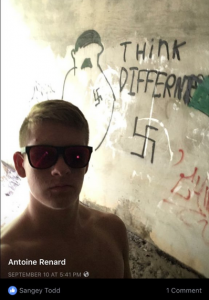
Brandon Troy Higgs, 25, from Reisterstown,
Who are these chuds?
Patriot Front broke away from white nationalist org Vanguard America following #unitetheright in #charlottesville after James Alex Fields was seen with a VA shield before driving his car into a crowd, murdering Heather Heyer & injuring dozens of others
Syed Robbie Javid a.k.a. Sayed Robbie Javid or Robbie Javid of Alexandria,
Happy Monday everyone :-) Let's ring in September by reacquainting ourselves with Virginia neo-Nazi and NSC Dixie affiliate Sayed "Robbie" Javid, now known by "Reform the States". Robbie is an explicitly genocidal neo-Nazi, so lets get to know him a bit better!
— Garfield but Anti-Fascist (@AntifaGarfield) August 31, 2020
CW on this thread pic.twitter.com/3gzxrIo9HD
Antoine Bernard Renard (a.k.a. “Charlemagne MD” on Discord) from Rockville, MD.
https://t.co/ykEjdZFDi6
Brandon Troy Higgs, 25, from Reisterstown,