Rectangle pattern also known as trading range, consolidation.We get multi-day, multi-week or multi-month consolidation where price move in range.
Rectangle pattern also known as trading range, consolidation.We get multi-day, multi-week or multi-month consolidation where price move in range.
The price should touch two point of resistance and two point of support parallelly to form rectangle pattern. Price move in range line "A " and line "B", line "A" known as resistance or supply, line "B" known as support or demand.

If you go through textbook method volume should dry up during the consolidation. But in my experience it is not necessary that volume should dry up there are time when volume get aggressive during consolidation.


Longer the duration of rectangle pattern generally more aggressive the breakout going to be.
ENTRY:- Entry will be at breakout candle high with 0.3% buffer.

More from Stockslearnings

Read and retweet. One of thr best investors in India who has made multibaggers from various sectors such as seeds, Financials, Auto Ancs, Real estate, Chemicals, Pharma,Technical textiles, Animal health etc. Uniquest and most realistic+diverse approach in my view @SamitVartak
Compelled to take down notes from this very interesting talk by @SamitVartak and share with the Investing community. Was introduced to this gentleman by @ishmohit1 - Thanks !!https://t.co/bCfjfNBWO1
— Mouzam (@mmali09) July 18, 2021
Highly recommended to watch it.
\u267b\ufe0fRetweet to if you find my notes useful https://t.co/3zZ9qCf90z pic.twitter.com/LGjoJDaJsT


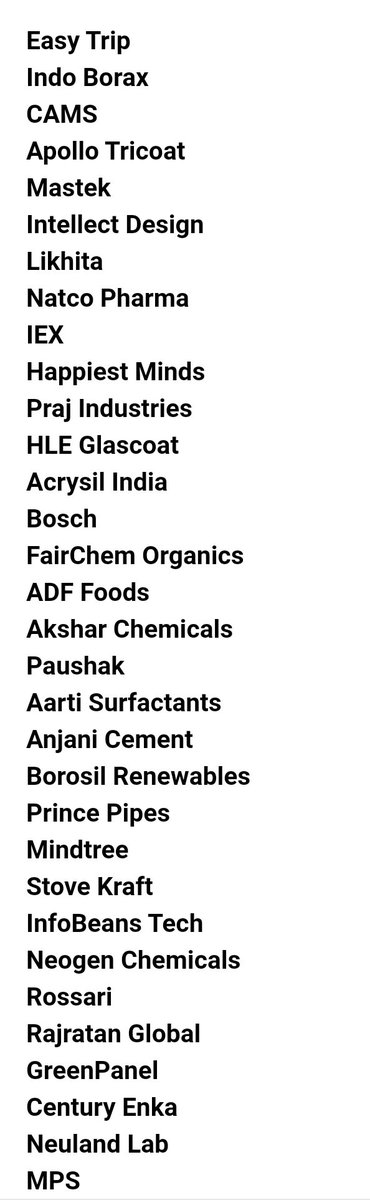

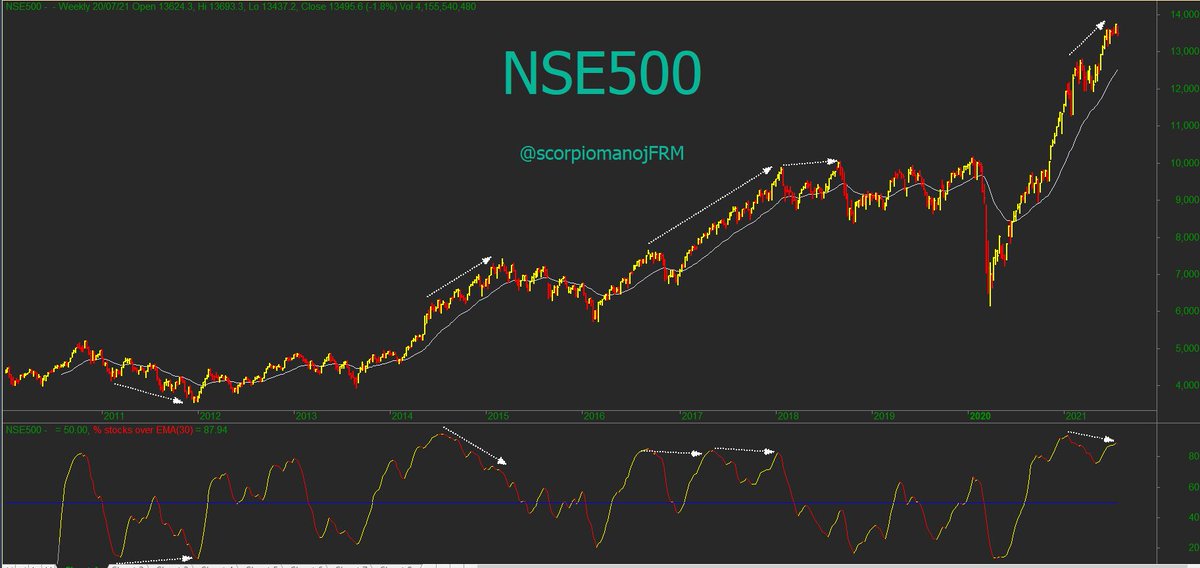

1/n
Dear @chartmojo
Out of curiosity, just gone through your timeline and prepared a data of your shared tweets in OCT'2020;
You will not believe the following numbers:
Charts shared = 29 (2 excluded due to splits)
Period = 8-oct to 30-oct'20
..
2/n
If min.10k invested on your each design, then
Amount invested in Oct'20 = 2.91 lacs
Present investment value = 4.72 lacs
Maximum drawdown = 9%
ROI = 62% in 200 days
Annualized ROI = 147%
**You ROCK brother**
...
I've prepared a sheet for all your Oct'20 tweets; It was so much learning on the charts as well as on the data-part; Please keep on the good work.
Sheet link:
https://t.co/8BJtMsOkBD
With regards,
Deepak
Dear @chartmojo
Out of curiosity, just gone through your timeline and prepared a data of your shared tweets in OCT'2020;
You will not believe the following numbers:
Charts shared = 29 (2 excluded due to splits)
Period = 8-oct to 30-oct'20
..
2/n
If min.10k invested on your each design, then
Amount invested in Oct'20 = 2.91 lacs
Present investment value = 4.72 lacs
Maximum drawdown = 9%
ROI = 62% in 200 days
Annualized ROI = 147%
**You ROCK brother**
...
I've prepared a sheet for all your Oct'20 tweets; It was so much learning on the charts as well as on the data-part; Please keep on the good work.
Sheet link:
https://t.co/8BJtMsOkBD
With regards,
Deepak
You May Also Like


https://t.co/6cRR2B3jBE
Viruses and other pathogens are often studied as stand-alone entities, despite that, in nature, they mostly live in multispecies associations called biofilms—both externally and within the host.
https://t.co/FBfXhUrH5d

Microorganisms in biofilms are enclosed by an extracellular matrix that confers protection and improves survival. Previous studies have shown that viruses can secondarily colonize preexisting biofilms, and viral biofilms have also been described.

...we raise the perspective that CoVs can persistently infect bats due to their association with biofilm structures. This phenomenon potentially provides an optimal environment for nonpathogenic & well-adapted viruses to interact with the host, as well as for viral recombination.

Biofilms can also enhance virion viability in extracellular environments, such as on fomites and in aquatic sediments, allowing viral persistence and dissemination.

Viruses and other pathogens are often studied as stand-alone entities, despite that, in nature, they mostly live in multispecies associations called biofilms—both externally and within the host.
https://t.co/FBfXhUrH5d
Microorganisms in biofilms are enclosed by an extracellular matrix that confers protection and improves survival. Previous studies have shown that viruses can secondarily colonize preexisting biofilms, and viral biofilms have also been described.
...we raise the perspective that CoVs can persistently infect bats due to their association with biofilm structures. This phenomenon potentially provides an optimal environment for nonpathogenic & well-adapted viruses to interact with the host, as well as for viral recombination.
Biofilms can also enhance virion viability in extracellular environments, such as on fomites and in aquatic sediments, allowing viral persistence and dissemination.