I talk a bit about what business was like in 2008. Besides some personal struggles, 2008 was also a time when individuals and businesses were clamping down on spending. So what can you do if you are freelancing through that?
My interview with @Mixergy is live. Check it out here: https://t.co/fvxio9FArN
It's great. We cover 15 years of business.
I like getting tactical on podcasts. I know Andrew likes it too. I missed some spots. So here are 5 tips I wish I shared during the interview.
🧵👇
I talk a bit about what business was like in 2008. Besides some personal struggles, 2008 was also a time when individuals and businesses were clamping down on spending. So what can you do if you are freelancing through that?
This was part of what encouraged us to focus on membership sites.
!!!
We weren't tracking it. The membership sites we helped launched had reporting built in showing $$$.
There were already a couple established membership plugins for WP when PMPro launched.
We didn't try to recreate the affiliate networks they had already set up.
We focused on becoming the best free membership plugin available on the https://t.co/d1AEC5iAwa repository.
When I told Andrew about the frustrations of dealing with 3rd parties changing their APIs when trying to grow WineLog, he asked "Do you have to deal with that kind of thing with PMPro?"
Yes! We do. What's different? Focus.
We didn't have the energy, time, or desire to pivot and try something new.
If you have other active projects, you can turn to them for what seems like easier progress.
But if you only have one project to focus on, you HAVE to make it work...
Stopping work on WineLog, InvestorGeeks, and the other side projects we had back around 2010, gave us the time and attention needed to make PMPro a success.
When we made the switch from consulting to 100% products-based revenue, we turned down $90k in new work over 3 months to focus on a PMPro relaunch.
The relaunched PMPro 4x'd revenue immediately. Focus.
https://t.co/iX5eyPiHcq
I glossed over that one to talk about other add ons, but ARC is pretty cool. The idea behind it is insightful even if you don't use PMPro.
They maybe want access to something right away, but don't really see the benefit in extending membership another month or year.
Auto-Renewal Checkbox tries to address these customers.
You see this kind of UI all the time when donating online.
However, if you notice this pattern on your site, you should try some things.
Think about how you could create a separate 1-time-payment product. Maybe your subscription is giving TOO MUCH value, and you should break part of it off into a separate product.
I talk more about timing and pricing here:
https://t.co/klD0HkRXy7
I said it was easier to step away from work in a products company vs a services company.
Andrew said, "Yeah? What's the longest you stepped away?" Maybe hoping for a great sabbatical story, but I had none.
I'd say 4 days in the minimum to really get away. Shoot for 7. More could be better.
If you haven't done that in a while, work it out.
If you can, watch the interview anyway. Like it on the site. Ask a comment there. It really helps to show Andrew you're listening.
https://t.co/fvxio9FArN
https://t.co/x67YCk5v1o
More from Startups


1/ If you want to find out what is in the Y Combinator S19 batch, @Golden has compiled (using public signals) a near complete list of truly exciting companies.
If we are missing any or you want to help improve the data you can edit the topics.
https://t.co/9QGLiEPsn3
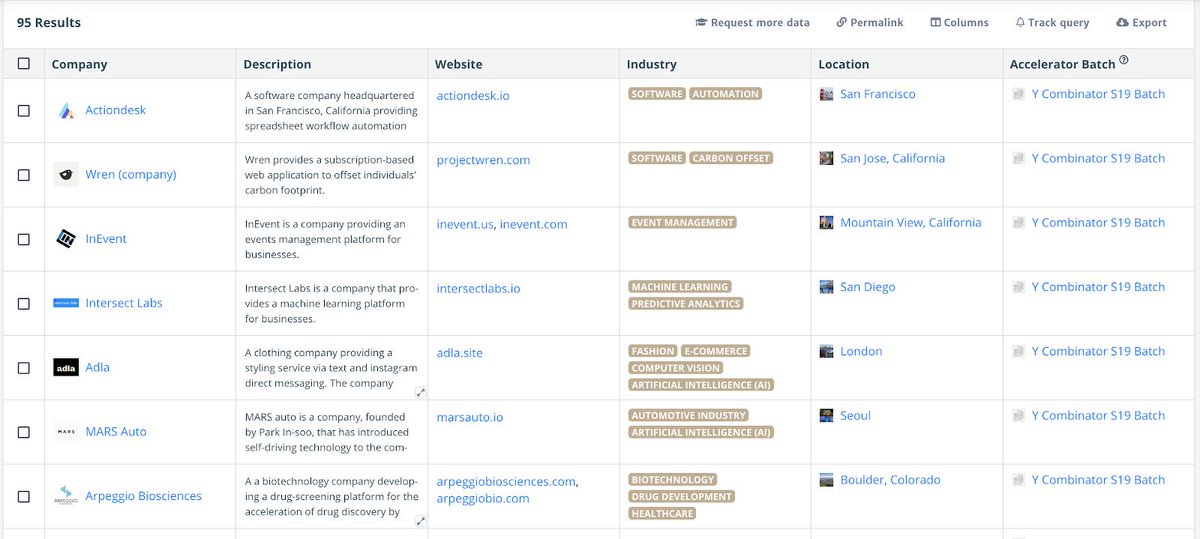
2/ Here is the direct public query if you want to check it out:
https://t.co/aqb8qYN4y9
[Note: no off the record cos are in here unless they have been publicly launched already]
3/ Also, here are 2,000+ other YC companies we have generated information
4/ We used the Golden Research Engine to generate this information, which you can find out more about here and ping me if you want a
If we are missing any or you want to help improve the data you can edit the topics.
https://t.co/9QGLiEPsn3
2/ Here is the direct public query if you want to check it out:
https://t.co/aqb8qYN4y9
[Note: no off the record cos are in here unless they have been publicly launched already]
3/ Also, here are 2,000+ other YC companies we have generated information
4/ We used the Golden Research Engine to generate this information, which you can find out more about here and ping me if you want a




1/ Tuesday was my last day as CEO of @CircleUp. I’ve been CEO since starting the co. in 2011 with my co-founder @roryeakin.
This is a thread about what happened, why and my emotions about it. For more detail:
https://t.co/vYImcm1bTM
Much of this I have never talked about.
2/ My goals: I hope it helps founders feel less lonely than I did. Little public content about the challenges of transitioning exists, but I longed for it. I’m not here to provide a playbook- just to share my experience. Hope it might build greater empathy.
Here goes….
3/ Why: When I tell people that I’m transitioning to an Exec Chairman role their first question is always: “why?” Short answer: co. pivot + fertility issues + health issues + a false sense that grit was always the answer = burnout. Long answer: is longer so hang in there with me
4/ Over a 12-18 month period that ended in late 2017 I ran my tank far beyond empty for far too long. You know that sound your car makes when it’s sputtering for more gas? It was like that. Worst year of my life. Since then it has felt like bone on bone.
5/ Here is what happened:
Professionally: pivoting a Series C company was a living hell in and of itself, as I’ve talked about before.
This is a thread about what happened, why and my emotions about it. For more detail:
https://t.co/vYImcm1bTM
Much of this I have never talked about.
2/ My goals: I hope it helps founders feel less lonely than I did. Little public content about the challenges of transitioning exists, but I longed for it. I’m not here to provide a playbook- just to share my experience. Hope it might build greater empathy.
Here goes….
3/ Why: When I tell people that I’m transitioning to an Exec Chairman role their first question is always: “why?” Short answer: co. pivot + fertility issues + health issues + a false sense that grit was always the answer = burnout. Long answer: is longer so hang in there with me
4/ Over a 12-18 month period that ended in late 2017 I ran my tank far beyond empty for far too long. You know that sound your car makes when it’s sputtering for more gas? It was like that. Worst year of my life. Since then it has felt like bone on bone.
5/ Here is what happened:
Professionally: pivoting a Series C company was a living hell in and of itself, as I’ve talked about before.
1/ We Pivoted a few yrs ago. This is the story- mostly my feelings. It has never been told publicly.
— Ryan Caldbeck (@ryan_caldbeck) April 16, 2019
This will be rambly and represents the chaos in my head at the time. There is [hopefully] no advice here. I don\u2019t know if we did it right.