How Morning Brew grew to 2.5M subscribers in 5 years ☕
Here are the early growth tactics used to reach 20M+ revenue in 2021
A thread👇👇
Current outlets like the Wall Street Journal lacked the high level roundup that most young people needed to quickly stay informed and not put them to sleep
At 20 years old, Alex created a PDF newsletter (originally called the Market Corner) and sent it to 45 friends and family. They then got their first 300 subscribers by putting out flyers and speaking at lectures to fellow students at Michigan University
Referrals account for 30% of their total subscribers today. This component was key to accelerating their growth flywheel.
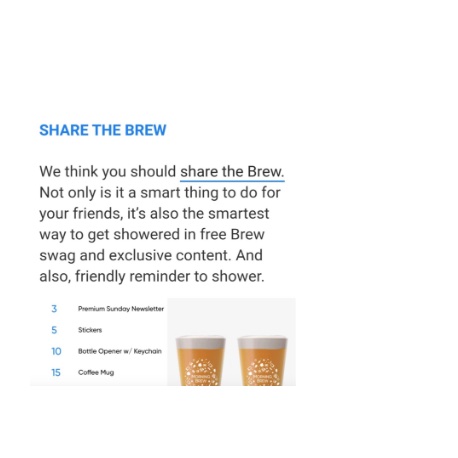
They have a section at the bottom every newsletter called “share the brew”, which takes the readers to the referral program hub.
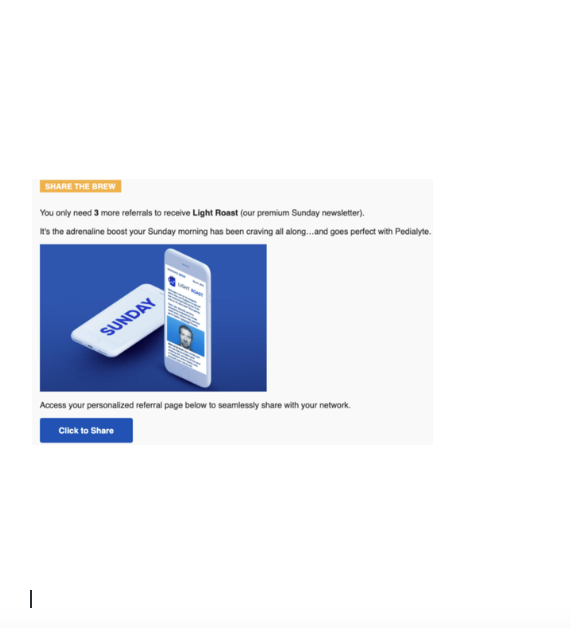
They also made it easy to share right away via link, email, or social media
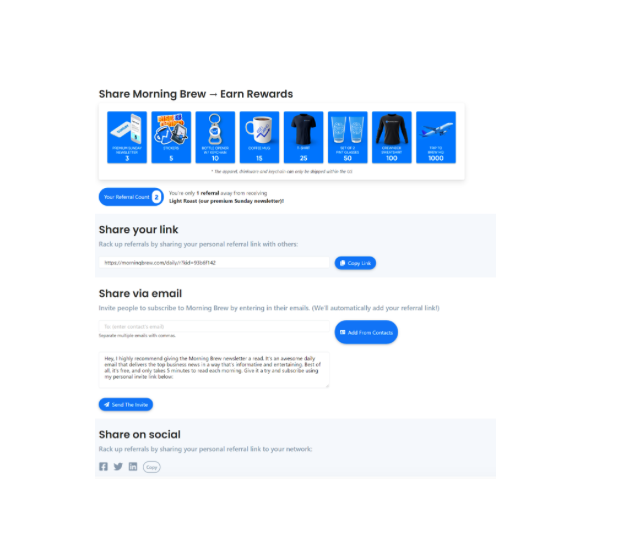
Once they signed up, Morning Brew sent an email reminding them of their reward progress (designed to encourage more referrals, maintaining the viral loop)
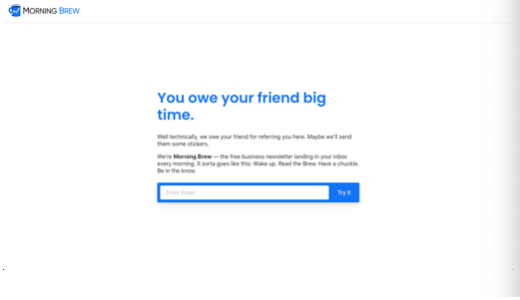
They used enticing email subject lines that got noticed, while showcasing the brand's quirky personality.
Their copywriting was key to their success, leading to a daily open rate of 45% (15% -25% considered “good” in most industries)
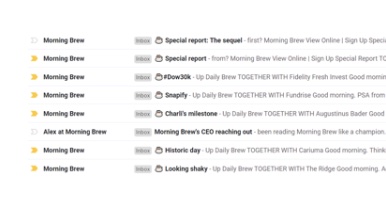
They sent emails to 4 groups of readers with different subject lines (but not all readers, a smaller portion), and whichever one had the highest open rate was used for the remaining (majority) of followers.
Their content was perfectly catered to their younger audience.
They gave quick rundowns of current events, breaking down content into bite sized chunks to not feel overwhelming. Students were tired of too much business jargon. It solved real problems
- $75M valuation
- Acquired by Business Insider
Keys to success:
- Finding a unique niche and solving a problem
- Created content people loved and relied on
- Referral system with clear rewards and tracking
- A/B testing Copywriting
https://t.co/8DMqYhu5ii
And follow me on Twitter for a new thread like this every week!
More from Startups
There are a *lot* of software shops in the world that would far rather have one more technical dependency than they'd like to pay for one of their 20 engineers to become the company's SPOF expert on the joys of e.g. HTTP file uploads, CSV parsing bugs, PDF generation, etc.
Every year at MicroConf I get surprised-not-surprised by the number of people I meet who are running "Does one thing reasonably well, ranks well for it, pulls down a full-time dev salary" out of a fun side project which obviates a frequent 1~5 engineer-day sprint horizontally.
"Who is the prototypical client here?"
A consulting shop delivering a $X00k engagement for an internal system, a SaaS company doing something custom for a large client or internally facing or deeply non-core to their business, etc.
(I feel like many of these businesses are good answers to the "how would you monetize OSS to make it sustainable?" fashion, since they often wrap a core OSS offering in the assorted infrastructure which makes it easily consumable.)
"But don't the customers get subscription fatigue?"
I think subscription fatigue is far more reported by people who are embarrassed to charge money for software than it is experienced by for-profit businesses, who don't seem to have gotten pay-biweekly-for-services fatigue.
On a serious note, it's interesting to observe that you can build a decent business charging $20 - $50 per month for something that any good developer can set up. This is one of those micro-saas sweet spots between "easy for me to build" and "tedious for others to build"
— Jon Yongfook (@yongfook) September 5, 2019
Every year at MicroConf I get surprised-not-surprised by the number of people I meet who are running "Does one thing reasonably well, ranks well for it, pulls down a full-time dev salary" out of a fun side project which obviates a frequent 1~5 engineer-day sprint horizontally.
"Who is the prototypical client here?"
A consulting shop delivering a $X00k engagement for an internal system, a SaaS company doing something custom for a large client or internally facing or deeply non-core to their business, etc.
(I feel like many of these businesses are good answers to the "how would you monetize OSS to make it sustainable?" fashion, since they often wrap a core OSS offering in the assorted infrastructure which makes it easily consumable.)
"But don't the customers get subscription fatigue?"
I think subscription fatigue is far more reported by people who are embarrassed to charge money for software than it is experienced by for-profit businesses, who don't seem to have gotten pay-biweekly-for-services fatigue.