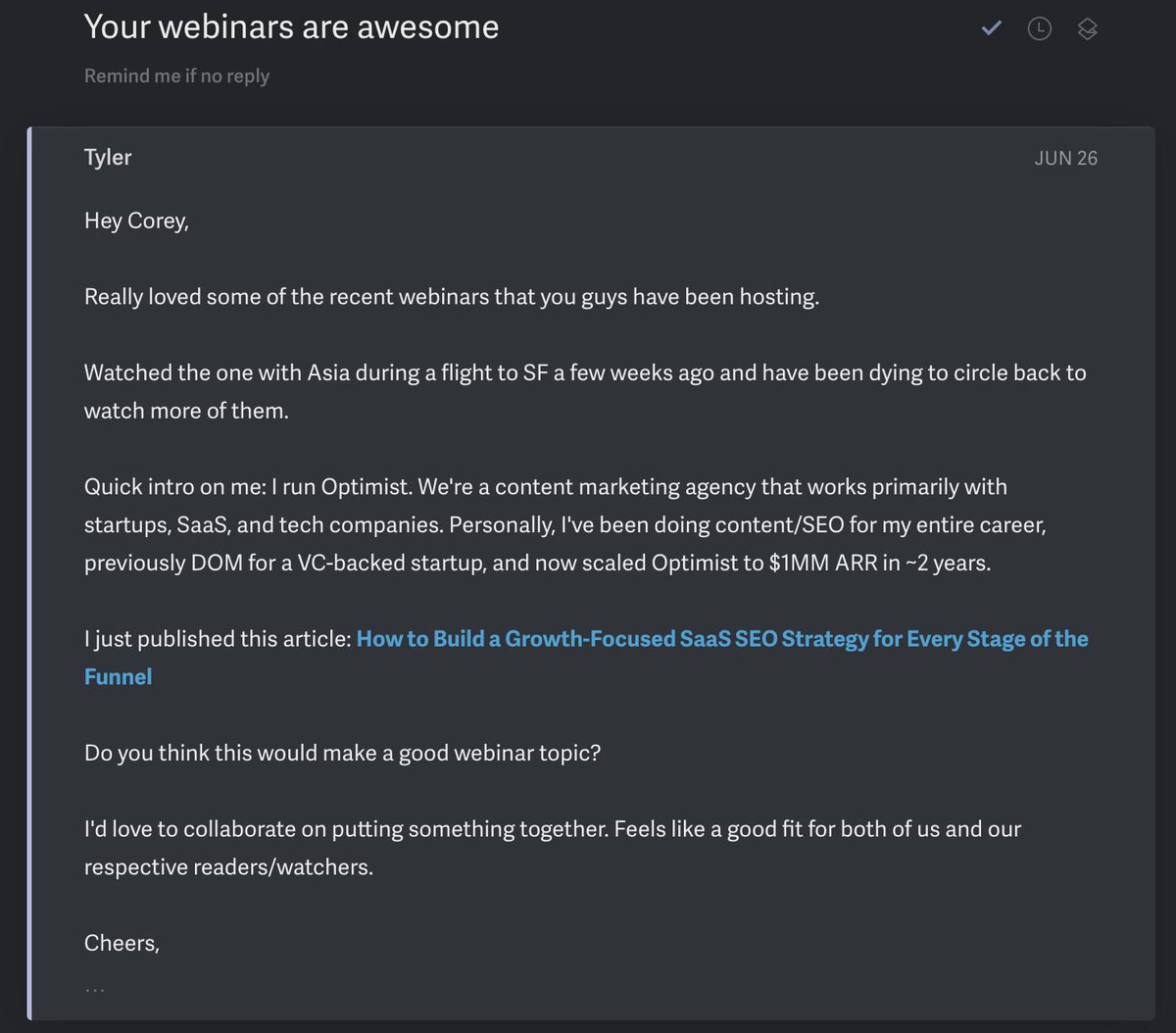
A couple months ago, I got an email out of the blue from someone I had never met or heard about.

Today, that person co-hosted a webinar with me that had over 470+ registered and 130+ live

👇 Quick lesson on how to successfully pitch partnerships and co-marketing opportunities

How did he get in contact with me?

He sent a cold email, but not just any email. It was clearly personal, relevant, and conversational.

Lesson: Notice the language he used and how he tied it back to previous webinars.
Not only was it well written, but I could also easily judge if he'd be a good fit based on the article he wrote and linked to.

It's SUPER well-written and proved that he knew what he was talking about.

Lesson: Make your "ask" as easy as possible to consider.
There were three things that made the webinar a big success:

1. Tyler sent the webinar to his email list and did a lot of promotion.

2. He prepared ahead of time and put a lot of work into the deck, even incorporating some Baremetrics assets and references.

3. He had fun
Super appreciate all the work @TylerHakes put into today's "SEO for SaaS"

If you missed it, here's the recording: https://t.co/dGSY8ThmQX

More from Startups

You May Also Like

Recently, the @CNIL issued a decision regarding the GDPR compliance of an unknown French adtech company named "Vectaury". It may seem like small fry, but the decision has potential wide-ranging impacts for Google, the IAB framework, and today's adtech. It's thread time! 👇

It's all in French, but if you're up for it you can read:
• Their blog post (lacks the most interesting details):
https://t.co/PHkDcOT1hy
• Their high-level legal decision: https://t.co/hwpiEvjodt
• The full notification: https://t.co/QQB7rfynha

I've read it so you needn't!

Vectaury was collecting geolocation data in order to create profiles (eg. people who often go to this or that type of shop) so as to power ad targeting. They operate through embedded SDKs and ad bidding, making them invisible to users.

The @CNIL notes that profiling based off of geolocation presents particular risks since it reveals people's movements and habits. As risky, the processing requires consent — this will be the heart of their assessment.

Interesting point: they justify the decision in part because of how many people COULD be targeted in this way (rather than how many have — though they note that too). Because it's on a phone, and many have phones, it is considered large-scale processing no matter what.