
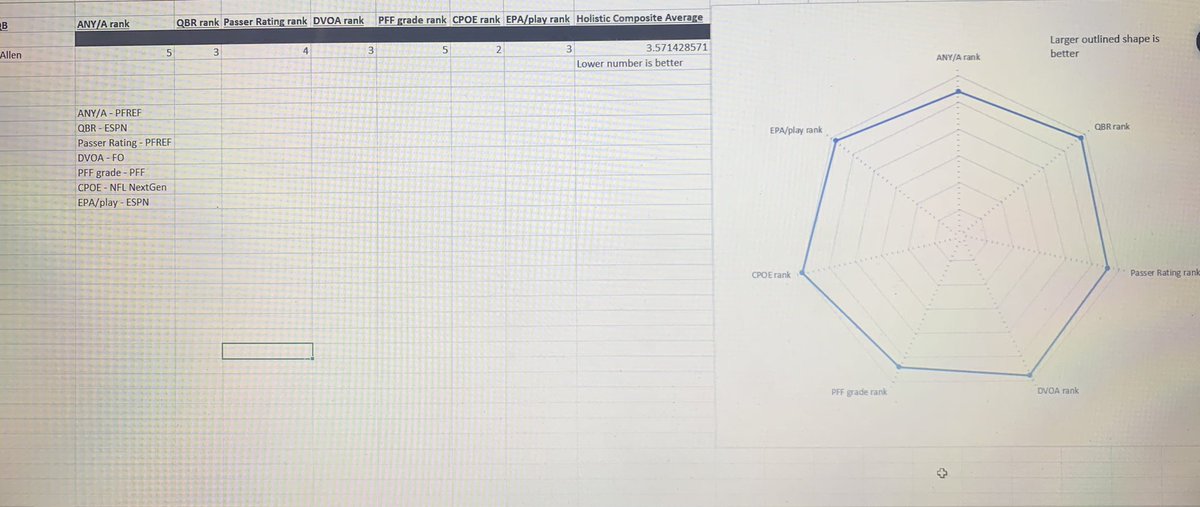
You wanted it, you got it. The final 2020 QB STEW composite for Josh Allen. I will sit down and do all the NFL QBs soon.
#2 in CPOE
#3 in EPA/play
#5 in ANY/A
#3 in QBR
#4 in passer rating
#3 in DVOA
#5 in PFF grade
STEW score of 3.57. For reference, Wentz in 2017 was 4.71.
More from Sport





It is hardly phony, especially on social media, to refer to IS-LM models and the like as \u201cKeynesian.\u201d Krugman pushing it and, for better or worse, rising in popularity.
— tylercowen (@tylercowen) January 17, 2021
Like many people, I enjoy reading Tyler's blog. But there are times (alright, many times) I disagree with him. This is no big deal. I also disagree with myself sometimes (especially my past self). But his recent post left me
What is he trying to say here? After thinking about it for a bit, I think he's critiquing the idea that "running the economy hot" leads to employment *and* real wage gains. Perhaps the former, but only at the expense of the latter. At least, this is what a textbook IS-LM model
tells us if one "runs the economy hot" through increased fiscal stimulus (on consumption and transfers, not public infrastructure investment). If this is what he meant, then he should have just said so, instead of labeling this a "Keynesian" proposition.
In fact, this property follows as a *neoclassical* proposition that is embedded in the IS-LM framework. (For non-economists, note that Keynes did not invent IS-LM; the framework was developed later by Hicks as an interpretation of *some* parts of the General Theory.)

You May Also Like











Decoded his way of analysis/logics for everyone to easily understand.
Have covered:
1. Analysis of volatility, how to foresee/signs.
2. Workbook
3. When to sell options
4. Diff category of days
5. How movement of option prices tell us what will happen
1. Keeps following volatility super closely.
Makes 7-8 different strategies to give him a sense of what's going on.
Whichever gives highest profit he trades in.
I am quite different from your style. I follow the market's volatility very closely. I have mock positions in 7-8 different strategies which allows me to stay connected. Whichever gives best profit is usually the one i trade in.
— Sarang Sood (@SarangSood) August 13, 2019
2. Theta falls when market moves.
Falls where market is headed towards not on our original position.
Anilji most of the time these days Theta only falls when market moves. So the Theta actually falls where market has moved to, not where our position was in the first place. By shifting we can come close to capturing the Theta fall but not always.
— Sarang Sood (@SarangSood) June 24, 2019
3. If you're an options seller then sell only when volatility is dropping, there is a high probability of you making the right trade and getting profit as a result
He believes in a market operator, if market mover sells volatility Sarang Sir joins him.
This week has been great so far. The main aim is to be in the right side of the volatility, rest the market will reward.
— Sarang Sood (@SarangSood) July 3, 2019
4. Theta decay vs Fall in vega
Sell when Vega is falling rather than for theta decay. You won't be trapped and higher probability of making profit.
There is a difference between theta decay & fall in vega. Decay is certain but there is no guaranteed profit as delta moves can increase cost. Fall in vega on the other hand is backed by a powerful force that sells options and gives handsome returns. Our job is to identify them.
— Sarang Sood (@SarangSood) February 12, 2020

