Firstly, I made use of the auto-rigging feature in Mixamo to give my character a skeleton. This allows you to use the Mixamo animations for the character in Unreal Engine.
It’s been a minute since I’ve written code. So, I figured that now might be a good time to start learning how to use the Blueprint system in #UnrealEngine. I felt that it’d be interesting to share my progress and mistakes. So here goes!
🧵
Firstly, I made use of the auto-rigging feature in Mixamo to give my character a skeleton. This allows you to use the Mixamo animations for the character in Unreal Engine.
In the Animation Blueprint, I tried to add a punching state to the character. The problem I faced initially was that the character glides while punching. This occurs because multiple states of the animation are active (as their transition conditions are satisfied).
There are a couple of solutions for this:
👉Blending the punch and idle states (character can punch while running) by using the Layered Blend Per Bone node.
👉Disabling input while the punch occurs.
I didn’t like the outcome when I blended the animations. as the hip rotates more than we’d like it to. This leads to the character punching upwards and to the left. This isn’t favorable as the enemy is usually straight ahead. Disabling the input worked way better!
The punch’s effect takes place before its impact is felt. To solve this issue, we add notifies to the punch animation to indicate whether the punch has reached its zone of impact. These notifies create events for which we can write code. During impact, I spawned an explosion.
A small bug I came across was that the emitter doesn’t get destroyed as soon as the punch ends in some cases. I realized that the boolean used to check whether the punch was in the zone of impact wasn’t being set back to false.
As a result, my man turned into Bakugo lol.
I’m assuming this has something to do with the tick event, which runs every frame and the duration of the punch. To solve this issue, I made use of another boolean which checked whether the punch animation was ongoing by setting it as one of the conditions for the branch.
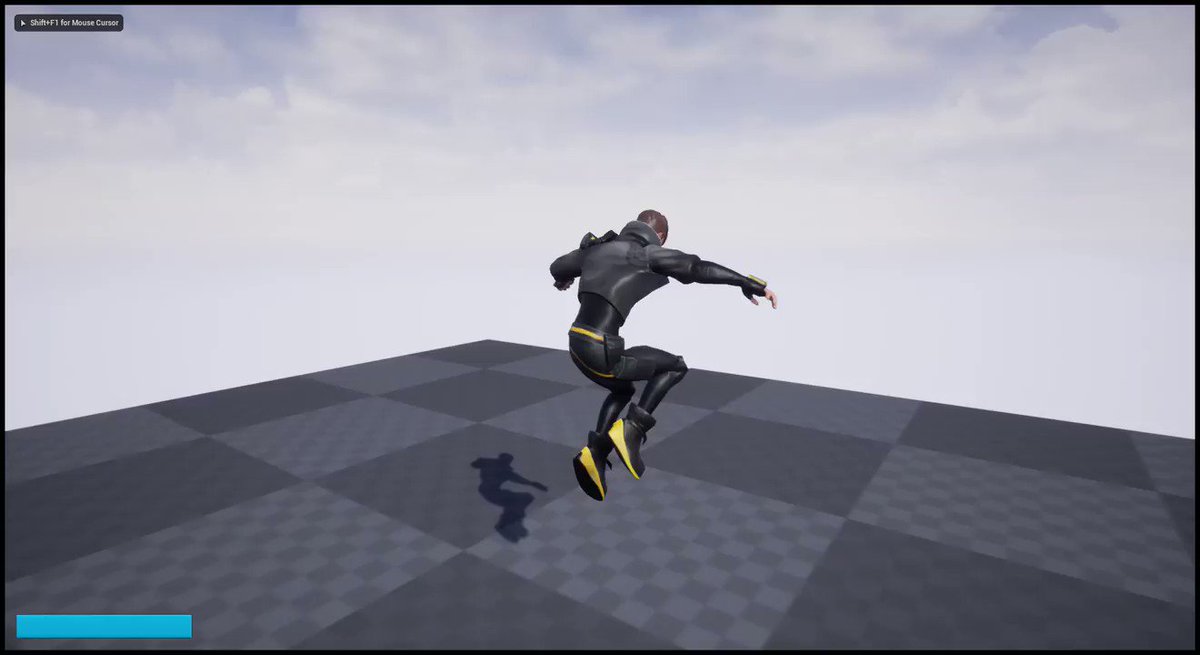
Then, I tried to set up the jump functionality of the character. One thing I learned was that creating a single state for the jump doesn’t work as the duration of the animation may not match that of the jump.
Initially I tried using a single animation and divided it into three chunks. This didn’t work as the transition b/w the states wasn’t smooth enough.
The best solution is to find loop animations in Mixamo for the jump, fall and landing.
https://t.co/NbpT6mHJei
More from Software
Software architecture is in crisis, and the way to fix it is a hefty dose of anarchy.
Some lay the blame for this on @boicy with the whole microservices thing.
(Admittedly, @nicolefv, @jezhumble and @realgenekim didn’t help when they statistically proved that he might have been onto something with all that de-coupling and team-alignment…)
However I don’t blame him at all.
I think he saved us; bringing us back to the path of value-delivery and independent services, but now with added independent teams.
But one thing is clear. Microservices need more architecture, not less (as do other forms of #Accelerate-style software organisation).
(See https://t.co/B2hWmXhIqe if you need convincing)
I mean, all those pesky slices we need to carve up our monoliths (or were they big balls of mud?) That’s a significant amount of work right there…
Some lay the blame for this on @boicy with the whole microservices thing.
(Admittedly, @nicolefv, @jezhumble and @realgenekim didn’t help when they statistically proved that he might have been onto something with all that de-coupling and team-alignment…)
However I don’t blame him at all.
I think he saved us; bringing us back to the path of value-delivery and independent services, but now with added independent teams.
But one thing is clear. Microservices need more architecture, not less (as do other forms of #Accelerate-style software organisation).
(See https://t.co/B2hWmXhIqe if you need convincing)
I mean, all those pesky slices we need to carve up our monoliths (or were they big balls of mud?) That’s a significant amount of work right there…
@JuliaLMarcus @Iplaywithgerms This paper gives documentation on software (with causal reasoning, assumptions reviewed in appendix) for a parametric approach to estimating either "total effects" or "controlled direct effects" with competing events and time-varying
@Iplaywithgerms Total effects capture paths by which treatment affects competing event (e.g. protective total effect of lifesaving treatment on dementia may be wholly/partially due to effect on survival). Controlled direct effects do not capture these paths
@Iplaywithgerms More detailed reasoning on the difference and tradeoffs between total and controlled direct effects and causal reasoning in the point treatment context provided here along with description of some estimators and
@Iplaywithgerms If you are familiar with more robust approaches like IPW or even better TMLE for time-varying treatment, these are trivially adapted to go after the controlled direct effect by simply treating competing events like loss to follow-up (censoring). e.g.
@Iplaywithgerms Examples of IPW estimation of the total effect of a time-varying treatment described in Appendix D of this paper:
https://t.co/RNhcgTBMkb
And here
https://t.co/rMWmwFBWwV
Others in reference lists of above papers.
@Iplaywithgerms Total effects capture paths by which treatment affects competing event (e.g. protective total effect of lifesaving treatment on dementia may be wholly/partially due to effect on survival). Controlled direct effects do not capture these paths
@Iplaywithgerms More detailed reasoning on the difference and tradeoffs between total and controlled direct effects and causal reasoning in the point treatment context provided here along with description of some estimators and
@Iplaywithgerms If you are familiar with more robust approaches like IPW or even better TMLE for time-varying treatment, these are trivially adapted to go after the controlled direct effect by simply treating competing events like loss to follow-up (censoring). e.g.
@Iplaywithgerms Examples of IPW estimation of the total effect of a time-varying treatment described in Appendix D of this paper:
https://t.co/RNhcgTBMkb
And here
https://t.co/rMWmwFBWwV
Others in reference lists of above papers.